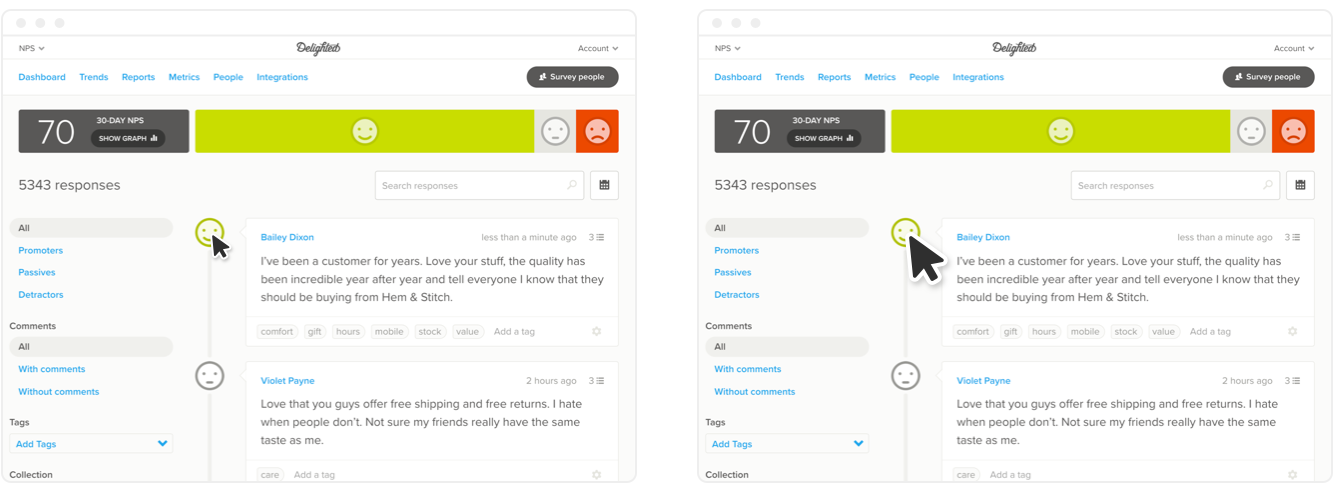
Welcome to Delighted’s first-ever quarterly product recap! This quarter, we have updates all over the Delighted platform, ranging from a refresh of our Link platform to brand new integrations. Let’s get right into it.
In-App Link Builder
We’ve updated our Link platform with 4 brand new features that you can start using today:
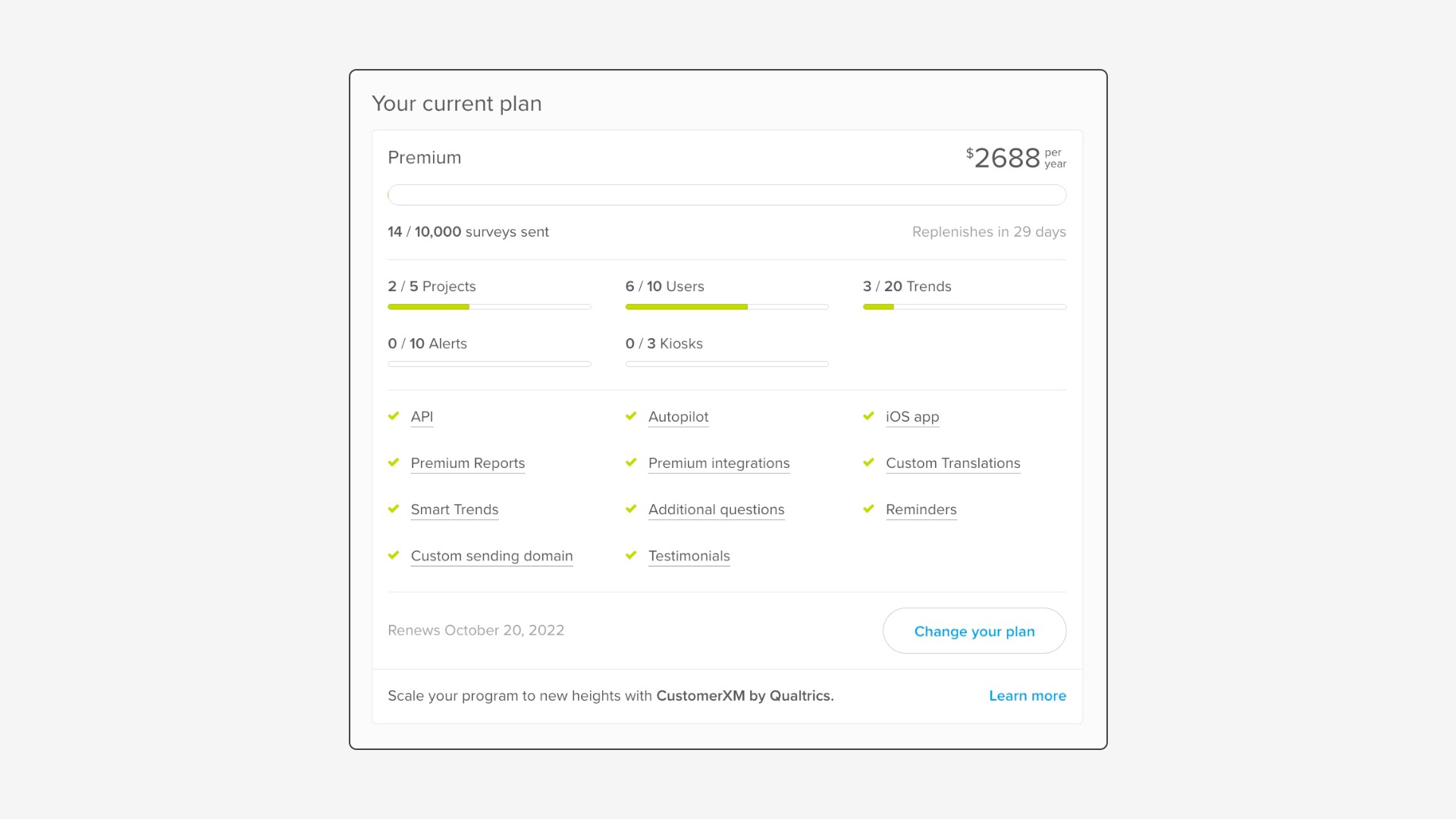
One recurring question we heard from customers was: “What am I using in Delighted? What am I missing out on?” In the past, it was difficult to find this information without searching throughout your dashboard. Not anymore!
We’ve made sweeping updates to your Plans & Billing page, which will reveal your total platform usage. Whether the number of Alerts sending notifications to your team or the total number of Projects you’ve set up, you now have all the most important usage details at your fingertips!
G2 Integration
Interested in driving more reviews to your G2 page? You can now collect G2 reviews immediately following your Delighted surveys.
Our new integration removes the need for your customers to have a G2 account in order to leave a review, reducing drop-off rates between Delighted survey completion and G2 Review submission.
Ready to get started? Learn more about how to set up our G2 integration.
Localized Demo + Help Center
Getting the Delighted information you need should be easy, regardless of your native and/or preferred language.
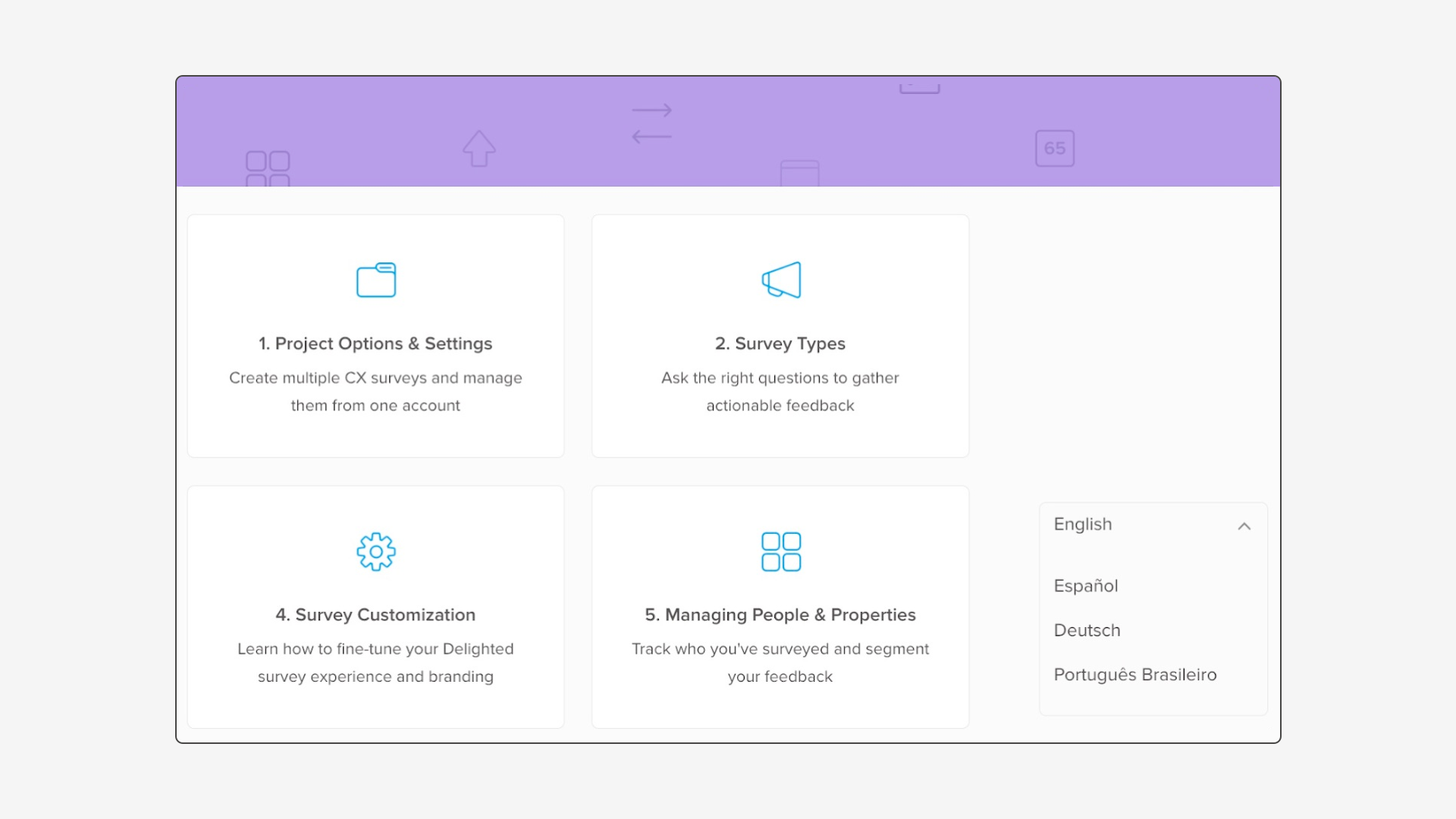
We’ve introduced a brand new language switcher to both our demo environment and our Help Center. Simply select your preferred language and we’ll automatically translate the entire page for you!
Set Custom Domain
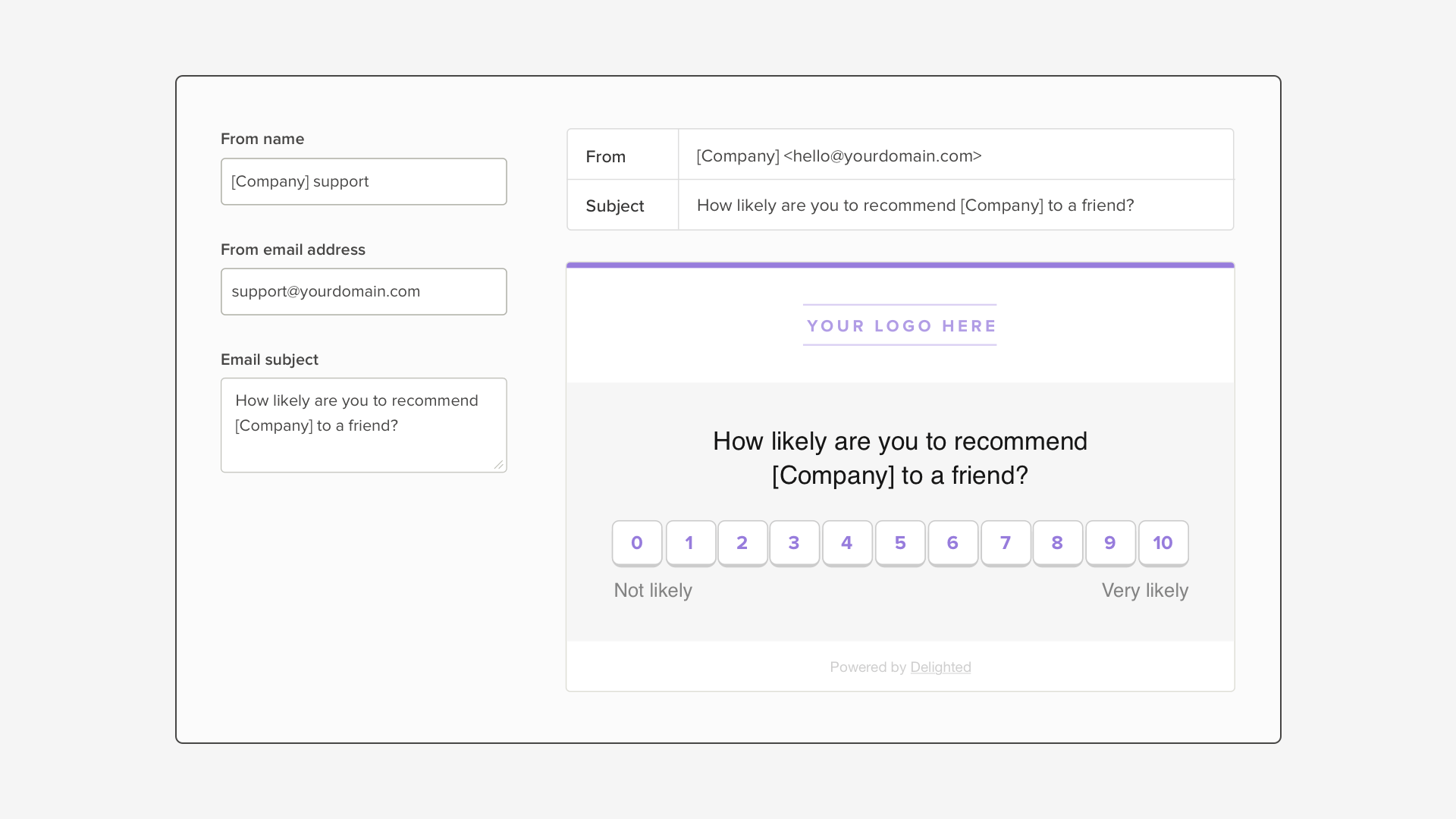
Add more personalization to survey emails by sending from your domain. Using our new Sending Domain feature, we’ll provide you with a few records to add to your domain host’s settings. Once added, you can wrap up the configuration in Delighted and start sending from your domain right away!
That’s it for Q2! If you’re interested in learning more about these updates, or what else we have on our roadmap, send us a note at hello@delighted.com. See you in the Fall!
This article was written by Emma Kimmerly, Partner Marketing Lead at Friendbuy.
Every brand loves a happy customer, and knowing that you have recent buyers who love your product enough to give you positive feedback is a great feeling. But your happiest customers can do more than provide validation and direction – they can also become significant revenue drivers for your business through a referral program.
Beyond their *hopefully high* repeat purchase rate, your happiest customers are also the most likely to recommend your product to their friends and family. These word-of-mouth referrals are powerful – and scalable.
In fact, high-growth brands can acquire 5 to 15% of their new customers with a thoughtfully implemented referral program. Your customer experience program is a great way to identify your happiest customers, and then encourage them to refer their friends throughout the post-purchase journey.
In this post, you’ll learn everything you need to know about referral programs, and how to set up your own.
A referral program is a marketing strategy that incentivizes customers to recommend your product to their friends and family. It is a way to offer your best customers a reward when a new customer purchases because of their recommendation.
For example, you can offer your existing customers a $20 off coupon code if they share their referral link with a friend and their friend purchases. You should also offer a special discount for the referred friend, to encourage them to buy.
Why referral marketing is an effective way to attract new customers
Have you ever seen a friend or family member’s shirt and asked or wondered where they got it from? It’s situations like that one that create opportunities for word-of-mouth referrals. A conversation with someone you trust about a product is going to create a lasting impression that a paid advertisement just can’t. In fact, according to Nielsen, 92% of consumers say they trust earned media (i.e. word-of-mouth recommendations from friends and family) above all other forms of advertising.
Here are the broader reasons why referral programs can be such an effective growth strategy for your business.
High margin growth
Every customer you acquire through referral is one less you have to acquire through a paid channel. Casper’s referral program actually has 7x higher ROI than their average marketing investment. That’s a high-margin conversion.
Increase customer lifetime value
Referral programs provide significantly higher customer lifetime values and faster conversion rates than other channels. We typically see that referred friends convert 5x faster than other channels and their lifetime values can be 3x to 4x higher.
A quicker path to your best customers
In addition to your customer experience program, referral programs can help with identifying who your best customers are – and help you find more people who fit your ideal customer profile.
It’s usually your best customers doing the referring, and it’s usually the case that you acquire your best customers through word of mouth – referral programs operationalize this coveted consumer behavior.
Types of referral programs
A best-in-class referral program can help you capitalize on the three different types of referrals: direct, reputation and incentivized.
Direct referrals
Direct referrals are real-time, word-of-mouth recommendations. Picture you’re sitting at a bar with a friend, and they ask where you got your jeans from. You pull up your phone, send them your referral link, and they purchase – that’s a direct referral.
Friendbuy defines these as impulse referrals. In order to do this successfully, we recommend brands have a referral program with three key elements: awareness, accessibility and ease of use. Your customers need to know you have a referral program, it needs to be quick to get to, and it needs to be easy to use. When you have all three ingredients, your customers will be able to easily refer their friends on impulse.
Reputation referrals
Reputation referrals are exactly what they sound like: someone referring your product based on reputation alone. In this case, the referrer may or may not have tried your product for themselves, but they’re confident enough in the reputation of your brand to recommend it to others.
You can encourage anyone to refer friends by running referral campaigns with enticing incentives. For example, if someone is about to purchase a mattress from you, but wants a discount, they might refer a friend or family member to purchase so you both receive a discount when buying.
Either way, as the brand, you just acquired two new customers that you might not have otherwise.
Incentivized referrals
Incentivized referrals are when a customer refers a friend in order to receive a reward, such as a coupon code or a free gift. How you choose to incentivize your customers to refer, and how you incentivize the friends to buy, are key to the success of your referral program – more details on that below.
How to start a referral program
So you’ve decided your company should have a referral program (great idea), but you aren’t sure where to start. Here’s a step-by-step guide for ensuring your referral program is set up for success.
1. Determine who will own your referral program
It’s recommended to have a marketing professional own your referral program. However, what’s most important is that this person has the time and ability to optimize your referral program strategy, determine the best copy and creative, and even run limited-time offers or referral contests.
In addition to identifying the person (or people) who will run your referral program, it can be helpful to consider using a referral platform. A best-in-class referral platform can do a lot of the heavy lifting for you, turning a 5-person operation into something one person can handle themselves.
2. Identify your referral program goals
There are a few key business metrics that you can track to measure the success of your referral program:
Cost per acquisition
Percent of new customers acquired
Total referral revenue
Average order value for advocates and friends
Customer lifetime value
Determine which ones are the most important for your business and set high-level goals you’d like to achieve.
3. Decide on the referral reward
As mentioned before, the incentives you offer for referrals can make or break your program. When determining what to offer your customers, ask yourself a few of the below questions:
How much are you willing to spend to acquire a customer?
How often does your company provide discounts, and can you provide a referral offer that’s even better than that? This is important, as a referral incentive that isn’t as appealing as your regular “new customer welcome offer” will likely not perform well.
What’s your repeat purchase rate? If you’re a company that sells big ticket items such as a mattress, offering a discount on another mattress isn’t effective unless your customers are buying multiple mattresses on a regular basis.
A discount off future purchases (good for brands with high repeat purchase rates)
A cash incentive
A gift card (good for brands with lower repeat purchase rates)
4. Identify your top customers
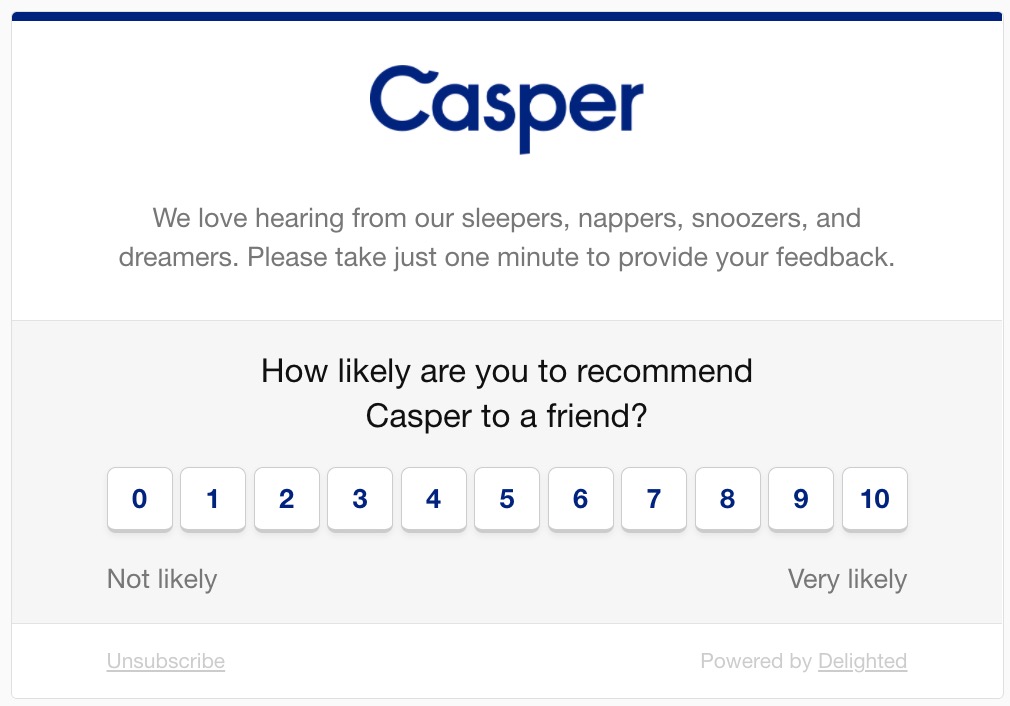
This is the fun part, finding out who your happiest customers are! One way to find out is to set up Net Promoter Score (NPS) surveys, and see where your customers stand. If someone leaves a Net Promoter Score of 9 or 10, they’re likely to be receptive to referring their friends.
5. Publicize your referral program
Another important aspect of your referral program’s success is making sure people know you have one!
Here are some of the best practice placements:
Promote your referral program on your website
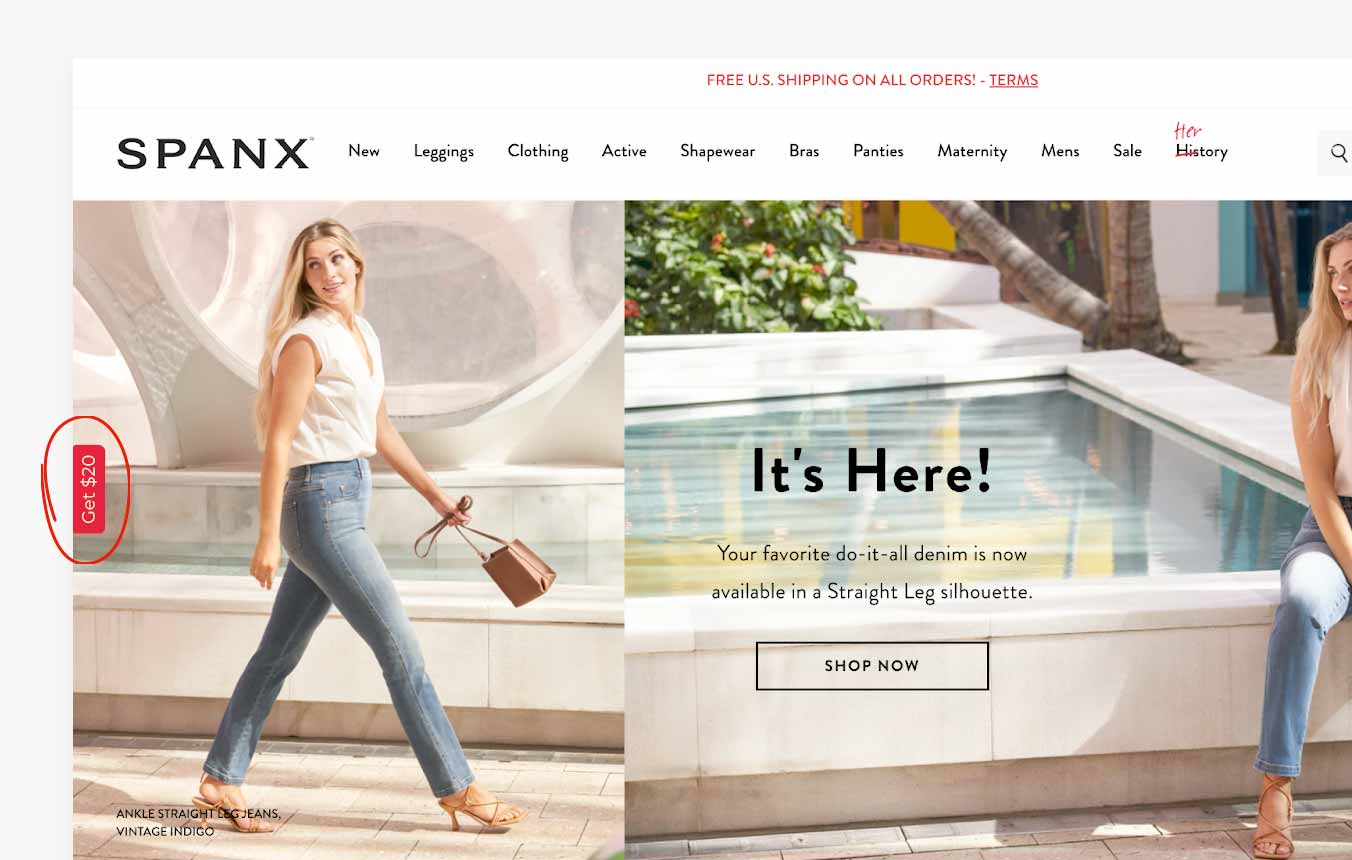
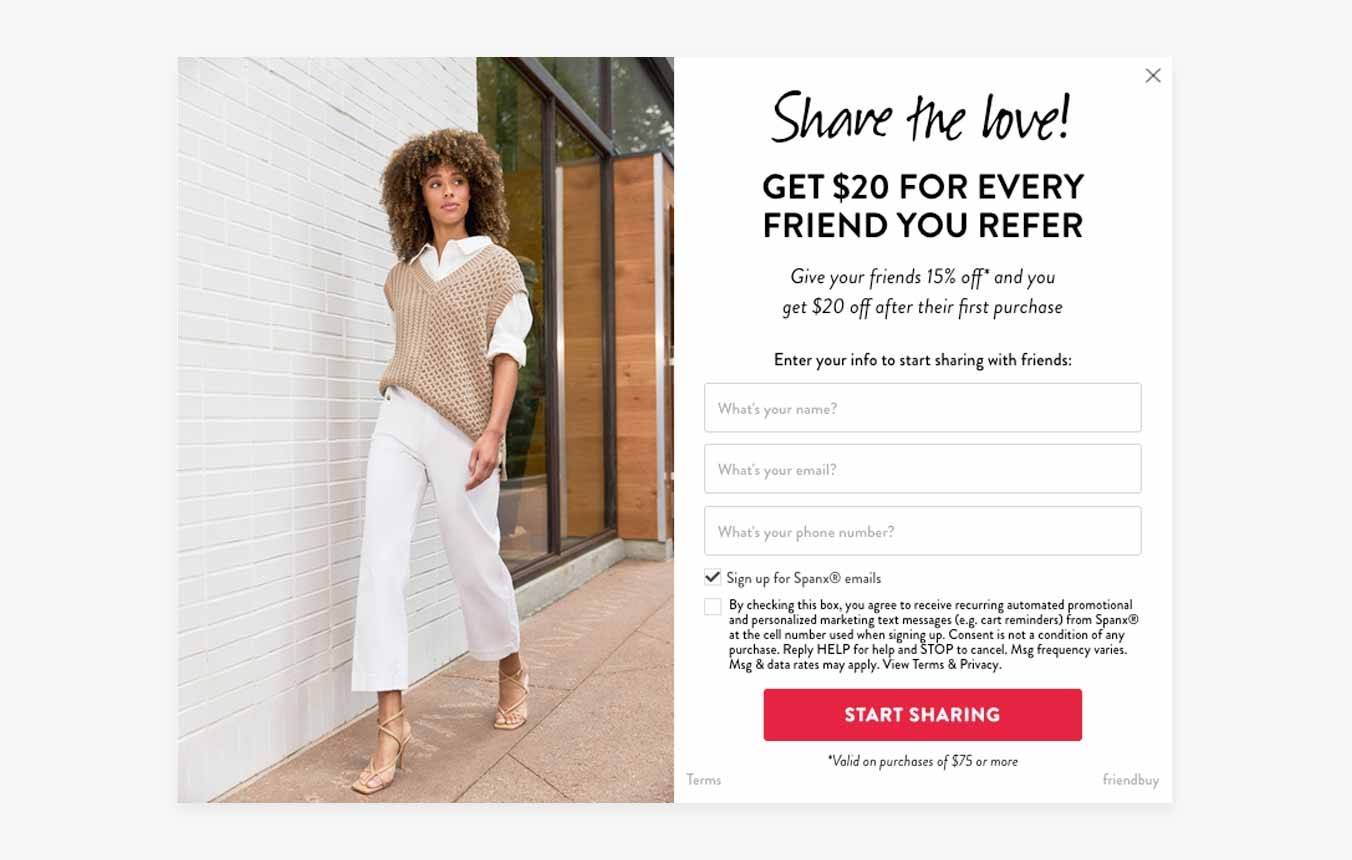
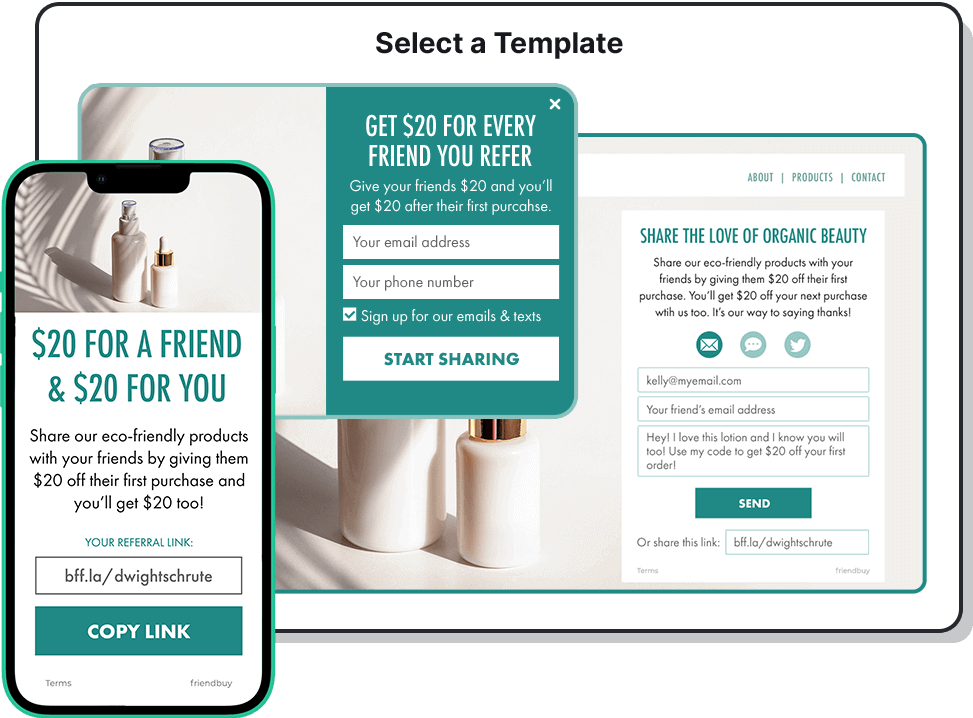
Add it to your homepage in the top navigation bar, or as a tab on the screen as Spanx has done below (see the “Get $20” CTA on the left-hand side).
The “Get $20” CTA on the left-hand side leads to a referral offerThe “Get $20” CTA opens this referral offer popup
Send a referral program email
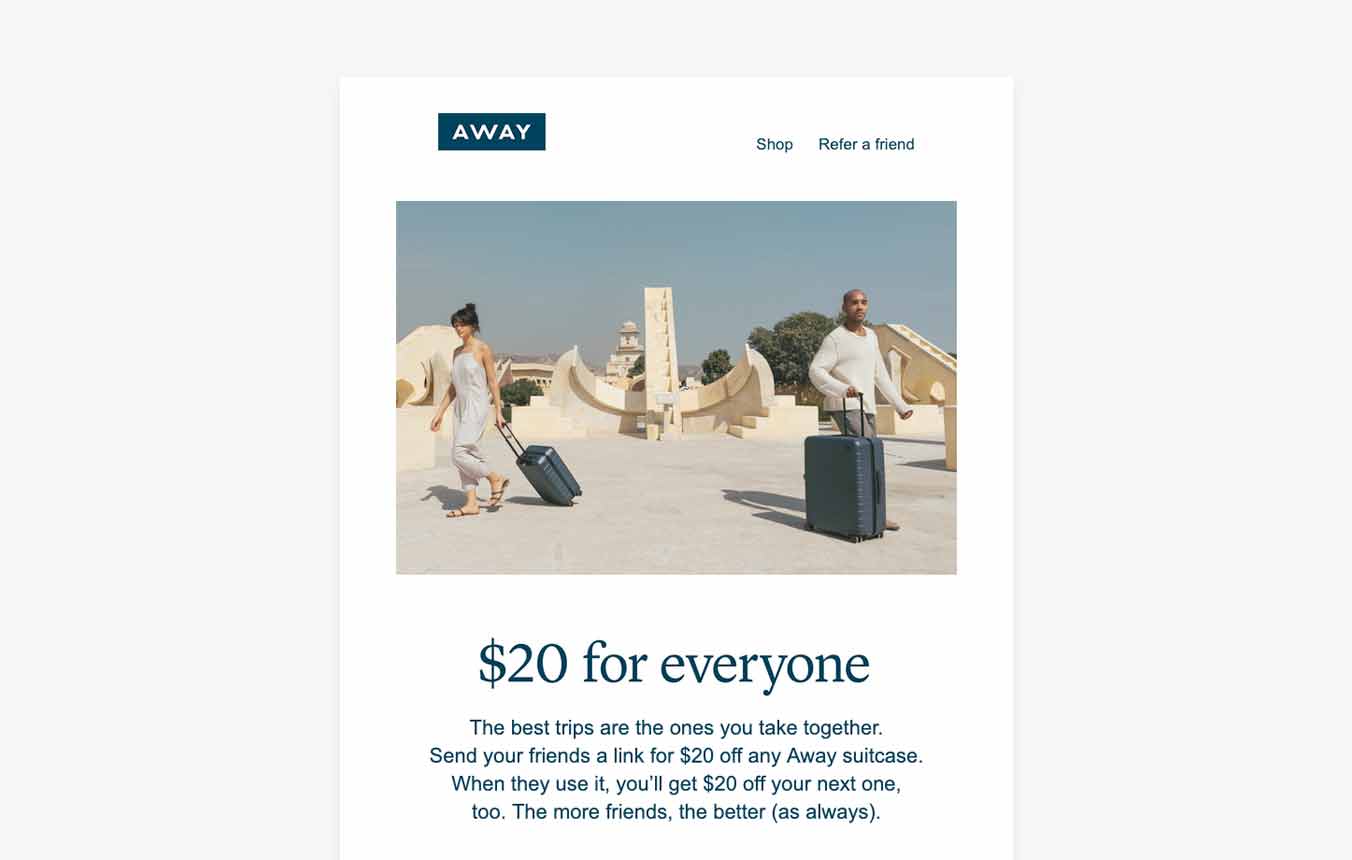
Away sends a dedicated referral email to all new customers, ensuring everyone knows about their referral program right off the bat.
Example of referral email Away sends to new customers
Link to your referral program from your feedback surveys
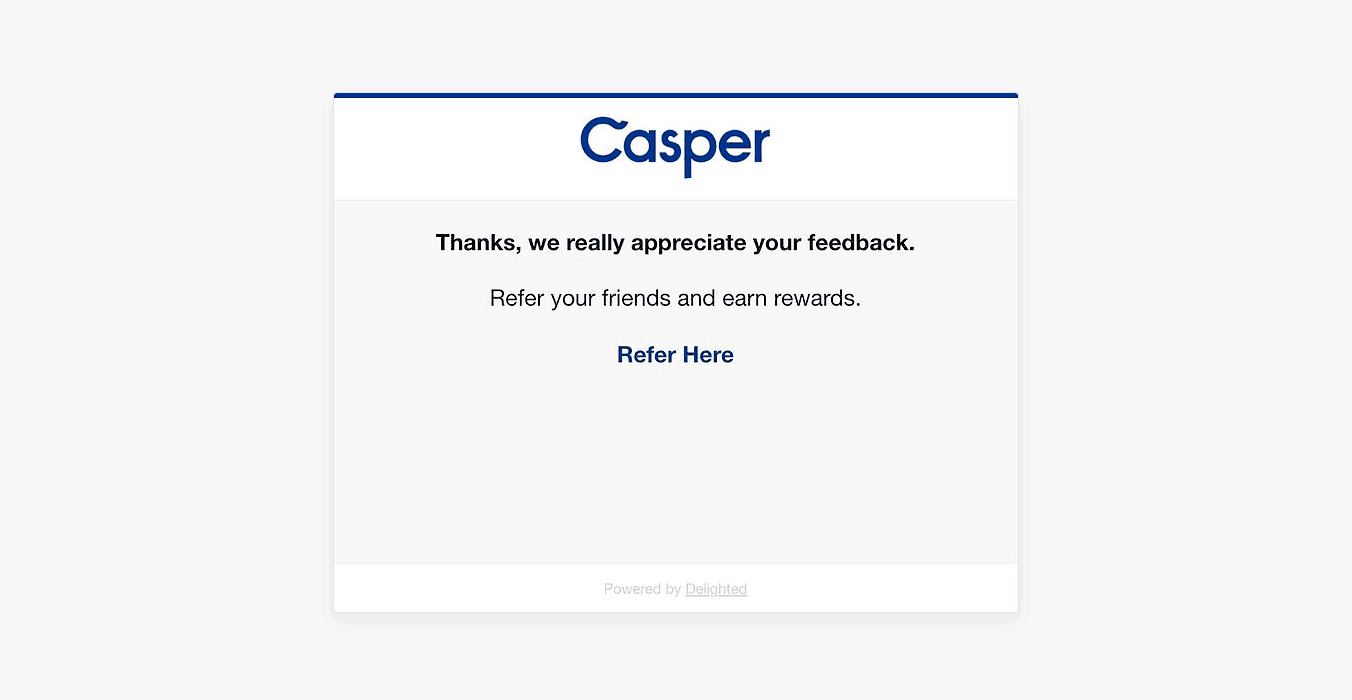
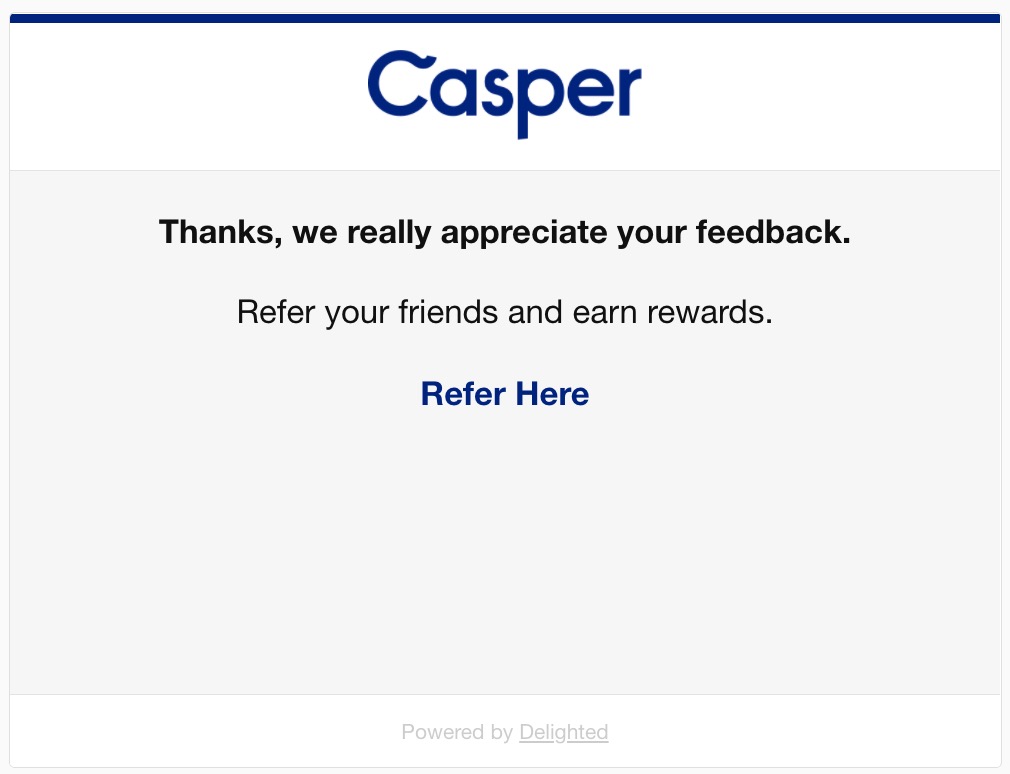
Every Delighted survey ends with a “Thank you” message. The Delighted + Friendbuy integration makes it easy to create a personal referral link that immediately offers promoters the chance to refer a friend.
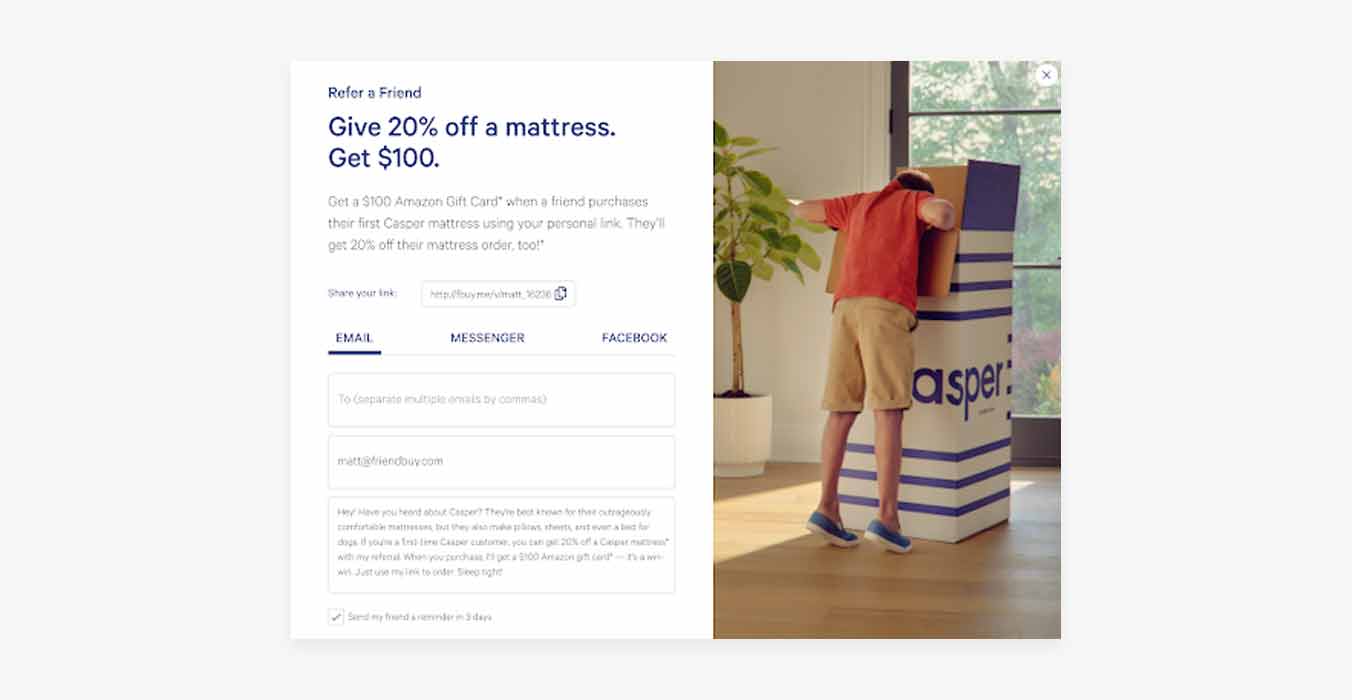
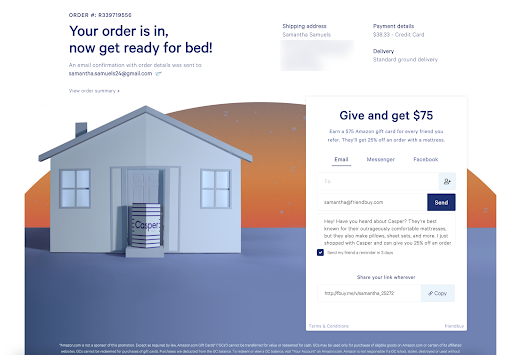
Casper shows promoters a referral program CTA when they complete their Delighted survey
6. A/B test to maximize your referral program ROI
To ensure you’re getting the most from your referral program, it’s recommended that you A/B test your offers to see what resonates with your customers.
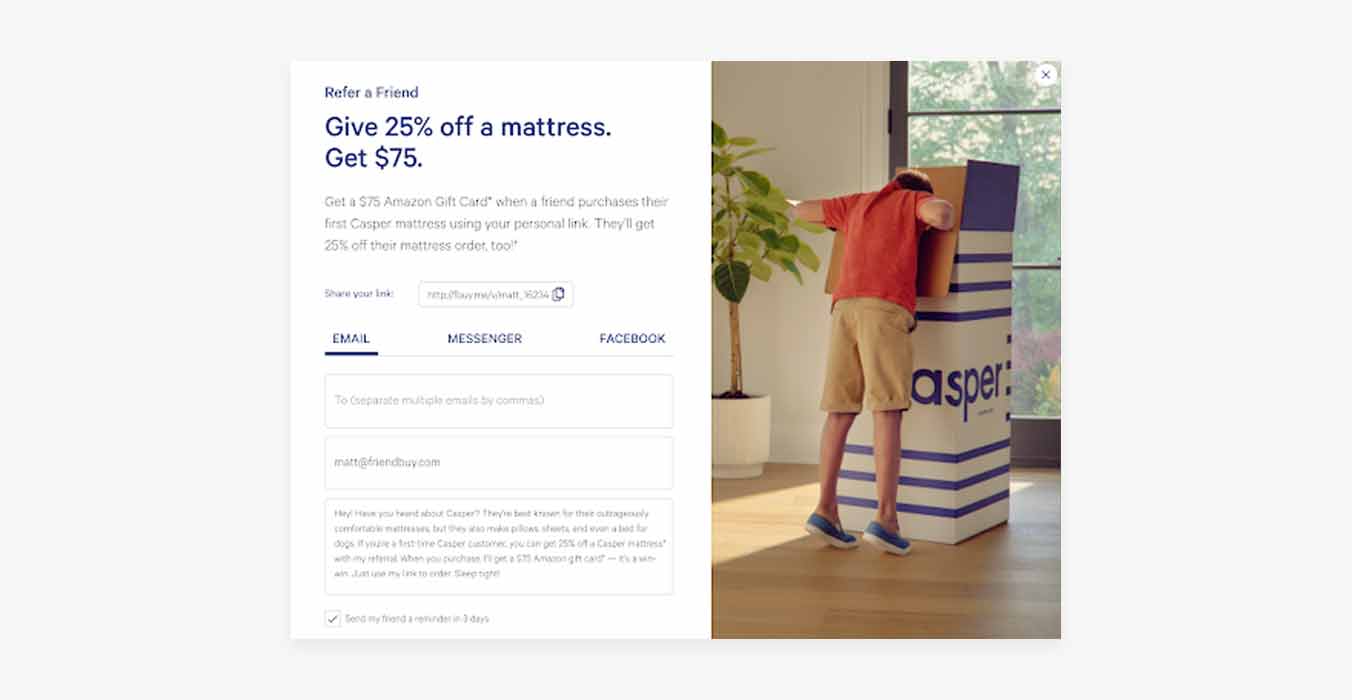
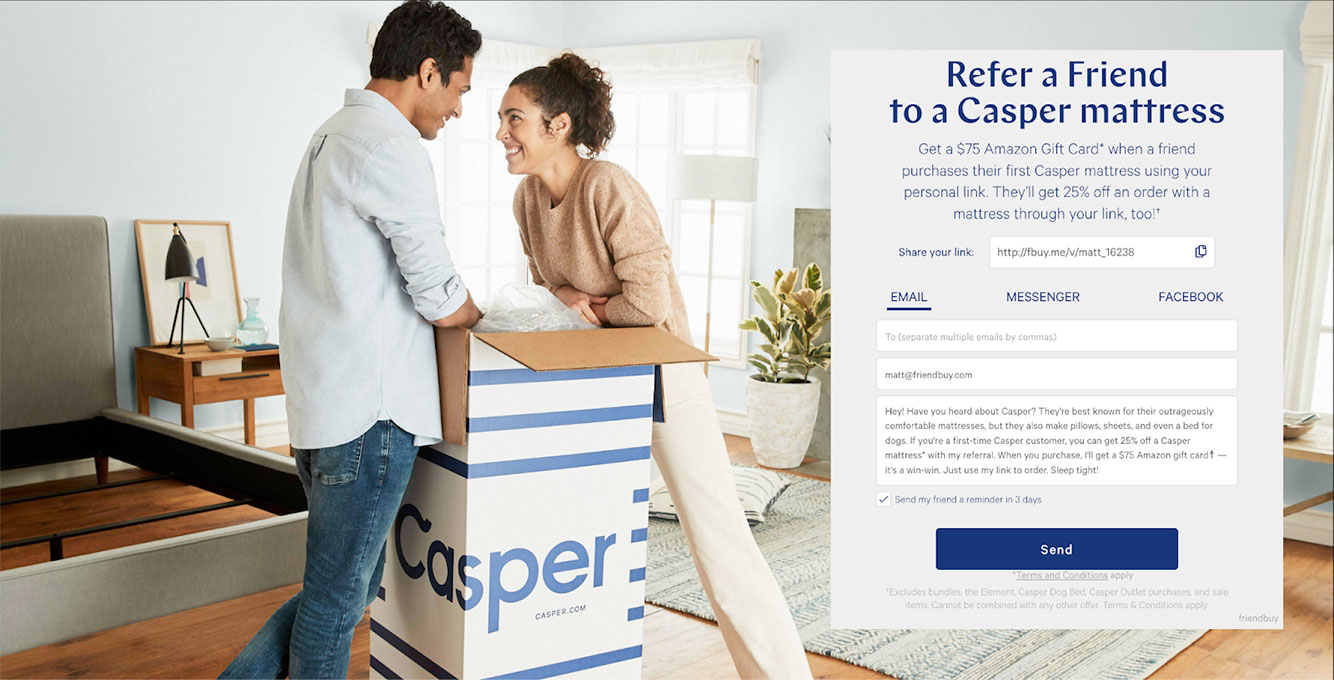
The below is an offer strategy test that Casper has run to see if a higher friend offer of 25% off, and a lower advocate offer of $75 works better than a lower friend offer at 20% and a higher advocate offer of $100.
Version A: The friend gets the more generous referral reward
Version A offers 25% for the friend and $75 for the advocate
Version B: The advocate gets the more generous referral reward
Version B offers 20% for the friend and $100 for the advocate
Ready for the winner?
It’s version A! The 25% offer for friends and $75 Amazon Gift Card performed better than the 20% offer and $100 gift card. These types of A/B tests are a great way to challenge assumptions about what your customers will be interested in, and help increase your customer acquisition.
Sample referral programs that work
If you’re interested in learning more about the success that high-growth brands can have with referral programs, feel free to check out the below articles.
Activate your top customers to drive referrals today
The above are just some examples of how brands can turn a referral program from an afterthought to a sustainable growth channel that helps you meet your goals.
Plus with Delighted and a best-in-class platform like Friendbuy, it’s easy to make your referral program part of your customer journey today. For example, with Friendbuy, Klaviyo and Delighted together, you can automatically provide promoters with a referral link, making it easy for them to take action and refer a friend.
Ready to get started? Sign up for Delighted for free and start identifying your top customers for your referral program today.
Already using Delighted? Great news: Friendbuy has created a special offer for Delighted customers, who can get one month of Friendbuy for free.
About Emma Kimmerly
Emma Kimmerly is Partner Marketing Lead at Friendbuy, where she collaborates with leading technology and agency partners to help brands grow through best-in-class referral and loyalty programs.
Emma loves telling people’s stories. With experience writing for a national newsroom, a world-class mental health hospital, and now high-growth SaaS companies, Emma enjoys meeting and telling the stories of people that are changing the way the world works. At Friendbuy, Emma works closely with partners and leading DTC brands to share ideas and trends that are shaping the ecommerce world.
When she’s not writing, Emma can be found walking, cuddling, or taking pictures of her golden retriever, Ben.
About Friendbuy
Friendbuy helps brands get more out of every customer. With a best-in-class referral and loyalty program, you can accelerate your growth through word-of-mouth referrals and increase lifetime value by 4x.
No matter how you connect with your customers, link surveys allow you to capture feedback through any unique channel that exists along the customer journey – email signatures, social media posts, support chats, receipts, in-store posters, and more.
However, it’s crucial to include context and segmentation with each link survey response. Why? Because the more context you gather with your surveys, the quicker and easier it is to understand and act on the feedback.
With the latest revamp of the Link platform, you can get segmented, contextual feedback every time – personalize the links by support rep, by location, by product line, or any data point that is valuable to you.
With our new user-friendly in-app survey link builder (no technical skills required), you can now:
Create personalized link and QR code surveys, right within the Link platform
Design vanity URLs for your link surveys so they’re easily distinguishable from one another
Configure the ability to accept or block multiple submissions in a given time window
Ensure up-to-date feedback by deleting survey links that you no longer need
Let’s take a closer look at the 4 benefits.
1. Build and customize unique survey links in-app
Need a unique survey link for each customer service rep? Looking to collect link feedback for every single one of your retail stores?
Now you can efficiently create, name, customize, and manage your survey links in our easy-to-use survey link builder.
Name your link
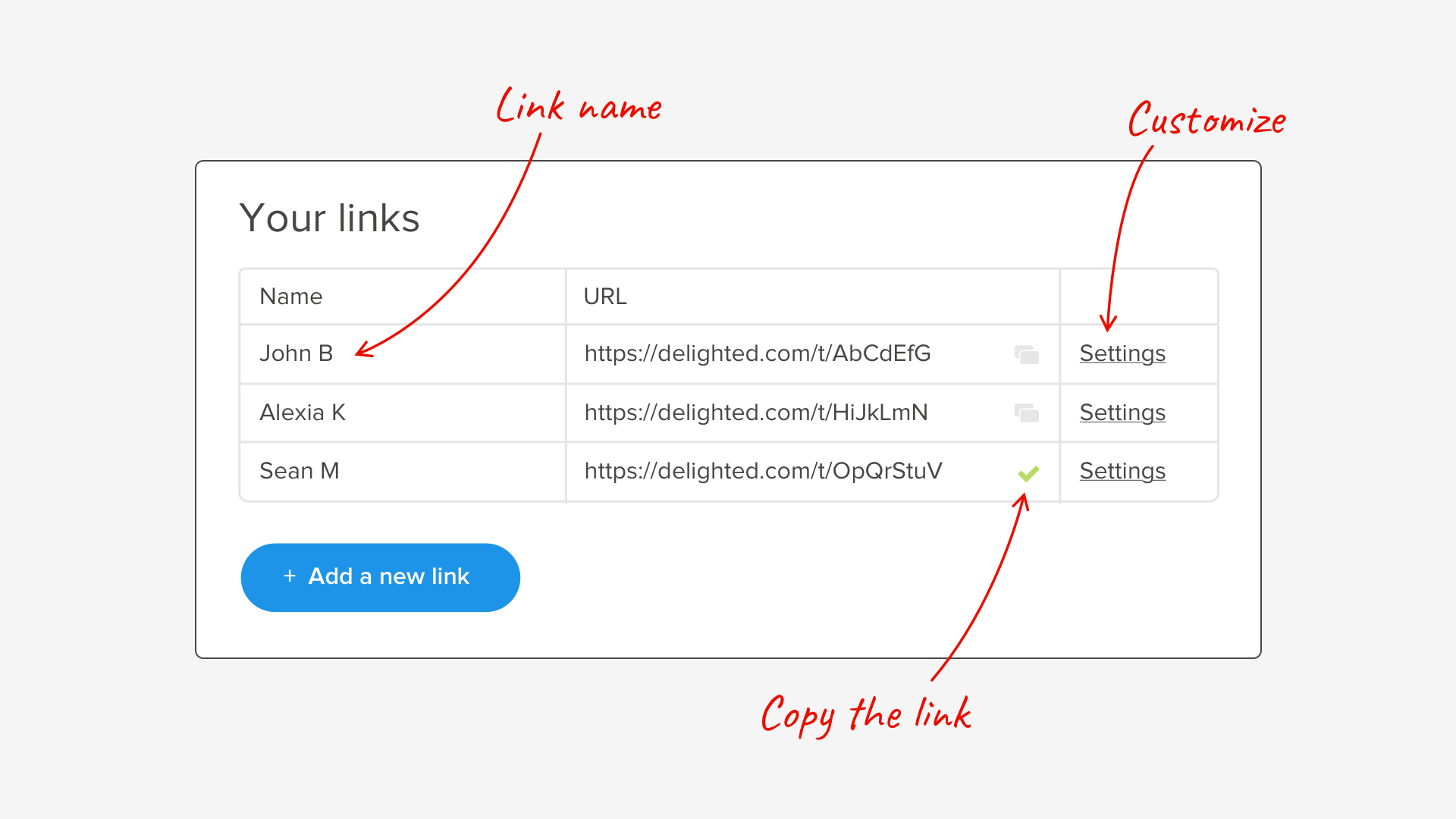
Distinguish between your unique survey URLs by naming them individually. Label them according to your use case: by support rep name, store location, product name – whatever makes sense for your program. Then, use the vanity URL flag to attach the name directly to the unique URL string. More on this below!
Add Properties
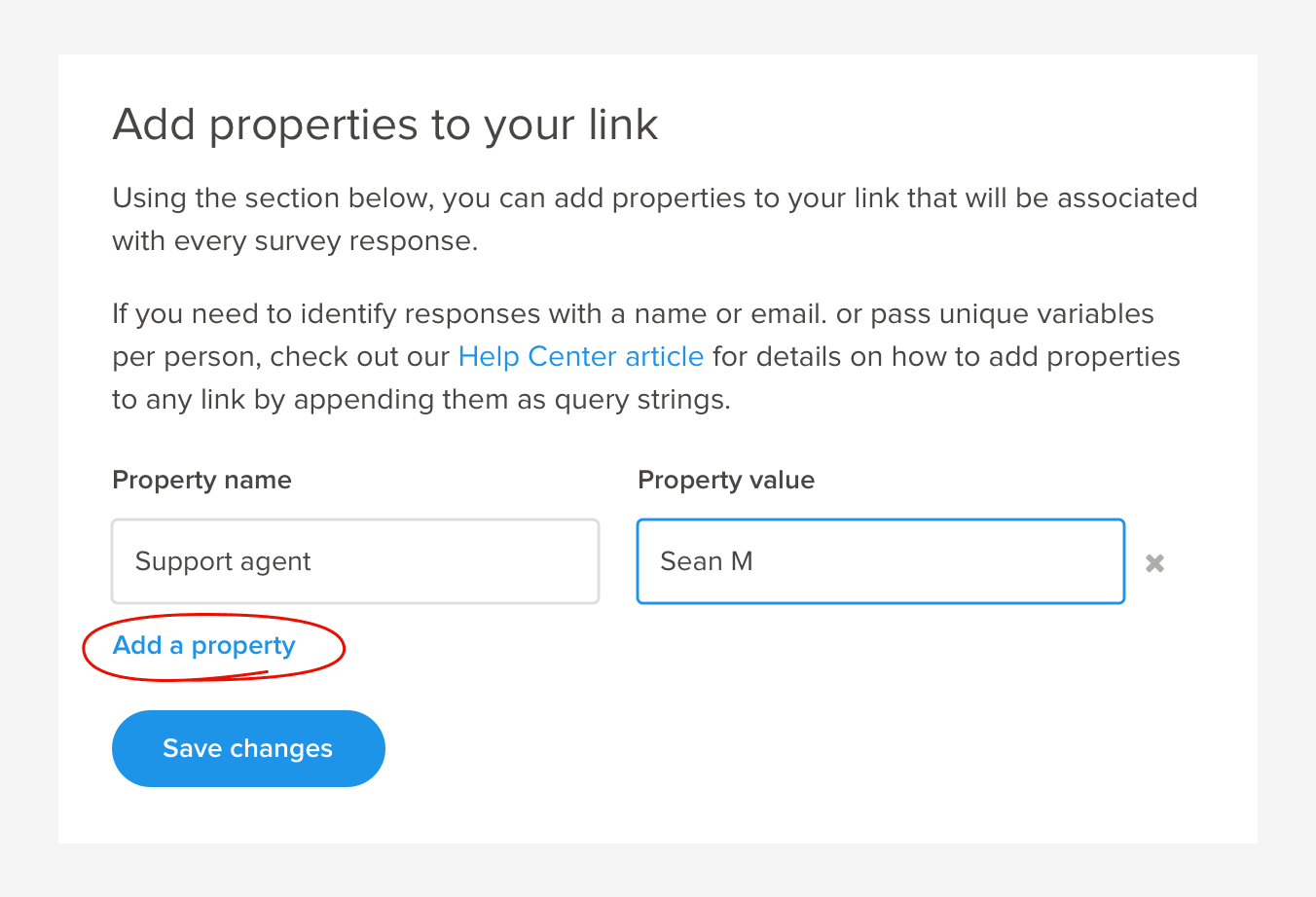
Add Properties to your links. Once a customer responds to your survey link, the added Properties will pull into your Delighted Dashboard for easy filtering and feedback organization.
This is an example of adding a “Support agent” property to an individual link. This survey link could then be added to Sean M’s email signature or support chat message to gather feedback on his customer interactions.
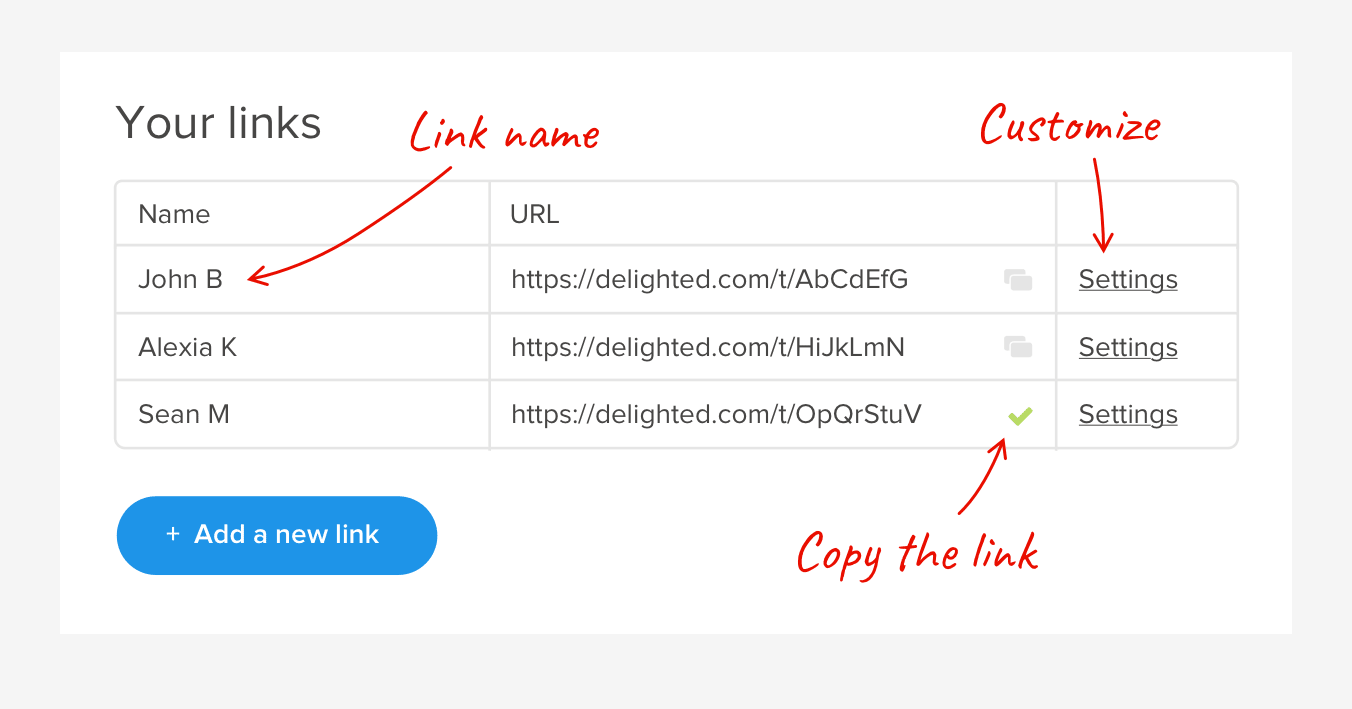
Copy and edit your link
View all of your links in one dashboard and copy or customize your link settings with a click of a button.
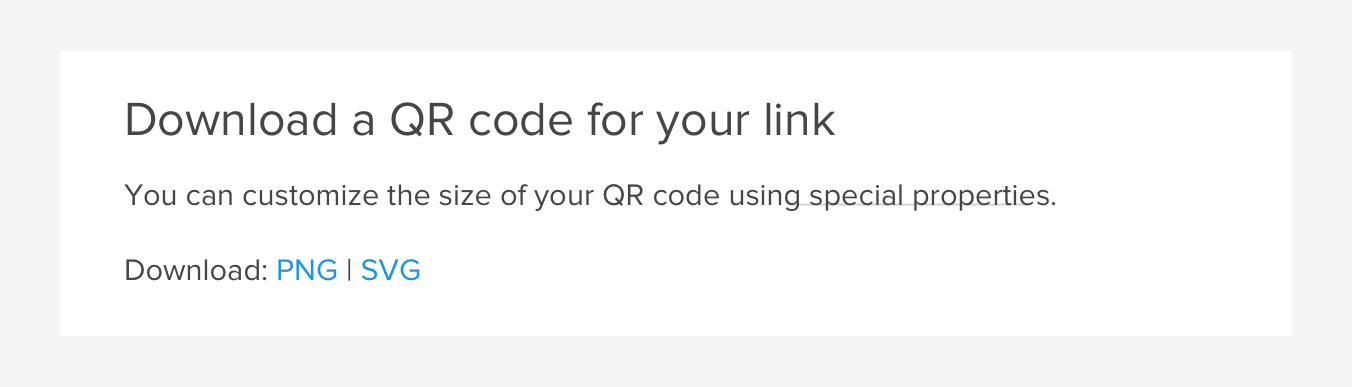
Download as a QR code
You can download a QR code for any survey link you create. This feature is helpful if you want to gather in-person feedback. For example, adding unique QR codes to printed store receipts, or adding scannable codes to posters across multiple locations, allows for quick feedback collection after an in-person shopping experience!
2. Create vanity URLs for easier management outside of Delighted
Distinguish between URLs at a glance by attaching the survey name to the URL string.
Give these individual links to the appropriate CSMs or sales reps so they can attach them to their email signatures or use them in response to social media messages from customers. There will be no more confusion around whose link is whose.
3. Accept, or block, multiple submissions in a given time window
Whether you want to capture multiple responses from a link survey in your email signature, or you’d prefer to test the link survey before it goes live, this feature will allow you to control the frequency of submissions.
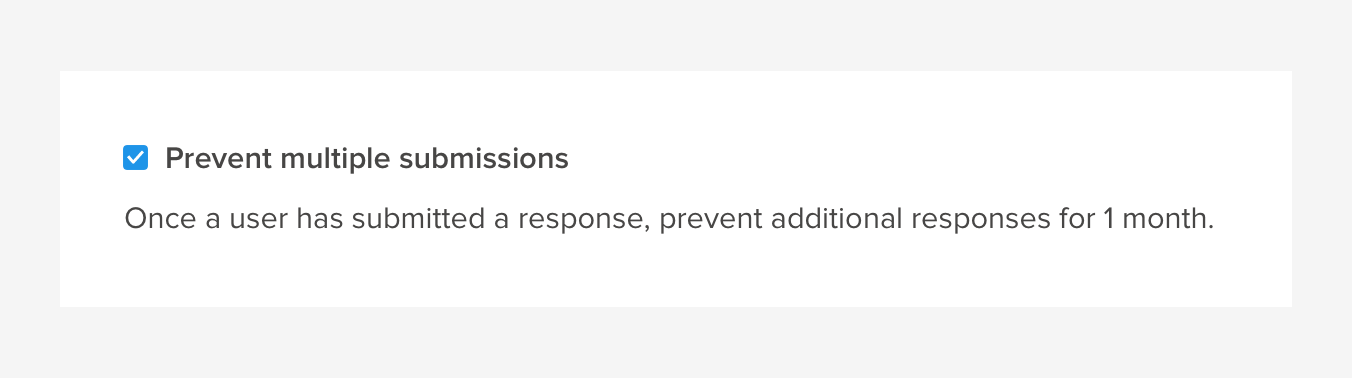
If “Prevent multiple submissions” is checked: The customer will only be able to respond to the survey once a month.
If “Prevent multiple submissions” is unchecked: All responses will be received and saved, no matter how many times the link survey is completed. As mentioned above, this is crucial for ease of testing purposes – you can test the link as many times as you’d like, without worrying about cookie expiration.
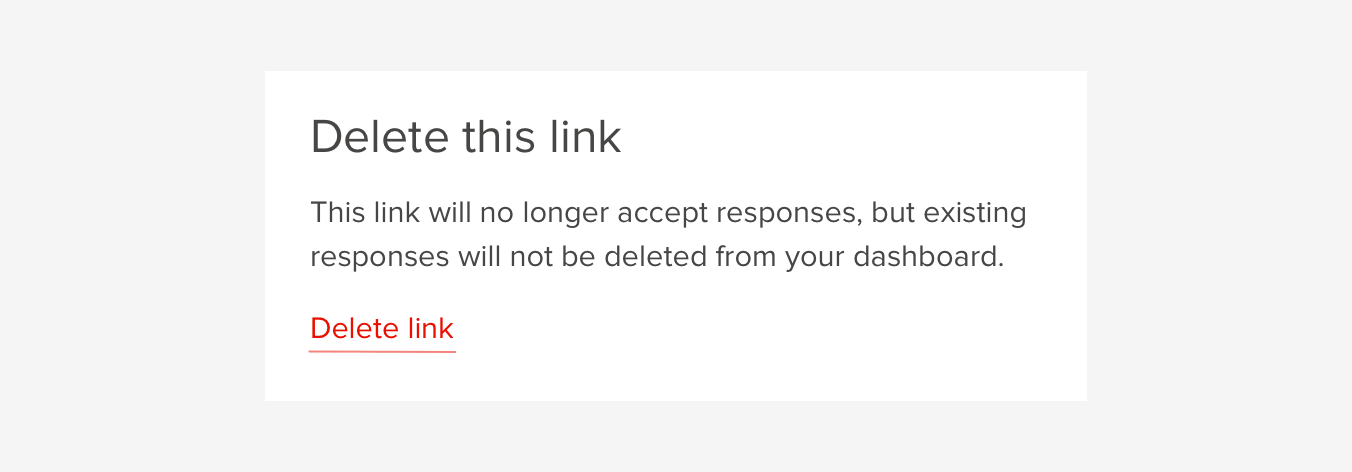
4. Ensure up-to-date feedback by deleting survey links that you no longer need
Clean, accurate data is necessary for making widespread decisions based on experience feedback. Make sure to delete old survey links that you don’t use anymore to prevent any customers from accidentally stumbling on a survey that is out-of-date.
Expand your survey reach with the Link platform
A DIY link-building experience gives you the opportunity to gather and act on feedback faster than before – and that speed is key as you scale and expand your feedback program.
While customer surveys can yield amazing insights into what your customers want and need, they can also be a liability if the underlying survey questionnaire is flawed. One of the most common causes of unreliable survey feedback is the biased survey question.
Customer feedback is not easy to come by, which makes every survey response all the more significant. It’s important to make sure the input you collect from respondents is as unbiased as possible, and provides a clear lens into the customer experience. When you have bad survey questions in your questionnaire, you end up wasting a valuable opportunity to surface critical insights from customers and employees about how to improve your products and services.
In today’s retail environment, customers expect to be able to seamlessly transition from browsing on a mobile device to picking up an item in-store. The best omnichannel retail strategy ultimately results in an experience that allows customers to go from one channel to another without friction.
Omnichannel retail is now a vital part of every retail strategy. Brands that master omnichannel retail can cater to the 73% of customers who use multiple channels to research products, look for discounts, or compare prices. In this article, we’ll cover:
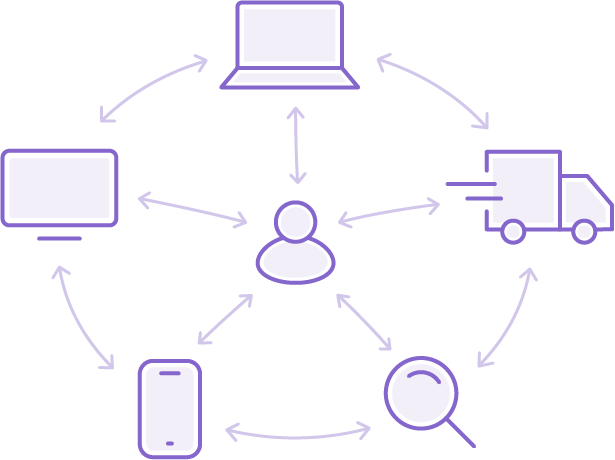
Omnichannel retail is a fully integrated approach to commerce, providing shoppers a unified experience across all channels and touchpoints, including web, brick and mortar, and in-app. The goal of omnichannel retailing is to provide customers with a convenient experience across all aspects of their retail journey.
A successful omnichannel retail strategy lets customers choose their preferred transaction location while also making cross-channel transitions convenient for customers. In fact, 14% of customers will spend more after they have been presented with an omnichannel strategy: the proof is in the revenue.
It also requires inventory, customer service, and the sales experience to be unified across multiple channels. Recent developments in IT infrastructure and data analytics have made it possible to track a customer’s journey across multiple touchpoints, from social media ads and interactions, to the website, app, chat, customer service calls and email, and finally back to the brick-and-mortar store.
Omnichannel vs. multichannel retailing
Before omnichannel retail, there was multichannel retail: meaning that all the different channels existed, but they stood alone, unintegrated. With the rise of omnichannel retail, customers can hop from one channel to another easily since the channels are designed to roll up into one overarching brand experience.
Why is omnichannel retail so vital to the retail customer experience?
Seamless and personal, omnichannel retail, when done correctly, is built entirely around the customer experience to accommodate consumer behavior and preferences. Those who have mastered omnichannel retail have a holistic understanding of their customers in terms of what their needs are, and how they want those needs fulfilled.
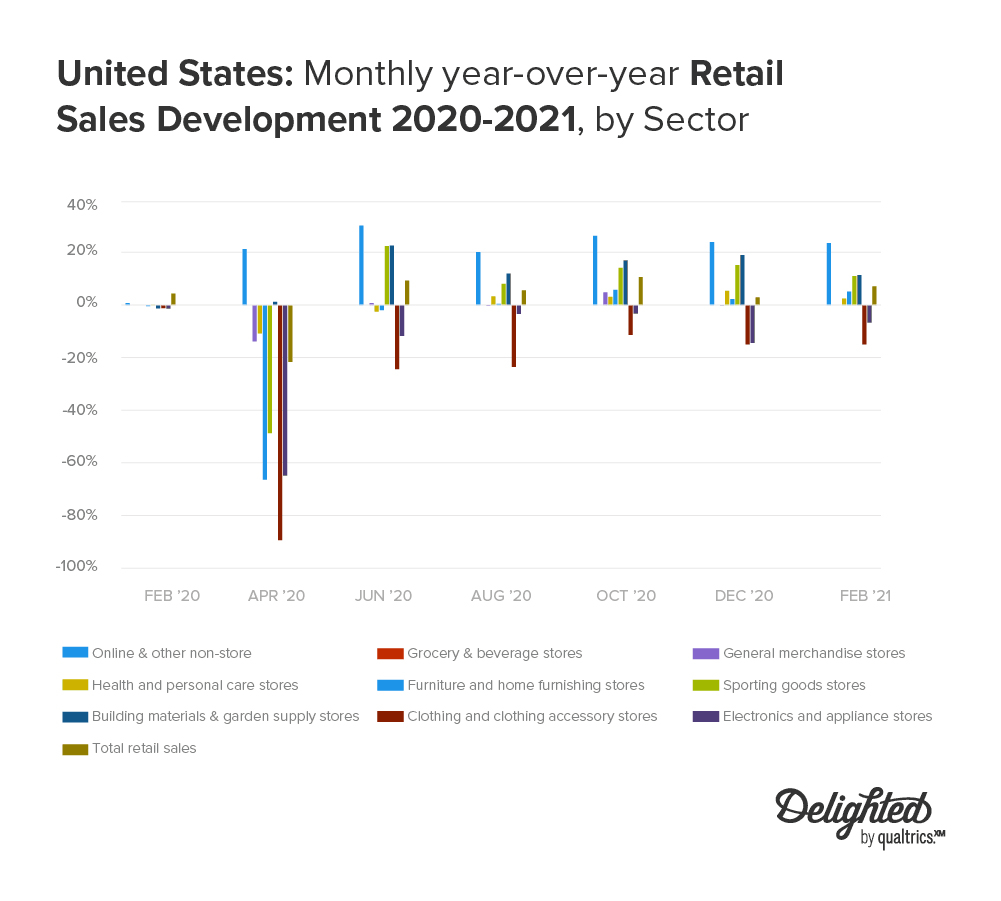
Since the beginning of the pandemic in 2020, the retail landscape has changed drastically and may perhaps never be the same. With over a hundred retail chains closing up shop, this economic change has impacted varying retail industries differently. Retailers discovered that to adapt to the changing retail landscape, they must ensure a unified customer experience across platforms.
We surveyed 1,200 shoppers across the US in our 2021 study to gain a deeper understanding of how the pandemic has affected shopping behavior and consumer expectations moving forward.
Omnichannel retail trends for 2021 and beyond
The pandemic showed retailers that customers want a personalized shopping experience that meets their needs. Whether that be curbside pick-up or ordering online, businesses have had to adapt to the changing preferences of their customers, even more so since the pandemic.
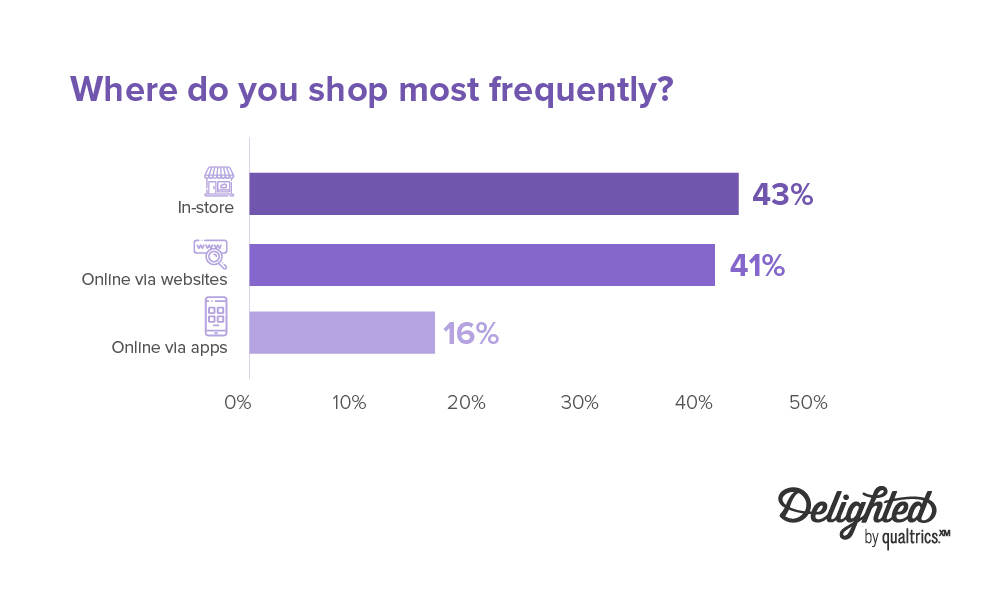
What our research found is that a majority of US consumers are shopping online either via websites (41%) or apps (16%). And this trend is likely here to stay.
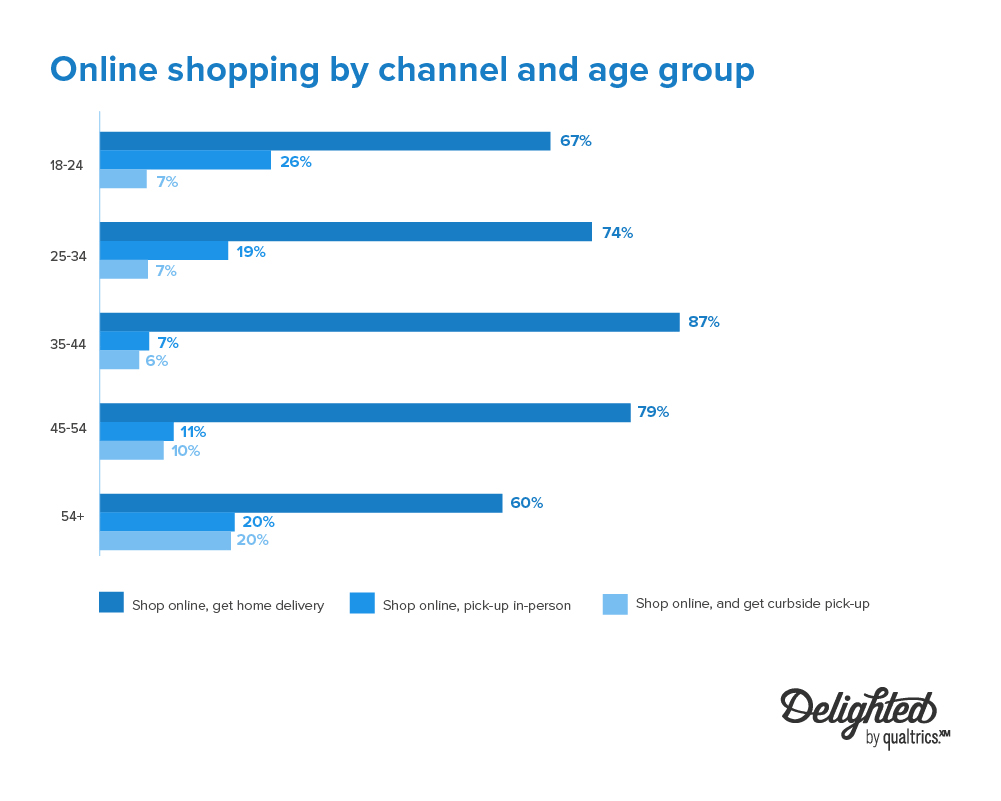
Curbside pick-up increased in popularity, but delivery is king
Curbside pick-up and in-store pickup exploded during the pandemic, with Target citing a 500% growth in curbside pick-up in 2020.
Regardless, all age groups surveyed reported that they shop online and have purchases delivered more than they pick up in-person or curbside. 87% of shoppers surveyed ages 35-44 prefer home delivery with those ages 45-54 showing a preference for home delivery as well at 79%. Those aged 54 and older had the lowest reported preference of home delivery at 60%, with 20% opting for in-person or curbside pick-up.
This might be due to the fact that 90% of shoppers expect deliveries to arrive in 2-3 days, while 30% expect same-day deliveries.
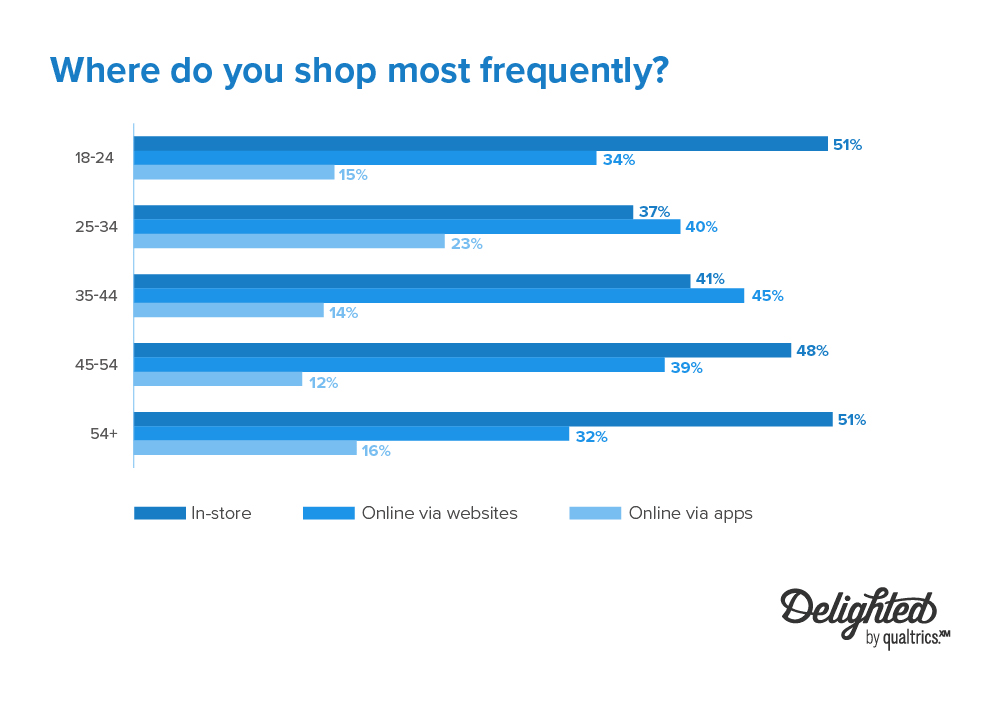
However, there’s still a pattern of certain age groups shopping in-store more than others, like those who are 18-24 and 54 or older (51%). Millennials and Gen X, on the other hand, prefer purchasing online via websites. 39-45% of shoppers ages 25-54 prefer online shopping via websites while 12-23% of those ages 25-54 prefer shopping on mobile apps.
Consumers still want to see and try out items in-person
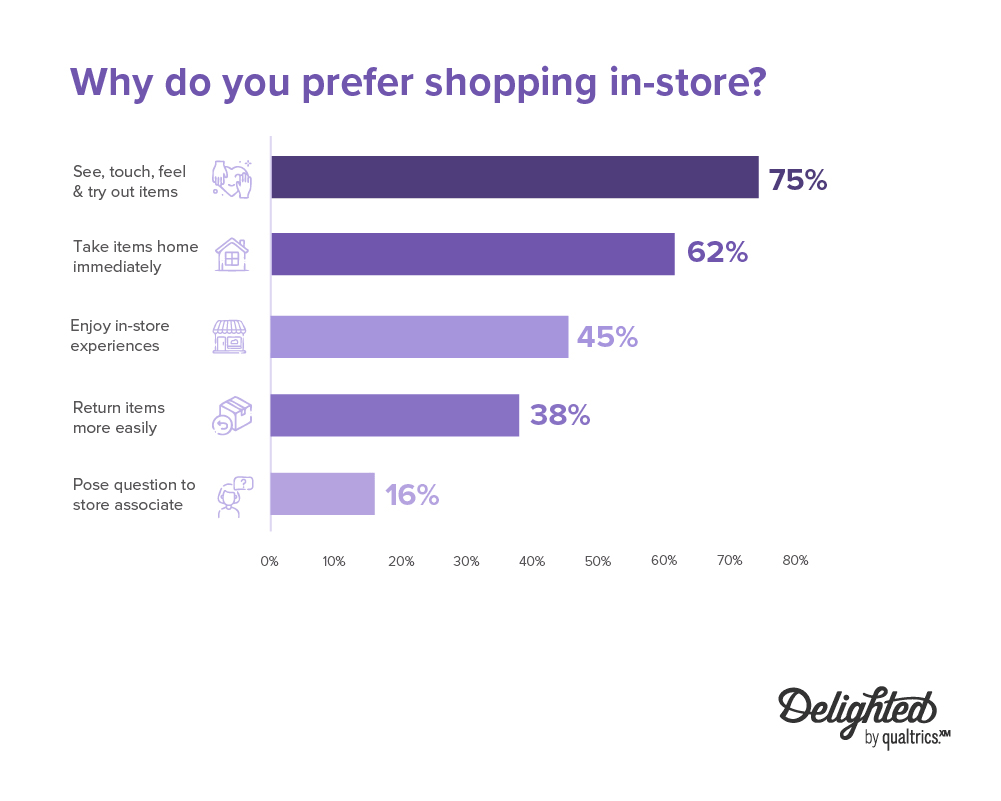
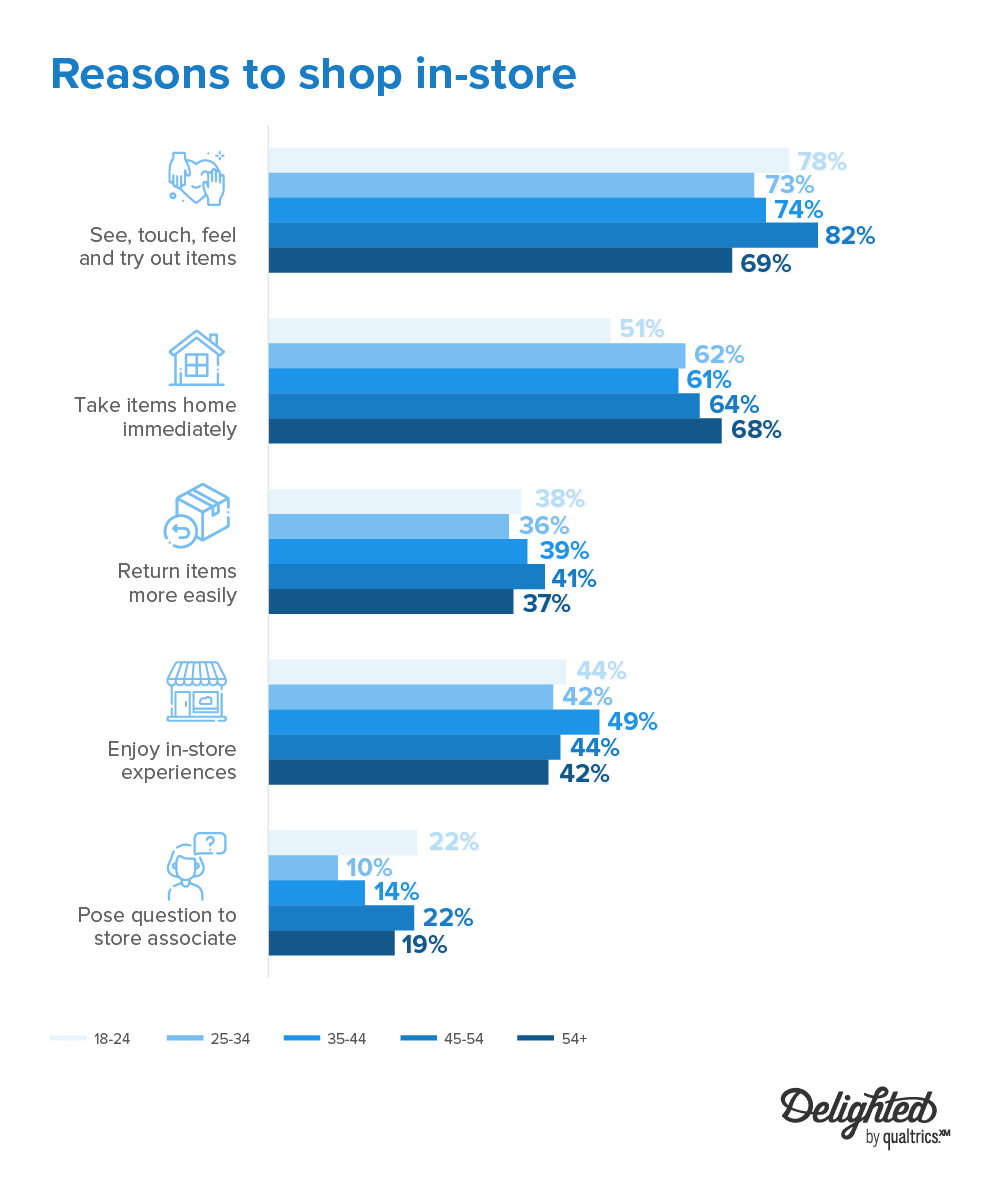
This begs the question: what’s the most popular reason for customers to shop in-store? By and far, the ability to touch, feel, and try on items was the top reason (75%) to get the in-store experience.
Across all age ranges, seeing and feeling the product remains the core reason shoppers like to visit a brick-and-mortar store.
Middle-aged and older shoppers like aspects of in-store purchasing such as trying the item (74% of shoppers ages 35-44 and 82% of those ages 45-54) and taking it home immediately (61% of shoppers ages 35-44 and 64% of those ages 45-54). Since many shoppers prefer to do their own research, access to store associates is less of a concern (19-22%) for all age groups.
Uncertainty around product quality and fit is the top con of online shopping while convenience is the top pro
This remains one of the biggest drawbacks of online shopping: shoppers remain uncertain about the actual quality or fit of the product until it arrives at their doorstep.
Combined with sometimes complicated returns processes, online shopping can feel like playing a slot machine – the anticipation is exciting, but the outcome, underwhelming.
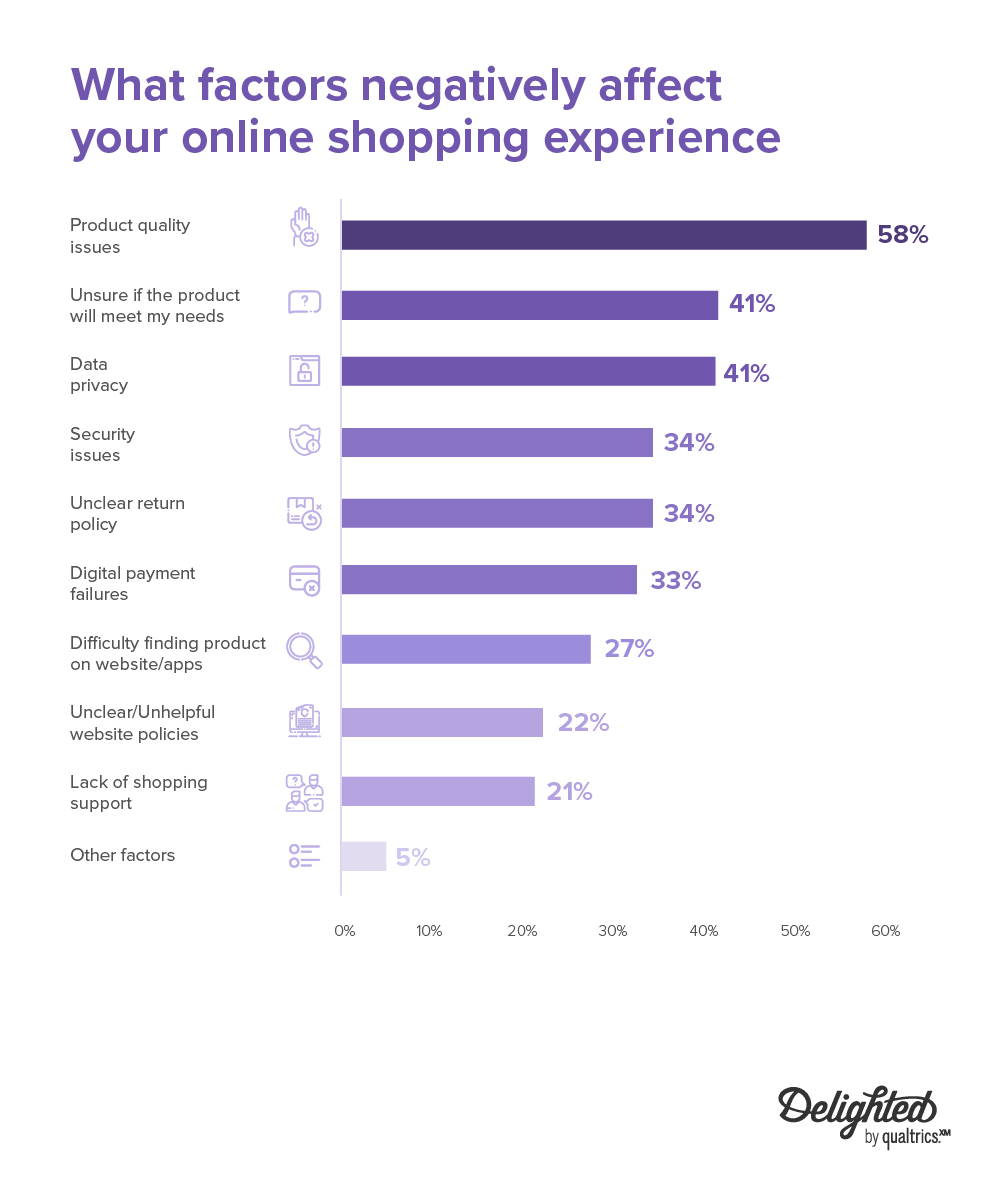
This connects with the biggest grievance in-store shoppers have against online shopping: product quality is perceived as poor compared to what’s advertised once consumers have their order in hand (58%). Or, consumers are unsure if what’s shown online will be suitable for them (41%). Delays in shipping, outdated information about stock, and shipping costs add more friction to the shopping experience.
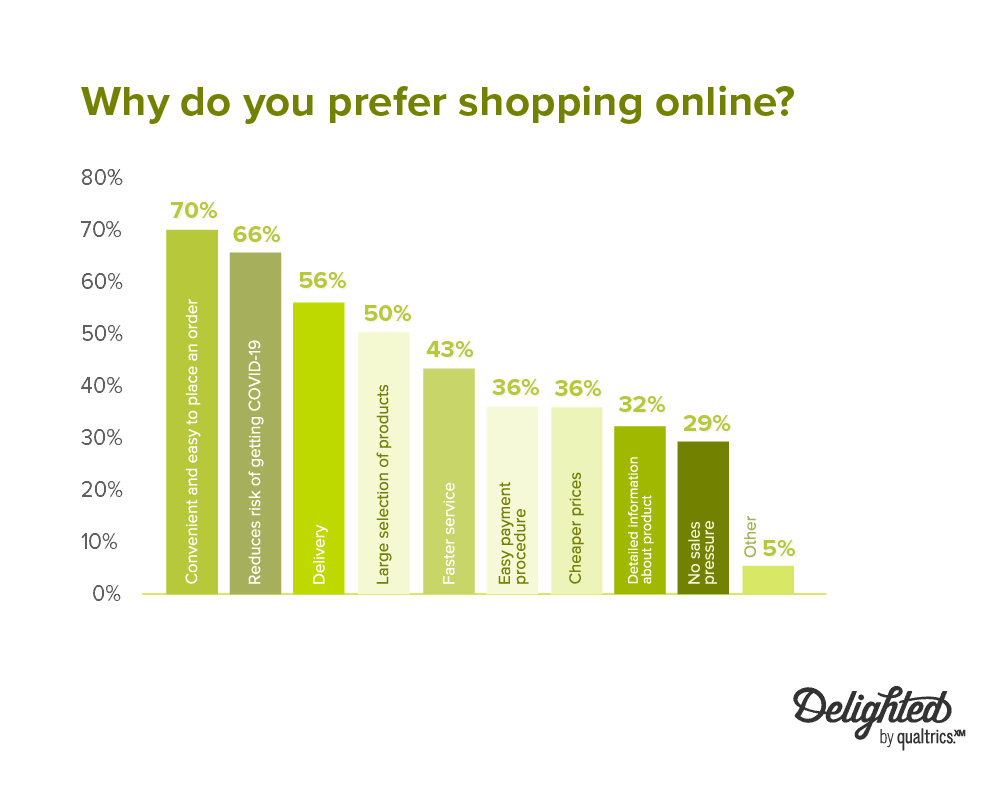
This may explain why despite online shopping affording convenience (70%), ease of delivery (56%), and the obvious benefit of avoiding exposure to COVID (66%), consumers still shop in-store.
Retailers with premium pricing are also in luck: cheaper prices were ranked lower on customers’ priority list at 36%. This goes to show how much shoppers value convenience over discounts or sales.
Consumers prefer to buy groceries and household essentials in-store
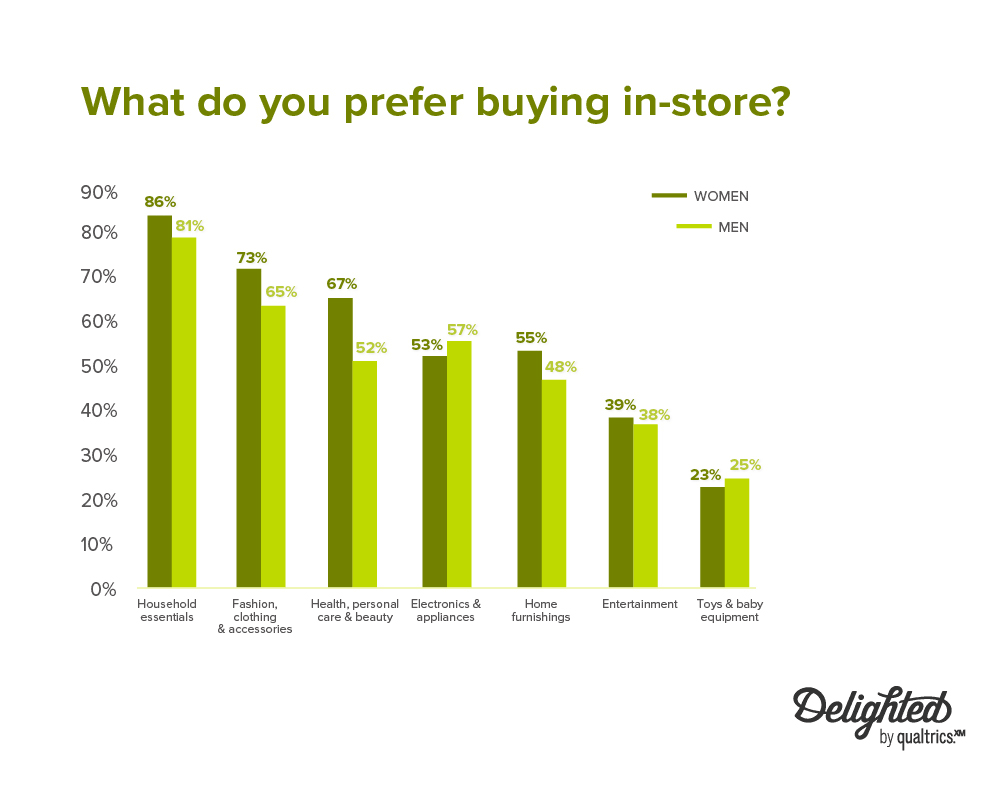
Depending on the type of product a customer is buying, however, the sales channel they choose may vary. One example is that groceries are best bought in-store: both women (86%) and men (81%) listed household essentials as the top category to purchase in person. The same goes for women’s clothing as 73% will shop in-store for functional or recreational reasons while only 65% of men do the same.
Top concerns for men and women when it comes to in-store vs online shopping
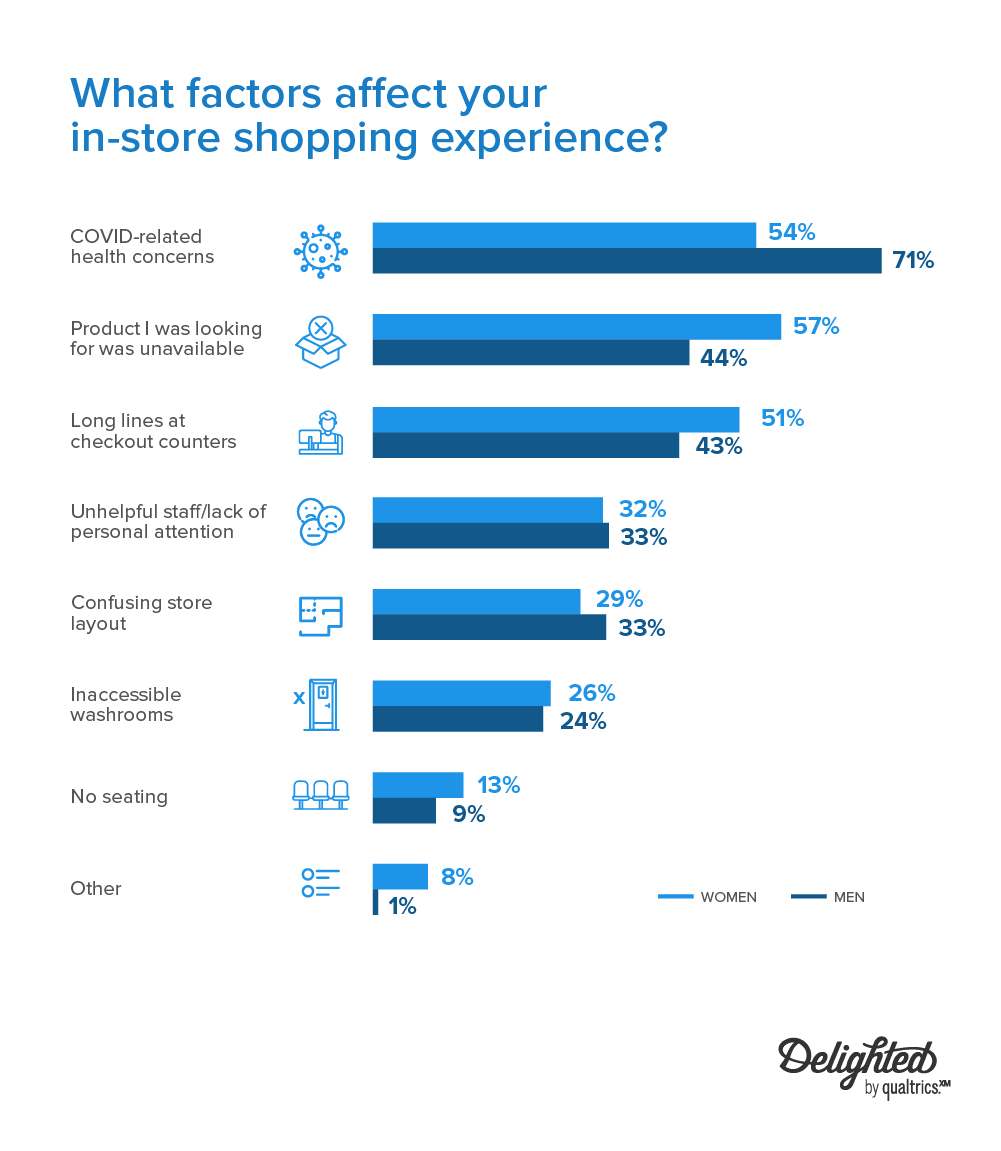
No sales channel is perfect: just like with online shopping, in-store shopping can have some drawbacks. When shopping, men were more concerned about COVID (71%) while women were put off by product unavailability (57%) and long checkout lines (51%).
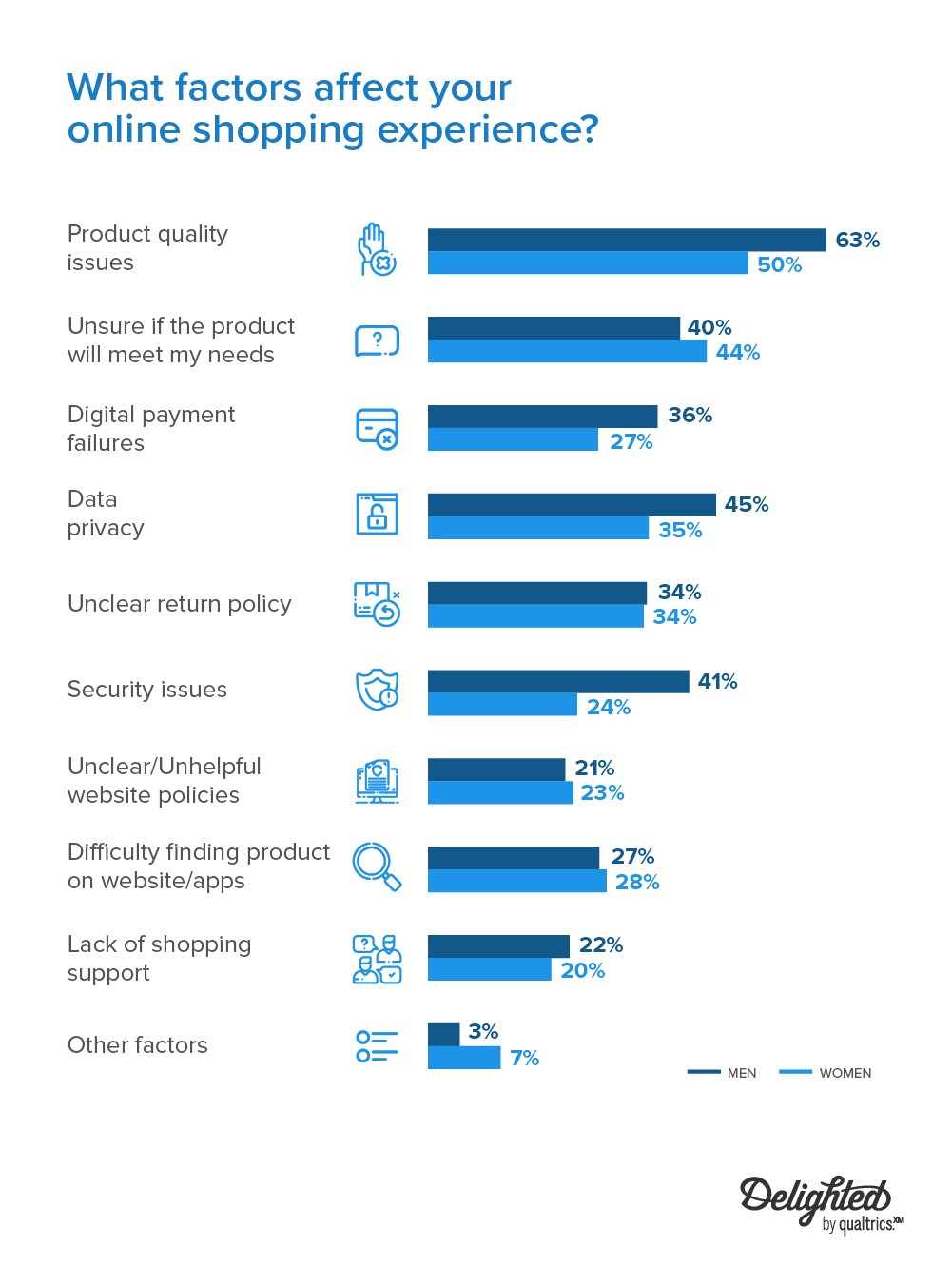
Some of the most common drawbacks of online shopping included unclear return policies (34% of men and women), digital payment failures (36% of men and 27% of women), and difficulty finding the product on the website or app (27% of men and 28% of women). Men reported greater privacy concerns (45%) than women (35%) by 10%.
Social commerce: the newest channel
Since the rise of social media, it was only a matter of time before retailers capitalized on their digital presence to sell their products on social media platforms like Instagram, Facebook, and Youtube.
In fact, 81% of Americans ages 15-25 use Youtube, 79% of those ages 18-29 use Facebook, and 75% of 18-24 year olds use Instagram. And with 92% of Instagram users reporting that they either clicked on an ad, followed a brand, or made a purchase because of an Instagram ad, it’s hard to deny its effectiveness.
Businesses spent record amounts on advertising on social media sites in 2020, increasing their spending on social media ads to $41.5 billion, accounting for nearly 30% of all internet advertising revenue.
Even during unprecedented economic turmoil at the height of the pandemic, social commerce has proven that it’s here to stay, quickly becoming one of the next big channels in omnichannel retail strategy.
Considerations for small and medium-sized enterprises
Note that this type of business model is incredibly hard to pull off: larger brands have the budget and resources to build IT infrastructure and AI-driven distribution algorithms.
Smaller and mid-sized enterprises (SMEs) shouldn’t fret: the heart of succeeding at omnichannel is understanding the consumer, like knowing where they like to spend time online and how they like to shop. This makes social media an excellent tool to connect with customers, paired with a great product and authentic values.
Also keep in mind that a full-fledged omnichannel retail strategy never happens overnight. Startups like Cotopaxi began as purely an ecommerce shop, and then expanded to physical locations for customers who preferred an in-store experience. You can learn more about their retail customer experience journey in our on-demand webinar.
One of the easiest ways to start learning about your customers’ preferences is to ask. An omnichannel survey solution like Delighted can help you get the information you need to improve your omnichannel retail experience, since you can easily ask for feedback via email, in-app, on your website, or in-store.
Guiding principles to build an omnichannel retail strategy
Now that we’ve covered the basics of omnichannel retail and the current landscape, you might be left wondering how to get started on your omnichannel retail strategy. Here are some steps to follow when integrating omnichannel retail into your business model.
1. Understand your audience and their behaviors
Feedback is instrumental when it comes to measuring success. Whether or not your customers are satisfied and if they would recommend your product or service to a friend can be a valuable metric for your company.
Prioritizing business goals and making sure that internal processes are supporting those goals is the key to seamless omnichannel retail flow.
Your KPIs – just like your channels – should be integrated across departments from marketing, to sales, to IT. If your company goal is to seamlessly integrate all sales channels for a frictionless experience, define that goal and work backwards to meet the company objectives.
3. Identify pain points within the customer experience
Analyze customer pain points by gathering data at different stages in the customer journey to determine what went wrong in cases of negative feedback.
Identifying trends in feedback can lead to system-wide improvements: you’ll be able to see where common points of friction are, and think of ways to resolve issues for everyone, not just for the individual customers who are bringing them to your attention. With the help of Customer Satisfaction Score or Net Promoter Score surveys, you can close the loop and create positive customer experiences overall.
4. Provide an exceptional customer experience during pre and post-purchase activities
As shoppers grow increasingly independent, 75% of customers want the ability to get their questions and concerns addressed by their own research. To cater to self-serve customers, businesses will want provide the resources necessary to help customers troubleshoot and solve problems themselves.
One way to capture how well your company adheres to the preferences of independent shoppers is by sending Customer Effort Score (CES) surveys. CES surveys are designed to evaluate how easy you’ve made it for customers to do something, whether that’s making a purchase or resolving a support issue. Check out our guide to learn more about what Customer Effort Score is and how it’s been tied to improvements in customer loyalty.
5. Gain the insights you need to create a successful omnichannel retail experience
By surveying customers across the entire customer journey, you’ll be able to surface where the friction is at all points in your omnichannel retail experience: whether that’s browsing in-store, placing the order online, or requesting support.
Measuring the success of your omnichannel retail strategy comes down to analyzing customer experience data and implementing the necessary improvements to keep customers returning and promoting what you have to offer.
The importance of a strong omnichannel customer experience
At the crux of good retail customer experience is omnichannel strategy: shoppers are not only more loyal to brands that meet their needs, but are also willing to spend more when presented with an integrated shopping experience.
Collecting customer feedback with a survey feedback tool can highlight and prioritize the parts of your omnichannel customer experience that need to be improved.
Selling to your existing customers is far easier than acquiring new customers. The general rule of thumb is it costs 5x as much to generate a new customer than to sell to your existing customers.
That’s not all.
Your current customers are also more likely to spend more. One study says that existing customer order value is 31% higher than the order value from a first-time buyer. The purchases loyal customers make from your company can add up to a significant value over time. When distilled down to a number, this is called their customer lifetime value (CLV).
To evaluate the success of your company and its trajectory for long-term, healthy growth, businesses use the customer lifetime value formula to make this crucial calculation.
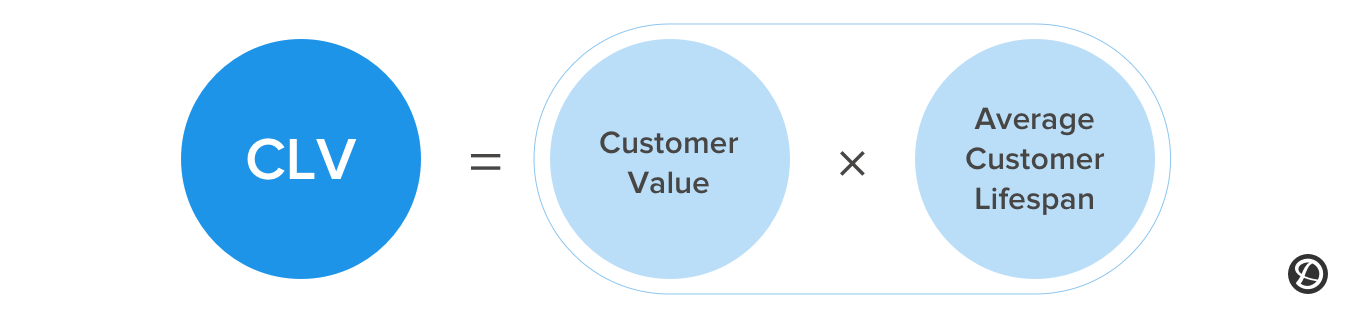
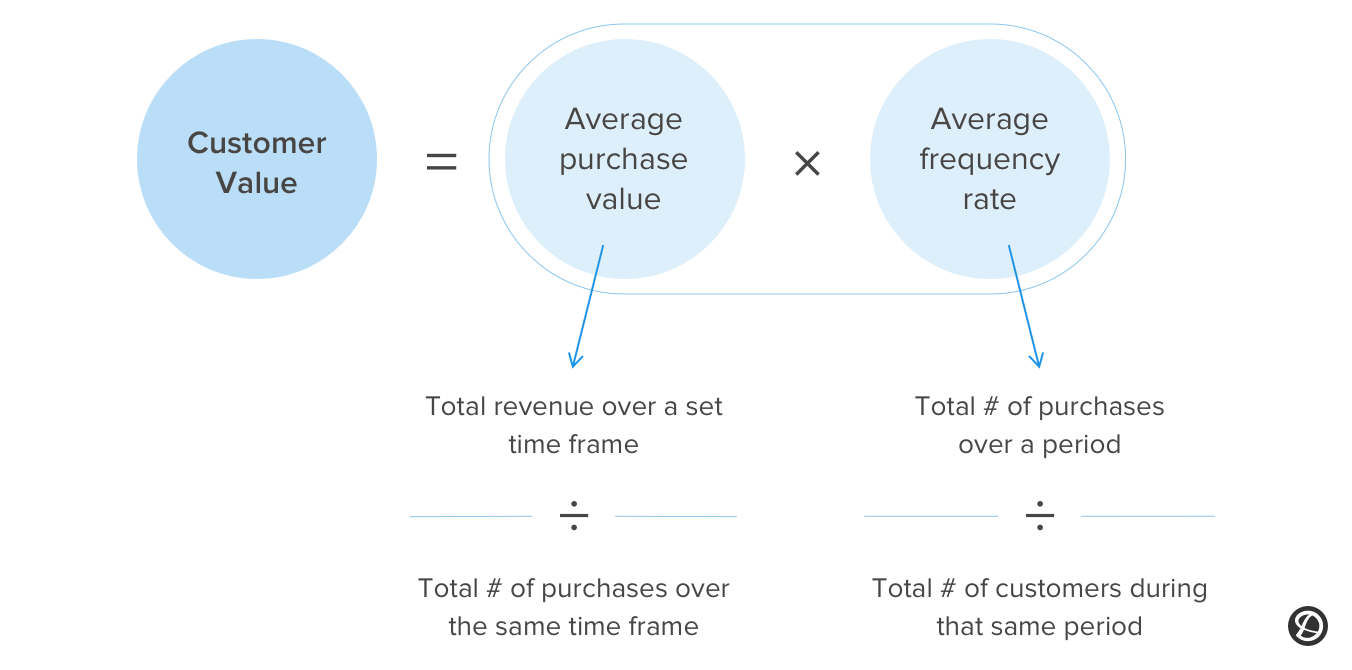
The customer lifetime value formula will tell you what the average customer is worth to your business throughout the course of the relationship. The typical formula used to calculate customer lifetime value is Customer lifetime value = customer value x average customer lifespan.
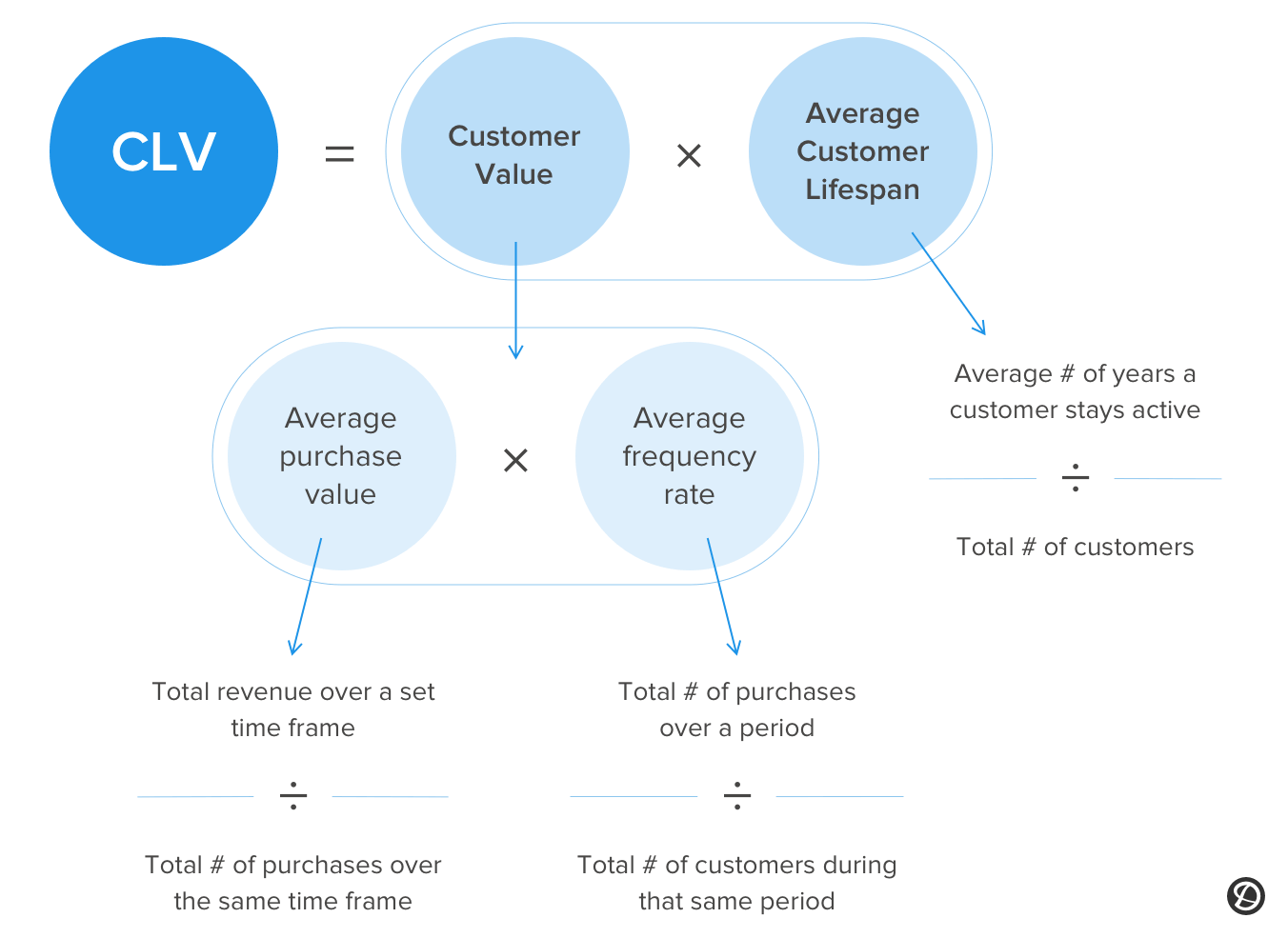
Customer value is the average purchase cost and frequency of their purchases, while the average customer lifespan is the average number of years a customer stays active divided by the number of total customers. The complete customer lifetime value formula is as follows:
It’s essential for customer success and support teams to understand CLV because it’s always less expensive to maintain an existing relationship than to create a new one.
Increasing the value of your customers is the best way to supercharge your business growth. Using the CLV formula correctly can help you develop strategies to get new customers and improve your average lifetime value of a customer.
Why is customer lifetime value important?
Customer value is at the heart of any stable business. The customer lifetime value formula is essential if you’re looking to achieve substantial growth patterns.
It’s a long-term calculation that measures how sustainable your business model is. If you have a low lifetime value, your business may be failing to deliver on customer expectations. It could also mean you’re spending much more than you need to maintain your margins.
So, why is lifetime value so significant?
1. It impacts your bottom line
Total consumer value has a direct impact on profitability. Businesses focusing entirely on lead generation and conversions pay the high cost of acquiring these customers. It also means you’re getting a smaller margin for every sale.
Knowing what your customer lifetime value is versus your customer acquisition cost can shine a light on how you need to adjust your strategy to bolster margins: optimize your lead generation program, focus on delivering more value for your customers, or both.
2. It steadies your cash flow
A steady stream of orders from your existing customer base stabilizes your cash flow. It’s no secret that cash flow is a company’s biggest challenge. According to one U.S. bank, 82% of failed businesses cited cash flow as a factor in their collapse.
Keeping your eyes on the readouts from a CLTV calculator makes it easier to project your income and stay on top of your bills.
3. You’ll practice more intelligent acquisition
If you know your average customer will spend $100 with you instead of $10, you can tweak your acquisition budget accordingly.
Companies whose customers spend an average of $10,000 can afford to allot much more to their allocation budgets than businesses with customer values of just $200.
Adjust what you spend and how you spend it based on the projected value of a customer. You’ll find yourself in the red soon enough if you’re paying $50 per acquisition and your customers are only spending $25.
4. You can achieve more growth
Your priority as a business is growing. Using the LTV calculation to find out more about your customers can allow you to increase your margins.
Companies with bigger margins can react by reinvesting that money and adding a touch of rocket fuel to their growth.
5. You’ll find out what your customers think
What does your lifetime value tell you about your customers?
If you’ve got a high figure, it tells you that your customers love to shop with you. It demonstrates that they’re satisfied with the service you offer. Most importantly, a high lifetime value shows a degree of brand loyalty.
It’s important to note that customer lifetime value is different from loyalty and satisfaction metrics like Net Promoter Score (NPS) or Customer Satisfaction Score (CSAT) because customer lifetime is based on revenue specifically, whereas other customer satisfaction metrics are based on sentiment and promise.
How to calculate customer lifetime value
The customer lifetime value calculation is not a straightforward step-by-step process. There’s more than one way to discover the value of your average customer.
In this section, we will discuss the different ways you can put an accurate dollar figure on your customers.
Calculating CLV: general formula
To begin, the most basic customer lifetime value formula of all is as follows:
Customer lifetime value = (customer value x average customer lifespan)
The simplest way to find the right numbers to plug into this formula is to calculate the average purchase value of your customers and multiply that number by the average number of purchases.
For the second part of the formula, you need to dive into your figures and calculate how long the average customer has a relationship with your brand.
Once you have these two figures, multiply them together to get the lifetime value of your customers.
Let’s look a bit deeper at each of the componenets of the customer lifetime value formula next.
Lifetime value formulas
You might choose to use different calculations for your CLV for various reasons. It’s useful for businesses who want to re-examine their customer retention strategies or gauge the financial viability of their operations. True data-driven companies don’t predict what customers find valuable about their brands. They find the truth.
To calculate Customer Lifetime Value, you’ll need to calculate total customer value first.
Total customer value
To find the total value of your customers, you’ll need to calculate the average purchase value (or how much a customer spends on an average order) and the average frequency rate first. Calculate those two variables with the formulas below before multiplying the average purchase value by your average purchase frequency rate.
Total customer value = (average purchase value x average frequency rate)
You might find that the value of your customers is higher or lower than you think. Comparing value to previous periods can be extremely helpful for tracking how you’re serving your existing customer base.
Average purchase value
If you want to find out the average purchase value for your business, you need to divide the total revenue of your company over a set period by the number of purchases over the same period.
Average purchase value = (total revenue over a set time frame / number of purchases over the same time frame)
Most companies will use a year’s worth of data, but you can also do it by quarter. Finding this number allows you to tell how much the average customer spends on each purchase. It’s also an easy way to find out how big your customer’s baskets are.
Average purchase frequency rate
Finding the average purchase frequency rate tells you how often your customers are making a purchase, giving you some insight into consumer buying behavior and how you might be able to influence it. To find this number, divide the total number of purchases over a period by the unique number of customers.
Average purchase frequency rate = (total number of purchases over a period / number of customers during that same period)
Average customer lifespan
Customer retention is essential to the success of any business. The longer you hold a customer, the greater their lifetime value. Approximately 82% of companies say that retention is more valuable than acquisition.
To work out the average customer lifespan, take the average number of years a customer stays active and divide it by the total number of customers.
Average customer lifespan = (average number of years a customer stays active / number of customers)
Once you have the above components calculated, you can enter the values into the comprehensive customer lifetime value formula outlined below.
Customer lifetime value models
There are two models you can use to measure the value of your customers during the relationship. Deciding on one model over the other will lead to different outcomes.
Your chosen model depends on whether you want to predict the future using current and past customer behavior or use historical numbers to make an accurate prediction.
Predictive model
The predictive model forecasts future lifetime value by considering the buying behaviors of new and existing customers. These calculators use a combination of machine learning and regression.
The advantage of using the predictive model is identifying your most valuable customers. This figure can also show you which products and services are responsible for the most revenue, which can help you improve your customer retention strategy.
Historical model
The historical model is the simplest because it uses past data to predict customer value. It also doesn’t consider whether your existing customers will be customers in the future.
Businesses that only interact with their customers for a set period will find this model most useful. However, since the customer journey is different for everyone, the historical model does have its drawbacks.
Active customers could become inactive and cause inaccurate figures. It also works the other way, with inactive customers becoming active again.
How to increase customer lifetime value
Growing your business and optimizing your sales funnel for conversions and retention should be your two priorities.
Now that you have the customer lifetime value formula, you may be wondering which strategies can help you grow that number.
1. Interview your most valuable customers
The problem with the lifetime value calculation is it gives you nothing but a number. The first step to increasing your lifetime value is to understand what brought you to that number in the first place.
An excellent initial tactic is to get in touch with your most valuable customers and learn more about them. Ask probing questions like:
How they use your product
The most valuable aspect of your product
What drew them to your brand
How they’ve grown with your product line since they signed up
Once you know what you’re doing well and where you can improve, you can launch a campaign of targeted change throughout your organization.
2. Raise your prices
One of the easiest ways to increase the value you get from each customer is to raise your prices. While this may be a touchy subject, you may find that you are undervaluing your products.
Ideally, most businesses should be raising their prices slightly every year. Moreover, they need to keep pace with their competitors.
Research the competition and see what they are charging. Are their price points broadly similar, or are they higher?
3. Invest in expansion revenue
Expansion revenue means selling more to your existing customers. There are several tactics you can employ to achieve more expansion revenue, including:
Upselling – Get your customers to purchase an upgraded package. Higher-priced plans and products are an easy way of upping lifetime value.
Cross-selling – The art of cross-selling is to focus on the products your customers use now and figure out what complementary products they may be attracted to.
Add-ons – If you have several different packages, you may choose to offer add-ons to enhance their existing plans.
Obviously, which of the three tactics you use depends on your business model and what you sell. Regardless of your industry, you should be using at least one of the above to get more from your existing customers.
4. Start a rewards program
Customers want to know that they’re valued. If you treat your customers as numbers, they have no reason to stay loyal to your brand. Feeling unrecognized is one of the biggest reasons why customers look elsewhere.
Loyalty programs are an excellent way to reward and recognize the customer segment that sticks with you. Retail stores regularly do this through store cards.
Offering exclusive content or early access to your latest product or service are two other ways to reward your most loyal customers and reduce your churn rate.
5. Improve your customer experience
Studies have shown that companies that increase customer retention rates by 5% saw an uptick in profits between 25 and 95%. Customer retention and experience go hand-in-hand as retention is the result of positive customer experience. Improving customer experience not only has an immense effect on brand loyalty, but will ultimately increase customer lifetime value.
Wondering how you can improve your CX program? First and foremost, map out the customer journey to identify any pain points or areas of improvement to outline your strategy and goals. Make sure your support team is easy for customers to contact and that customer concerns are resolved by your team.
It’s also a good idea to collect feedback from different touchpoints in the customer journey, from transactions to customer service interactions. In fact, a majority of customers prefer to solve problems themselves as opposed to contacting support: adding articles or guides to answer common customer questions and issues can help cater to this demographic of customers. Check out our guide to self-service for more concrete tips.
With just a few overarching goals for your CX program, you’ll improve the customer experience at your business in record time.
Gain valuable insights from your customers
The lifetime value of your customers all goes back to the sort of experience you provide. A great product or service isn’t enough to extract the most value from your customers.
Breeding loyalty and encouraging customers to upgrade from their existing packages is experience management 101.
With Delighted, you can quickly gain valuable insights from your audience, figure out where you need to make changes, and improve customer experience metrics to help your business succeed. Plug yourself into the minds of your customers with our survey templates.
Today, we’re excited to announce the new Delighted + G2 integration. G2 is a software and service review solution with nearly 2 million authentic reviews, and we’re partnering to help businesses collect customer reviews by integrating the survey feedback and review collection process into one frictionless flow.
How effective is the G2 + Delighted integration for obtaining reviews?
After activating the integration, G2 was able to generate 45 reviews in just one month, with 41 of the reviews being 4 or 5 star ratings. This goes to show that using Delighted’s self-serve platform to generate automated reviews can level-up your brand reputation in record time.
After activating the integration, G2 was able to generate 45 reviews in just one month, with 41 of the reviews being 4 or 5 star ratings.
So how does this all work? Let’s dig in.
How this integration helps you increase customer reviews
The G2 + Delighted integration, available on Premium Delighted plans, streamlines the review collection process while building in best practices:
1. A streamlined review collection experience
The integration removes the need for customers to create a G2 profile to write a review and takes them directly to the step of review submission, reducing drop-off rates.
Before, if you were directing customers to your G2 reviews page from the survey completion “Thank you” page, they would then have to register for or log in to a G2 account in order to submit a review.
With the G2 integration, the registration step is omitted so that customers are taken directly from the “Thank you” page to the G2 review form following a Delighted survey.
Note that for security purposes, users who have previously written a G2 review will be directed to log in on G2.com in order to edit or update the existing review there. This is done in accordance with G2’s moderation policy to ensure that one user doesn’t write more than one review for a product.
2. Broadened review ask
This integration will ask all customers who receive a Delighted survey to leave a review, regardless of their initial rating of your service. By asking all customers for a review, you’re able to cast a wider net and generate more reviews on the G2 platform. Not only does this increase visibility on the G2 grid, but it allows you to understand users at every level of satisfaction and implement improvements throughout the customer journey.
3. Shorter review form
The likelihood of a customer leaving a review for your service depends on two factors: how easily accessible your review page is, and the length of the review form.
The Delighted and G2 integration leverages these factors to increase review response rates by removing that first login step, but also by taking customers to a shortened review form. Instead of the 40+ questions in a traditional G2 review, this integration reduces the number of questions to as few as 15 for a user-friendly review process.
Once customers complete a Delighted survey, they’ll be prompted to leave a review which is later added to the G2 website after approval. No matter what channel you send your surveys through, the review integration will be available using Delighted’s survey tools.
4. Perfect timing
Delighted surveys are an ideal channel for generating reviews. Since your Delighted surveys are likely triggered at milestone product or service interactions, you can rest assured these customers have experienced your product enough to also leave an informed review. You’ll also be asking for a review right at the moment when your customers are in the mood for giving feedback.
Setting up the G2 integration just takes 3 steps
As with all Delighted integrations, setting up the G2 integration is easy, but you will either need access to the G2 platform or to get in touch with the person who runs your company’s G2 review program.
Get the G2 API token from the G2 integration hub. You’ll need a separate token for each product you choose to use the integration with.
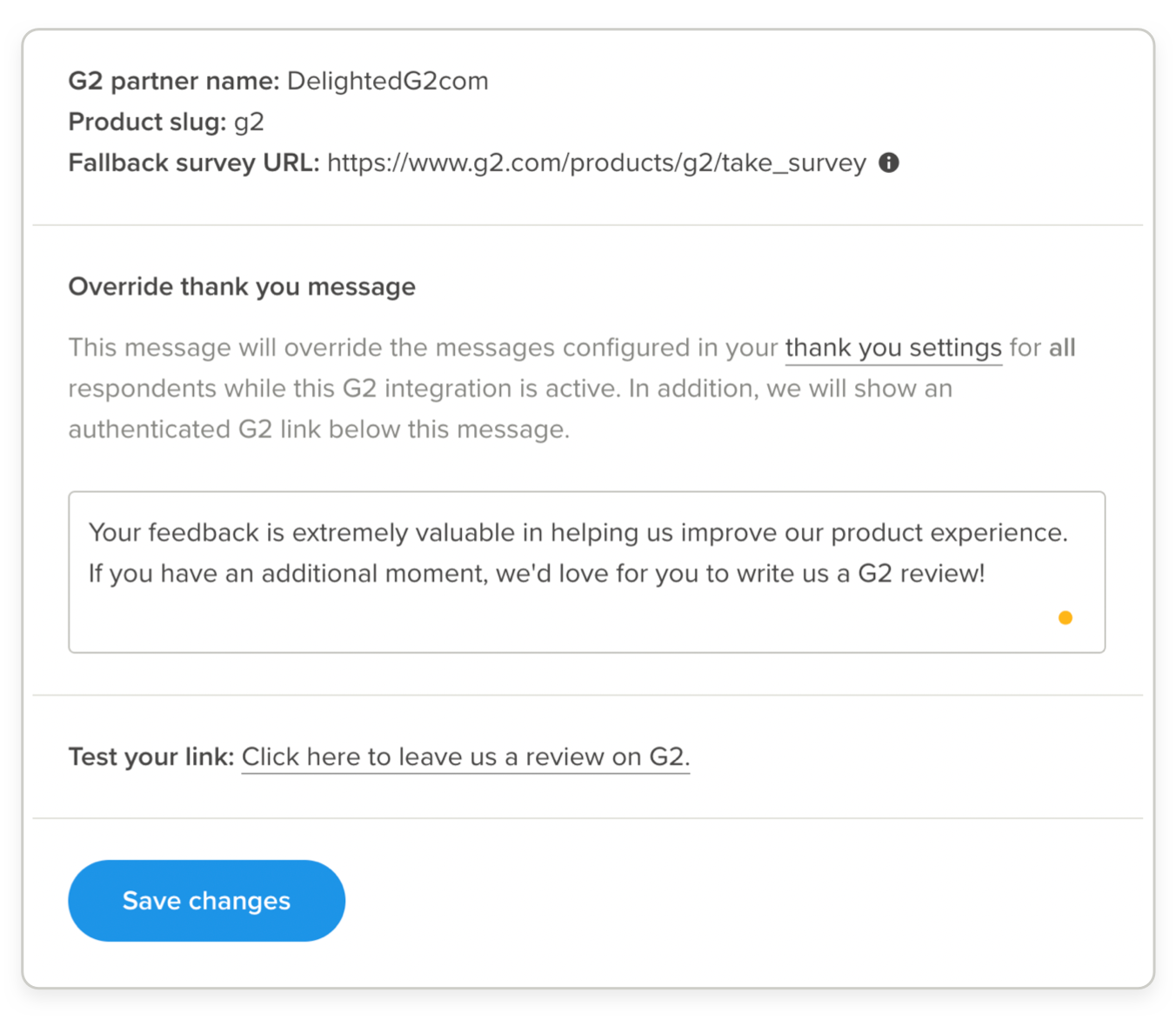
Your Delighted account admins can then enter the G2 API token, G2 partner name, and G2 product slug into Delighted on the dashboard under “Integrations.”
Customize the message asking customers for a review where they would otherwise find a typical “Thank you” message.
And with that, your integration is ready to test and push live! Your G2 review page will be easily accessible for a completely frictionless review experience.
Use the G2 integration to your advantage with the following tips and get the most out of your review automation.
Time your survey sends. Timing is everything, so make sure your Delighted surveys are optimized for high response rates to increase reviews as well. Each time the user completes a survey, they’ll be prompted with a review request for a seamless feedback loop while the customer is in the feedback mindset.
Consider shortening your Delighted survey. If your primary goal is to increase G2 reviews via Delighted, opt for skipping the comment prompt or additional follow-up questions so your customers can get to the review form as quickly as possible.
Set up a G2 token for each product. Request reviews on specific products you have available using a G2 API token for each product you’d like customers to review. That way, you can oversee reviews based on specified products with the appropriate feedback.
Use G2 custom questions for specific feedback. Looking for feedback on specific products? Use custom questions in the G2 platform to gather data outside of the standard G2 review form.
With these tips, you’ll have reviews waiting for you on the G2 website in no time.
Measure your success with reviews and feedback
With the G2 integration, you’re able to give customers the opportunity to leave reviews easily and watch your brand reputation grow using Delighted’s experience management software. Not only does Delighted offer a variety of survey templates and easy dashboard reporting, we also help businesses:
Put customer experience at the forefront by enabling them to act on feedback
Post contribution by Caleb Elston, Co-founder of Delighted.
Startups are entering a new economic reality where funding rounds are more challenging to secure and consumer spending is rocked by the continued crises of the war in Ukraine, domestic inflation, and a pandemic now well into its third year. More than ever, startups need to pay attention to the amount of investment capital they are spending, and how they prioritize their operating cash.
In an April 2022 study, we asked 251 US-based startup founders and CEOs about their top concerns and priorities for the next 6 months. The data from the startup survey offers a window into the current market landscape:
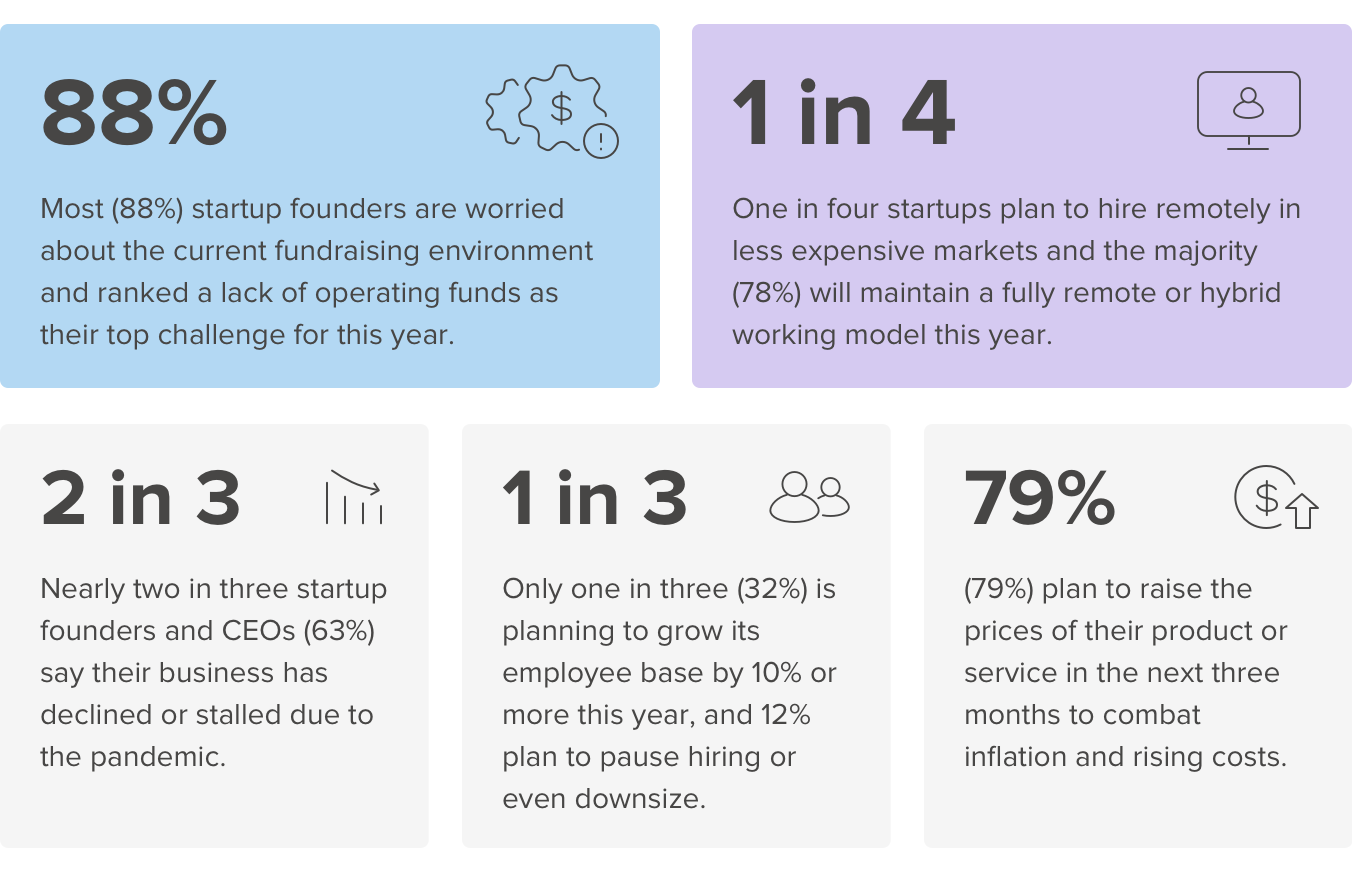
Most (88%) startup founders are worried about the current fundraising environment and ranked a lack of operating funds as their top challenge for this year
1 in 4 startups plan to hire remotely in less expensive markets and the majority (78%) will maintain a fully remote or hybrid working model this year.
Nearly 2 in 3 startup founders and CEOs (63%) say their business has declined or stalled due to the pandemic.
Only one in three (32%) is planning to grow its employee base by 10% or more this year, and 12% plan to pause hiring or even downsize.
79% plan to raise the prices of their product or service in the next three months to combat inflation and rising costs.
For a sector focused on explosive growth and facing numerous headwinds, one might expect customer acquisition, securing funding, or hiring new talent to rank at the top of any founder’s priority list. The research shows that startup founders are instead prioritizing strengthening their core business and delivering customer experiences built to last.
Customer experience is core to startup survival and success
Startup founders and CEOs said their top priorities for the next 6 months were improving their customer experience and investing in their technology infrastructure, above customer acquisition, securing funding, and acquiring talent.
The data shows there is clear room for improvement on this front. While 9 out of 10 startup founders say they collect customer feedback in some capacity, nearly a quarter of respondents (23%) said they only know moderately well what their customers expect from their brand, products or service.
Startups that reviewed customer experience data weekly or monthly were more likely to say they had a very good understanding of what their customers expect compared to those that only reviewed customer data quarterly or annually. So why aren’t all startups doing more with their customer experience data?
Top customer experience challenges startups face
The new research shows that 20% of startups do not have a dedicated Customer Experience (or Customer Service/Customer Care) team or even a single employee dedicated to customer experience, even though nearly 60% of founders have been asked about their Net Promoter Scores in an investor meeting.
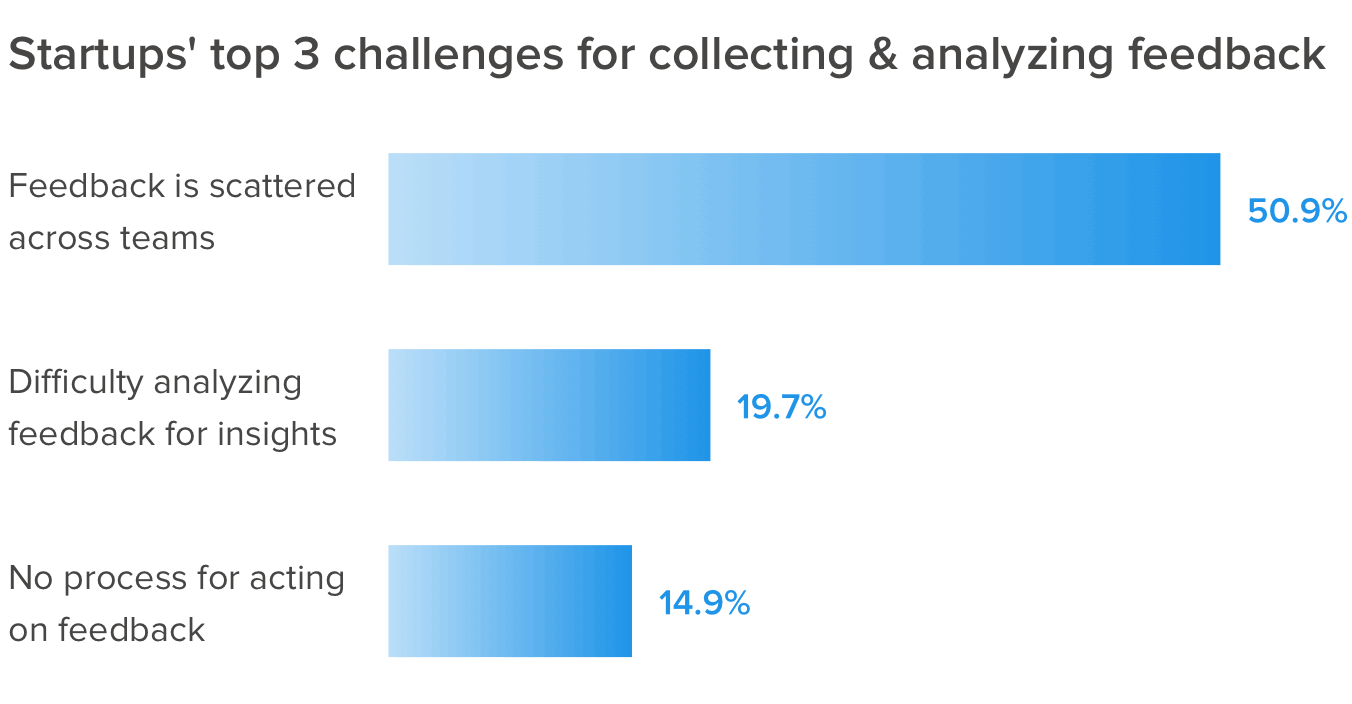
A quarter of all startups do not currently track how much effort a customer has to put in to get an issue resolved, a request fulfilled, a product returned/purchased or a question answered via a customer effort score. The data uncovers a few common issues that most startups face. Founders said their top three challenges for collecting or analyzing customer feedback were:
(50.9%) Their customer feedback is scattered across teams and kept in multiple formats
(19.7%) They don’t have the ability to uncover insights or signals from the collected data
(14.9) They don’t have a process in place for closing the loop on feedback
Founders and startup CEOs also indicated that a variety of teams own their customer experience program, from customer service to product and marketing teams to C-level executives. However, nearly half (43%) of all startups said their C-suite reviews customer experience data and 1 in 10 said their investors do as well.
Startups need fast, intuitive, and inexpensive tools to help them better understand their customers and their product/market fit
Startups face numerous challenges that are pivotal to success or failure: customer loyalty, employee engagement, product/market fit, and more. The failure rate across all new US business ventures within their first 5 years is over 50% according to the Bureau of Labor Statistics.
Many startups find out too late that there is little or no market for their products, and in times of uncertainty, closing the gap between customer expectations and the reality of your product or service can be the difference between success and failure.
The number one way for a startup to succeed is to build a product customers love
Many startups are evaluating the customer experience piecemeal, and lack the tooling or resources to take stock of the feedback they have for holistic experience improvement.
Delighted is one of the fastest and easiest ways to collect and act on customer feedback. Startups worldwide use Delighted to stand up multichannel NPS, Product/Market Fit, and CSAT feedback programs in minutes. Delighted AI automates every aspect of the customer feedback process, from optimizing survey deliverability and response rates, to analysis and reporting, so that companies can focus on closing feedback loops faster than ever. Get the results of the full study with our recommendations on how startups can achieve longevity.
The study found the primary reason startups did not collect customer feedback was a lack of resources. However, all early stage startups are eligible for the Delighted startups program that helps them easily launch a customer experience management program on a budget.
In addition, Delighted collaborations with leading venture capital firms and startup accelerators, including Halo Incubator, Greylock, Kleiner Perkins, Sequoia and Y Combinator provide companies in these portfolios with free credits to the Delighted platform and white glove support from Delighted’s support team that has guided thousands of startups and nearly 100 tech unicorns in their experience management programs.
The research is clear – amidst inflation and spending cuts, startups are trying to find and KEEP customers. Delighted provides the fastest and easiest way for startups of any size to gather actionable customer, product, and employee feedback.
About Caleb Elston
Caleb Elston is a co-founder of Delighted, the fastest and easiest way to gather actionable feedback from customers. Prior to starting Delighted, he led the team that created Mosaic. Elston also founded Yobongo, which was acquired in 2011, and was the former Vice President of Products for Justin.tv.
As a survey creator, you need to know what your customers or employees are thinking – and you want insights that you can take action on. But, what would happen if you asked certain questions that lead survey respondents to answer in a favorable way – also known as leading questions – without even knowing it?
The answer? Asking leading questions can do far more harm than good for your survey program.
In fact, asking them in your feedback surveys might not only return unhelpful responses, but could also produce misleading or untrue results. Results that, should you take action on, could lead to some detrimental business outcomes.
As such, we’ve taken a closer look at what leading questions are, a few examples of different types, the difference between leading and loaded questions, and share why you should avoid leading questions altogether to achieve improved versions of your surveys.
What are leading questions?
Leading questions are survey questions that encourage or guide the respondent towards a desired answer. They are often framed in a particular way to elicit responses that confirm preconceived notions, and are favorable to the surveyor – even though this may ultimately sway or tamper with the survey data.
Sometimes, leading questions are used intentionally to persuade the respondent to answer in a certain way, e.g., choosing between two products or services, instead of having the option to not choose something at all.
Other times, leading questions are included in surveys by accident. But, by making small tweaks to the framework of your questions, you can ask effective survey questions without compromising the trust of your intended audience (or the integrity of your data).
Types of leading questions with examples
Now that we’ve covered what leading questions are, let’s look at some types – and examples – so they’re easier to identify (and avoid) when you’re crafting future surveys.
1. Assumption-based leading questions
Assumption-based leading questions assume something about the respondents. These types of questions are often seen in surveys meant to evaluate perceptions of a product, service, or experience – whether through customer feedback surveys, website evaluation surveys, employee experience surveys, or other survey types.
Assumptions, however, should be avoided in surveys as they lead respondents to answer in preconceived ways only, and leave no room for them to express their true thoughts or opinions.
Here are a couple of examples:
How excellent is your new purchase? (Here, it’s assumed the respondent enjoys their purchase.)
How exciting was our online event for you? (Here, it’s assumed the respondent considered the event exciting.)
TIP: To avoid biased questions, make sure to include a range of appropriate options – including neutral or “other” options – for respondents to select from.
2. Coercive leading questions
Meanwhile, a coercive question forces respondents to answer in only one way, typically in the affirmative.
Here are a couple of examples:
You’re planning to remain working for this company, correct?
Our customer service team responded adequately to your needs, didn’t they?
3. Direct-implication leading questions
A direct-implication leading question sets the respondent up for future behavior (even if they weren’t yet thinking that way).
Here are a couple of examples:
If you enjoy working at this company, will you recommend it to your family or friends?
Your purchase means a lot to us. Will you recommend it to others?
4. Leading question with interconnected statements
This final type of leading question confuses the respondent by making a statement and then asking a follow-up question.
Here are a couple of examples:
Most of your colleagues want to return to the office. Do you?
Our customers rave about this product. Can’t you see why?
Much like a double-barreled question – another type of question to avoid in your surveys – interconnected statements reduce the clarity of your question, and in turn, muddy the responses you’ll get.
What’s the difference between leading and loaded questions?
You’ll oftentimes hear the term “loaded questions” alongside “leading questions” when discovering questions to avoid, so it’s important to understand the difference.
While leading questions guide respondents to a specific answer, loaded questions can be considered trick questions because they assume something about the respondent within the question itself. Oftentimes, in a feedback survey, the response (whether the respondent agrees or disagrees) will be favorable to the company.
Here are a couple of examples of loaded questions:
Where do you enjoy shopping? (Here, it’s assumed the respondent enjoys shopping, even if they do not.)
How does this company make you feel like you belong? (Here, it’s assumed the respondent feels a sense of belonging, whereas they may not.)
Why you should avoid leading questions in your surveys
If you want to maintain the integrity of your survey responses, leading questions – and loaded questions, for that matter – should be avoided at all costs. Here are a few reasons why:
1. You might not learn anything new
If you’re surveying your customers, you want to know what they’re thinking about your website, product, service, or something else related to your business. These insights can help you determine whether you’re reaching the right audience, attract and retain customers, and improve the way you do business.
But if you’re asking leading questions in your customer satisfaction surveys, you might not learn anything new about your business. Why? Because you’re guiding customers to answer questions in a predetermined way, providing you with the same responses you might have written yourself!
And even if you had the best intentions, and were unaware the questions you were asking were leading, you’ll, unfortunately, have wasted your – and your customers’ – time with a survey that returns no new or actionable insights.
2. You might gather false information
What might be worse than not learning anything new from customer feedback is gleaning false feedback. This false information could lead you to misunderstand your customer or employee experience, as well as how you’re product or service is perceived in the market, and lead to business decisions that hurt your organization instead of improving it.
REMINDER: This is why including neutral response options in your surveys is crucial!
3. You might not be able to use the data
By nature, leading questions lead survey respondents to intended – and often favorable – results, evade neutrality, and may result in prompting respondents to provide answers that are unreliable. They also introduce unwanted survey bias in your data, and could render your research unusable.
Creating surveys that return insightful, actionable data should be an easy lift, but sometimes, unwanted bias caused by the way questions are asked can happen. By thoughtfully avoiding leading questions, and asking questions to evade biases in general, you’ll gather more useful data that will help you drive better experiences for your customers and employees – and better outcomes for your business.
Start gathering feedback to understand your customers and employees with Delighted’s free online survey maker.
When your customers have questions, where do they turn? If they turn directly to your support team, then you’re missing out on an opportunity to ease customer pain and save your team time through customer self-service.
In this article, we’ll cover what customer self-service is, why you should focus on self-service offerings, and tips for creating a successful self-serve solution within your organization.
What is customer self-service?
Customer-self service refers to the myriad of solutions that you can present to your customers to answer their own questions as they use your product. Examples of this include a knowledge base or help center, tooltips in your platform, an interactive FAQ chatbot, how-to video content, and more.
The goal of customer self-service solutions is to help customers find answers to their questions without having to reach out to your support team or another service representative.
At Delighted, we’ve been working to improve the customer experience by offering robust self-service solutions for years, primarily through our Help Center and blog.
Why is customer self-service important?
From our research and first-hand experience at Delighted, we’ve found that providing customers with the resources to answer their own questions can save your team valuable time while boosting the overall customer experience.
Customers prefer self-service solutions
First and foremost, offering your customer self-serve solutions is a good idea simply because, well, they prefer it.
In studies conducted by Nuance and Coleman Parkes, 67% of customers said they preferred a self-service solution over speaking to a company representative, and 91% of respondents said they would use an online knowledge base if it were available and tailored to their needs.
We’ve seen this with our own customers as well. Take this feedback we received about our Delighted Core Certification course, an on-demand video series and exam designed to teach our customers everything they need to know when running their Delighted experience management program:
“It’s so empowering as a user to land a platform where you can get certified, find answers to your questions, and use a product without ever having to email for help.”
Self-service solutions save time
Allowing customers to find answers to their questions themselves saves time on both ends: for them, and for your customer support team.
Self-service solutions are often faster than emailing or calling into a customer support team. In fact, a study by Jitbit found that the average response time to customer support tickets is over 7 hours, and the average resolution time is about 3 ½ days.
Even the fastest customer service representatives are slower than not having to submit a ticket at all.
Investing in self-service solutions is more cost-effective
From a cost perspective, it is easier and cheaper to scale your organization when you don’t need to maintain a large support team.
After a revamp of the Delighted Help Center in early 2020, we saw customer support volume consistently decrease, even as our customer base increased!
Resulting from the Help Center improvements, we were able to allocate the team’s resources elsewhere due to the reduced customer inquiries – mainly, our team members were able to get hyper-focused on verbatim customer feedback and project plan for scaling product enhancements.
5 tips for a successful customer self-service solution
Now that you understand how important it is to offer a robust self-service solution to your customers, let’s dive into the 5 tips for creating a long-lasting and successful one.
1. Make your resources easy to find and navigate
A knowledge base or help center is perhaps the most basic form of customer self-service. But for this resource to be useful, customers have to be able to find what they’re looking for!
Searchability allows customers to find articles that answer their questions, while a clear and logical organizational structure allows them to discover new, related features that they may not have been familiar with.
Also, make sure the link to your help center is easily accessible from every part of your platform.
2. Cater to different learning styles
While step-by-step instructions are vital for teaching customers how to perform certain tasks, not everyone learns best by reading bulleted lists. When possible, use screenshots and gifs to demonstrate what you’re teaching visually as well. CloudApp is a great option for capturing these.
To level up, increase your cursor size when recording your screen. See how much easier it is to spot where the cursor is in the screenshot on the right below than it is on the left!
Videos are also a great way to relay a lot of information in a quick, easy-to-digest way. And, including captions or video transcripts for these resources ensures that they can be helpful for all types of learners.
3. Keep content up-to-date
It goes without saying, but if changes are made to your platform, your resources should be updated accordingly. To make this process easier:
Keep articles short, sweet, and to the point. Avoiding excess fluff makes the answers easier to find for customers and the content easier to update for your team.
Avoid duplicate information across articles. Instead of copying information from one article to another, redirect users to the original resource! That way, updates only need to be made in one spot.
Create a style guide. Decisions about the look and feel of your help center shouldn’t have to be made every time a new article is created or an edit is made. Having a style guide means your content is consistent and updates can be made quickly.
Make help center updates a regular part of the product release cycle. Before going live with your product update, the team responsible for updating the knowledge base should be made aware of all changes and given time to create new or updated content.
The Delighted team strives for a 25% content refresh rate, meaning that at least a quarter of the help center is updated every three months. This includes updates when product changes occur, as well as regular improvements to articles.
4. Let your customers tell you what to include
What should you include in your customer self-service resources? Look no further than the questions your customers are currently asking you.
The most common topics you receive inbound support volume about are no-brainers to add to your help center, either under an FAQs section or on their own pages.
You can also dig into failed search terms in your help center. What terms are customers searching for that aren’t currently covered?
Lastly, you can ask your customers directly via a Thumbs up/down survey and ask them questions such as “Was this article helpful?” or “What other information are you looking for?” to pinpoint which answers and topics should be highlighted in your resource center.
5. Teach your customers to fish
As you improve your self-serve offerings, you’ll have the opportunity to show customers how useful the resources can be. For example, when answering inbound support volume, include a link to any relevant help center articles in your response.
When you’re ready to expand, you can go a step further by creating training and certification content that gets ahead of questions customers may have.
Just as with surveying, think of critical touchpoints along the customer journey where customers may need new information, such as at sign-up or when upgrading plans. At these points, you can offer targeted training designed to preemptively educate them on what they may need to know.
Empowering for them, fewer questions for you – it’s a win-win!
How do you measure the success of your customer self-service solution?
To measure whether or not your customer self-service solution is effective, you’ll want to compare the use of your resources (like your help center) versus the use of your support team.
Here are the metrics that the Delighted team measures on a monthly basis:
Help Center views: How many users are viewing your help center site?
Support volume: How many inbound email, phone, and/or chat tickets is your support or customer service team receiving?
Content vitality: How many articles are in your help center, and what percentage of them have been updated this quarter?
Pages viewed per session: On average, how many pages are visitors seeing before leaving your site? This number should show a balance between discoverability (users are learning about multiple features when visiting) and ease of use (visitors aren’t just clicking around unable to find the article they need).
Abandon rate: What percentage of users visit the site homepage, but never actually open an article?
Self-serve ratio: What is the number of views your help center receives, divided by the number of tickets your support team receives?
Finally, you can measure your resources’ effectiveness by asking your customers what they think! Customer Effort Score (CES) surveys measure how easy it is for users to find answers to their questions, and, as mentioned previously, a simple Thumbs up/down survey is a great way to get a quick pulse on whether an article was useful to customers.
Customers prefer to find answers to their questions themselves – it’s faster and easier. It’s also cheaper for you, as it should reduce the number of support tickets you receive. More and more, customers are coming to expect these resources from the programs that they use. For all of these reasons and more, implementing and maintaining a customer self-service solution should be a core focus as your organization expands.
This article was written by Ola Ajayi, Senior Product Manager at Orium and former Product Manager at SSENSE.
Product development gives companies a way to explore new product ideas, upgrade existing products, and learn what potential customers want in the early stages of the development cycle.
Mastering each stage of product development, and perfecting them in your organization, can lead to greater development efficiency, more transparent and collaborative processes, and most importantly, a better-finished product.
What is product development?
Product development is the end-to-end process of delivering a new product or upgrading an existing product.
It is important to understand that each company is unique and in a unique industry – and although the basic product development stages are similar, it is often iterated or refined to best fit the company.
No matter what, you’re going to need to think of your product development process in terms of stages – and have a plan for how to handle each of those stages appropriately.
Stage 1: Idea generation and market need
Everything starts with your initial brainstorming and ideation.
Before a new product idea or feature is developed, product managers need to decide what to build. Validating what type of product will provide value to the user and the business is one of the critical roles of a product manager.
There are many ways to get inspiration for a new product idea. For example, you could start by looking at contemporary businesses in the market; are there business models that your product could feasibly improve? Or, is there a good market fit that your product could fill?
As you start to come up with new product ideas, make sure you consider the following:
Market need/User value: It is often said that product managers represent the users within the company. Understanding and validating user problems helps you avoid the struggle for adoption because you have built products and features to solve the problems validated from your market research. More to come on this in Stage 2.
Strategic fit: Successful product ideas get buy-in from leadership and cross-functional stakeholders once they align well with the business strategy at every level. It is important that your product ideas align with the overall business strategy, contribute to team goals, and drive company objectives forward in a meaningful way.
Business value: Solving relevant user problems provides lasting value to the business. For example, let’s say that you initiate a project that improves product delivery time in a retail company, which would ultimately improve customer satisfaction. This boost in customer satisfaction can drive better customer reviews, improve customer retention, and increase revenue.
TIP: Creating a product positioning strategy can also help your brainstorming and research process.
Stage 2: Quantify the opportunity
After Stage 1, you’ll likely have a handful of promising ideas. But before you start investing in your new product ideas or taking financial risks, it’s important to take a closer look at the concept. Is this product idea truly worth developing and how can you validate that?
These are some of the tools that can help you during this stage:
Surveys. Product/market fit (PMF) surveys are short, easy to create, and easily accessible to customers – and they can be an ideal way to learn about whether your product is a good fit for your desired target market. You can gather quantifiable data through all types of customer surveys to validate your product concept while also building the product based on a newfound understanding of customer values, perceptions, and needs.
Focus groups and interactions. You can also ask your audience directly through in-depth interviews to see if there is a problem in the market that your solution can fix. Or to validate your concept, you can ask if your customer would actually use and see value from the product.
Competition. Do competitive research to find out what competitors have as similar products already on the market and consider how your product will compete with them.
Financials and logistics. You will also need to consider financials. How much money will it take to develop and produce this product? How are you going to get it into the hands of customers?
Stage 3: Product design
After you’ve narrowed down your ideas and developed a product concept that aligns well with your overall company goals and user/market needs, you must consider the concept planning of your product – what are its core features? What other features could help it to stand out? How is it going to be distinguished from the competition? What are the key obstacles to its development?
In the design stage, you will also need to consider:
Brainstorming: The design and product teams will brainstorm different solution ideas, using the product constraints as guardrails.
Prioritization: The teams will also work together to continually prioritize and prototype solution ideas. Here, you will need to leverage your understanding of user problems, viability, and constraints to inform the product design.
Testing: Prototypes are created, tested with users, and adjusted based on feedback learnings. A prototype is the representation of a product design using fun applications like Balsamiq, Invision, or the good old sketches on paper.
Design Approval: The product manager ensures that the leadership teams are well aligned on the design prototype by conducting design reviews, updating the requirement document, and kicking off the project.
Stage 4: Product development
At this stage, the product idea has been approved and the design process has been completed.
Product development is kicked off by:
Preparation: The product manager defines milestones, and the technical lead creates the technical specification document and estimates the time and effort needed for development.
Executing: The product manager helps facilitate the discussion and provides actionable feedback that can be used to inform the next execution cycle.
Risk Management: The product manager actively takes steps and actions to manage risk and keeps the project on track.
Stage 5: Product launch
The final stage of product development is the actual product rollout. Most products will require continued refinement through improvements and iterations.
Product launch tasks typically include:
Launch Coordination: These are the tasks and activities that go into putting a final product into the hands of potential customers. For example, most product launches are staged to release complete product features to all markets over time or complete product features to more markets over time, or a combination of the two.
Product Performance: The performance of your product is evaluated after the launch, to see how the final product matches up to the goals of user value by solving the problems it was built to solve, and business value for the organization. This can be done by sending a feedback survey with any customer survey type.
Communication: The goal of communicating post-launch is to share the impact of the product launch with the stakeholders, share learnings, and improve the next steps in decision making.
Is your business undergoing changes to your product development process? Are you interested in better understanding your product/market fit (PMF) or your customers’ attitudes? Delighted has the tools you need. Use our customer experience solution to send PMF surveys or try our product survey templates to perfect your product development process with real-time feedback.
Ola is a Senior Product Manager at Orium and mentor at Product Gym. She previously worked at an e-commerce retail company, SSENSE, as a Product Manager. She started off her career in software engineering and pivoted to product management when she found out how exciting and rewarding she felt managing stakeholders and breaking down complex technical terms into relatable information.
Ola finds going through the product development life cycle – from the discovery stage to the delivery of great products while aligning with stakeholders – fulfilling.
Ola currently works and lives in Calgary, she spends her free time with family, staying healthy, and engaging in various self-care routines.
This post is presented by Casper, Friendbuy, Tremendous, and Delighted.
In this in-depth session, our very own Head of Product Management, Sean Mancillas, joins Casper’s Senior Director of Customer Marketing & CRM, James DeStefano, Friendbuy’s Head of Partnerships, Samantha Samuels, and Tremendous’ CEO, Nick Baum, to go through the nuts and bolts of building a referral program and provide best practice guidance on how you can set yours up for success.
Before we dive in, let’s go over the 3 reasons why a referral program can be such an effective growth strategy:
High margin growth vs the cost of traditional customer acquisition through a paid channel
The ability to develop a deeper understanding of your best customers by keeping them hyper-engaged
3x to 4x higher customer lifetime values and 5x faster conversion rates than other channels (Source)
In fact, Casper, a leading direct-to-consumer mattress retailer, has turned their referral program into one of their most efficient marketing channels, driving 7x greater return than their average marketing investment.
Watch the full replay, or skip below for the key takeaways.
Step 1: Identify your happiest customers
Casper has been using Delighted for three years to run their customer experience management program – sending out surveys at key customer journey milestones to capture customer sentiment, analyzing the feedback in Delighted, and acting on it in real-time.
Every single customer that converts on their ecommerce platform, as well as in one of their 70+ retail stores, gets a Delighted Net Promoter Score survey.
They use the resulting feedback in 3 ways:
1. Instant promotion of their referral program to their happiest customers
Customers who leave a positive NPS score or a positive review will be immediately presented with Casper’s referral program.
2. To isolate trends in feedback, positive and negative
Casper pipes all of their Delighted feedback data into Looker (Casper’s business intelligence tool). They also surface trends directly within the Delighted platform.
“The great thing about Delighted is they have the ability to isolate NPS scores to particular trends. We can look at all of our NPS scores for people who specifically leave comments about shipping and delivery. All of that information is extremely valuable, and we use the native Delighted platform to mine those responses.”
– James DeStefano, Casper’s Senior Director of Customer Marketing & CRM
3. To close the loop with customers in real-time
All Delighted feedback pops up in Slack in real-time – individual ratings and comments, as well as the aggregate daily NPS and rolling 30-day average. The immediate accessibility of the feedback means Casper is able to react just as fast to get ahead of any potential issues.
“In the past we’ve used NPS feedback to identify issues in certain manufacturers. If we get tons of feedback concentrated to a certain area (for example maybe our boxes are more damaged than someone would expect), we’ve been able to take that data and go back to correct some customer pain points. Having that data in realtime helps us to respond quicker than we otherwise would.”
– James DeStefano, Casper’s Senior Director of Customer Marketing & CRM
Through their use of Delighted, Casper not only identifies their happiest customers but also proactively improves their customer experience, setting the foundation for even more loyal customers.
Step 2: Choose an incentive that drives customer acquisition
Choosing the right incentive involves balancing the interests of three parties: your business, the existing customer, and the referred friend. The right incentive will help you acquire a new customer at a lower cost while making your customer feel appreciated.
Tremendous is a seamless way to distribute incentives that help you acquire new customers. You can choose to give cash deposits, gift cards, charitable donations, and pre-paid cards to vendors like Amazon, Adidas, Uber Eats, and more.
When selecting an incentive, the choices fall into two buckets: discounts on your products, or 3rd party gift cards.
So how do you know what might work best for you?
Tremendous CEO, Nick Baum, recommends incentive structures based on your business model.
When discounts work well
For consumer goods or services that customers repeatedly buy at relatively low cost, it makes the most sense to offer a discount or coupon.
For example, Uber Eats offers existing customers $10 off an order of $25. Referred customers get $20 off an order of $25 or more.
When you consider that the average Uber Eats customer spent almost $240 in Q4 2021, a new customer acquisition cost of $30 ends up being a drop in the bucket. On top of that, your new and existing customers are both encouraged to stay in the Uber Eats ecosystem.
When offering cash or gift cards works well
If your business offers higher-consideration, one-time purchase items, the instant gratification of a gift card would be much more appealing than a discount on a future purchase. In this scenario, though, a discount for the referred friend could still significantly lower the barrier to purchase.
For example, Casper’s mattresses range from $900 to $4,000. A mattress is a high-quality, high-consideration purchase that takes place only every few years.
So, instead of offering a discount to existing customers, Casper offers a $75 Amazon gift card, while referred customers receive 25% off their mattress.
Friendbuy is a complete solution that helps you scale your referral program, offering customizable referral templates for email, SMS, link and social; detailed analytics with A/B testing capabilities; and all the integrations you need to connect your referral campaigns to the rest of your tools.
Friendbuy also integrates with Delighted, so you can direct promoters to your referral page directly from the survey completion thank you page.
Best practices for building your referral program
Friendbuy distills referral success into a simple formula:
AWARENESS + ACCESSIBILITY + EASE OF USE =
IMPULSE REFERRALS
“The first ingredient is strong awareness of your program – in order for your customers to share on impulse, they’ll need to know that you actually have a referral program. The next ingredient is accessibility – it has to be really easy to get to. And then finally, it has to be super simple to use. When working together, these ingredients make a referral program successful.
Let’s say two friends are talking at a bar, your brand comes up in conversation, and one of them says, ‘Here, let me send you my referral link.’ That’s a referral happening on impulse. You want to make sure that customers can get to your referral program within 5 to 10 seconds.”
– Samantha Samuels, Head of Partnerships at Friendbuy
There are many places throughout the customer lifecycle where you can surface your referral program:
On your website as a CTA, e.g. “Get $20”
Via a dedicated email to customers with an incentive along with the personalized referral link
As a secondary CTA in your newsletters, transactional emails, new product announcements, and order and shipping confirmation emails
In a referral dashboard that your customers can see when they log into their account
Printed on an insert in the delivery box
Casper includes a referral widget on the order confirmation page of their site, so every customer who completes a purchase knows about the referral program. This placement also capitalizes on the excitement of the purchase – many customers will even share with friends once the order goes through.
Casper also triggers referral communications across multiple touchpoints. As we’ve mentioned before, Casper surfaces the referral program if someone provides a positive NPS rating, but also:
After a customer leaves a positive product review
At the top of their order confirmation page
In printed materials with product instructions
In their post-purchase email series
On top of building awareness and making their referral program as accessible as possible, Casper also focuses on A/B testing their incentive amounts and program placement.
Step 4: Maximize ROI with A/B tests
Casper is constantly A/B testing their referral program. Here are 4 examples of A/B tests, along with the winning result, to inform any tests you may want to try.
Testing the incentive
Casper ran an offer strategy test to see if a higher Friend offer of 25% off, and a lower advocate offer of $75 works better than a lower friend offer at 20% and a higher advocate offer of $100.
The winner: the higher Friend offer of 25% off with a $75 advocate offer. This version had a 26% lift in shares and a 16% lift in conversion.
Testing referral program placement
For Casper, their referral program is prominently placed in their navigation bar with a cash icon. When they removed this placement, their referral revenue significantly dropped.
It’s also in their hamburger menu, as well as on their order confirmation, order details, and shipping status pages. Although small, these placements are driving 60% of their total referral shares.
Trying product-specific referral programs
After COVID, interest in Casper’s pillow products experienced massive growth, so they decided to add a pillow referral program. Customers who refer a pillow to their friend receive a $10 gift card.
To ensure the pillow and mattress referral programs wouldn’t cannibalize, they A/B tested showing their pillow referral program on their main referral page as a secondary CTA before rolling it out. Now, they also show their refer-a-friend to a Casper mattress CTA on their pillow referral program landing page.
Testing urgency messaging with higher incentives
Finally, Casper tests limited-time “referral blowouts” with their audience, a strategy where they temporarily increase their referral incentive from a $75 Amazon gift card to a $200 gift card. They’ve seen a lot of success with that method, as their last referral blowout had a 29% lift in conversions, compared to the prior 3 months.
Conclusion
Building a successful referral program requires a deep understanding of your customers and their preferences, along with the right toolset to personalize and test an incentive structure that aligns with your audience and your business.
Jump into Delighted’s experience management platform to start collecting real-time feedback from your customers, and check out our integration partner, Friendbuy, to see how you can kickstart your referral program as well.
Though the terms sound similar, qualitative vs. quantitative research are two significantly different data collection methods. Understanding that difference can make a large impact on how you analyze the success of a product, service update, or overall company performance.
Let’s take a look at the difference between qualitative and quantitative research, when to use each (or both), and how to gather the data sets effectively.
What’s the difference between qualitative and quantitative research?
Qualitative and quantitative research are two different approaches to collecting data used to test hypotheses. Quantitative research is a numeric method of collecting data, whereas qualitative research is a non-numerical approach to data collection.
Quantitative research
Any data that can fall neatly into a numerical system or rating – number of customers, dates of purchases, revenue, Net Promoter Score (NPS), and so on – falls under the quantitative research bracket.
Quantitative data forms the what: the tangible aspects of an audience’s interest, such as sales data or customer engagement metrics.
The key benefit of quantitative data is that it is easy to analyze, as it is highly structured. Once collected, you can generate and categorize information easily with graphs, percentages, and tables – making it ideal for organizing on a dashboard.
This type of data helps you to more easily spot trends, make predictions, and see correlations. It’s easy to replicate your research, compare results, and analyze large quantities of data.
The downside of this type of data is that it’s hard to understand the motivation or reasoning – in essence, the context – behind the information you collect, making it difficult for you to confirm any theories you have based on what drives the data. Or, there might be structural bias, as you might be looking for the wrong type of data for your problem, measuring data incorrectly, or using an incorrect sampling method.
This is why qualitative research is equally as important to consider.
Qualitative research
Qualitative research usually involves studying language – words, their meaning, concepts, and opinions. It analyzes the why – what an audience thinks and why they hold a certain opinion. This data can be gathered from text, images, audio or video clips, and more.
The key benefit of qualitative data is that it helps you understand the motivations for your audience’s actions. It can explain the “what” as outlined in quantitative data, helping you to troubleshoot issues and create new ideas for research.
Qualitative data is also flexible and represents your audience’s views authentically. It’s descriptive, which helps you understand context more fully.
The downside of qualitative data – as most qualitative researchers will agree – is that it is by its very nature difficult to quantify, as it’s likely to be unstructured or semi-structured data. Qualitative data is also subjective, and relies on your audience to be truthful throughout the data collection process.
When to use qualitative vs. quantitative research and why
Both approaches can help you gain insight into your target audience group, but when is it more appropriate to use quantitative or qualitative data collection?
Use qualitative research to understand a problem, opinion, or experience
Qualitative data gives you the ability to understand the more nebulous facets of your audience’s experience and their opinion about these aspects.
Examples of when you might use qualitative research include:
Understanding why a product isn’t performing as well as you’d hoped
Finding out how to improve your retail experience
Getting insight into why a customer values you over a competitor
Collect quantitative research to test a hypothesis
Quantitative data gives you concrete results, meaning you can use it to test or confirm theories you might have about your audience’s experiences.
Examples of when you might use quantitative research include:
Testing how a change in customer experience affects your audience
Confirming a theory, such as why customers like a certain product or service
Using a combined or mixed method to get the whole picture
Using both qualitative and quantitative data will give you a more comprehensive understanding of your audience’s drives and the tangible outcomes of their attitudes and opinions.
You could use both types of data to:
Get insights from your audience (qualitative data) to create a theory and use quantitative research to test it
Identify patterns in your quantitative data, and understand why they’re occurring with qualitative information
How to gather qualitative and quantitative data
There are many ways to gather qualitative and quantitative data, no matter what sample size you’re working with in your study. The methods below include both qualitative and quantitative research methods.
Surveys
Likely the easiest way to gather qualitative or quantitative data, surveys allow you to deliver your research questions to your audience quickly and easily gather data for analysis. They can be served to participants in multiple ways – via email, in-app, on your website, and more.
Focus groups
Interviewing a select group of individuals to get their opinions on certain products or topics can give you honest insights from consumers.
Observational research
Observing how people use your business’s products and services can help you spot problems and troubleshoot them first-hand.
In-depth interviews
One-on-one discussions with individuals who could have keen insight into your business can help unveil more human insights into your company.
Case studies
Collecting stories from those who’ve used your products and services can help illuminate problems and successes.
Third-party research
Using third-party data can help you understand your business’ position when compared to others. This research is more likely to yield quantitative data.
Examples of quantitative survey questions
If you’re aiming to take action to improve your customer experience, you’ll need to ask the right questions. Depending on whether you’re looking for quantitative, qualitative data, or a combination of both, you’ll want to use different question styles.
Likert scale questions evaluate how much the survey respondent agrees with a particular statement by asking them to select a score on a numerical scale as it aligns with their sentiment.
You can then calculate the quantitative data for a chosen group of responses to produce an overall score to determine if you’re meeting or not meeting expectations (depending on what you’re measuring).
Net Promoter Score (NPS): How likely are you to recommend [brand/product/service] to a friend? Answer scale: 0 to 10
Customer Satisfaction Score (CSAT): How satisfied are you with [product/service]? Answer scale: 1 to 5, Very dissatisfied to Very satisfied
Customer Effort Score (CES): [Product feature] made it easy for me to accomplish [feature goal]. Answer scale: 1 to 5, Strongly disagree to Strongly agree
How satisfied are you with the quality of the product? Answer scale: 1 to 5, Very dissatisfied to Very satisfied
How likely are you to [repurchase/renew the contract]? Answer scale: 1 to 5, Very unlikely to Very likely
This [product/service] helps me accomplish my goals. Answer scale: 1 to 5, Strongly disagree to Strongly agree
Star rating, smileys and thumbs up/down rating
Similar to the Likert scale, a 5-point rating scale can be used with Smileys or Stars surveys. Universally recognizable and visually intuitive, it’s a simple way to get quantitative responses and sentiment data that can be tracked over time.
Thumbs up/down surveys are also an easy way to gauge your audience’s views. Innately straightforward, a two-option survey can lead to faster survey completion from your respondents and instant quantitative data collection.
Multiple choice and multiple answer questions
Giving your audience multiple options can help narrow down details on preferences, usage, quantity, frequency, and more. Though these questions contain words in the selection options, you are actually gathering objective, quantitative data that can work to support your statistical analysis.
Some question examples include:
How often do you visit our online store? [Option 1] [Option 2] [Option 3] [Option 4]
Which of our services have you used? Check all that apply: [Option 1] [Option 2] [Option 3]
Examples of qualitative survey questions
Numerical, quantitative data makes tracking, reporting, and sharing data across your organization possible. However, gathering qualitative feedback from your audience can unveil specific details about your quantitative data – why a customer gave a negative score or verbatim suggestions for how to improve – that can make a more strategic impact.
“Other” option after multiple select or multiple answer
If the respondent does not find that your provided options match their opinion, you can provide an “other” box to have them write their answer. This reduces the chance of survey bias and provides qualitative feedback on why they don’t align with the given options.
Open-ended questions and free response questions
An open-ended or free response survey question gives the respondent freedom to describe their experience or score decision in their own words. The verbatim comments provided from open-ended questions can shed light on why your quantitative data improves or decreases over time.
TIP: When using open-ended questions, it’s important to think about which research type (qualitative or quantitative) will really give you the data you’re looking for.
For example, if you simply want to learn about customer preferences, it may be best to get specific about the selection options in a multiple select question instead of an open-ended question to avoid obscure or a wide range of answers that will be difficult to quantify. That’s why instead of choosing between qualitative and quantitative research, combining quantitative (multiple choice) and qualitative (“other” option) can be beneficial.
Get started now with Delighted
As you can see, it’s not really a question of qualitative vs. quantitative data – it’s a blend of both that give you real audience insights.
Fortunately, your data collection method doesn’t have to be complicated. Delighted’s self-serve free online survey maker is equipped with quantitative and qualitative survey options to help you make the most out of your data analysis research.
Imagine a scenario: You’re tasked with setting up a customer experience (CX) program for your company, with the goal of…well, with the goal of improving customer experience. Your organization has never run a program like this before, and you’re not sure what to focus on, or what management of a program like this entails.
Or a similar scenario: Your predecessor stood up a CX program, and you’re now tasked with picking it up and managing it in their stead. The catch? They left very little documentation about how the program is being run, or what needs to be done to keep it running.
Or a third scenario: You’ve got a pretty good idea of your goals and what you want to accomplish with your CX program, but you’re a Delighted newbie. You don’t know how your program outline will translate to implementation within the platform.
Delighted’s goal has always been to make gathering customer feedback fast and easy, and this means enabling you to run your program effectively and efficiently. There’s no one more important in making this happen than the program Admin.
That’s why we’re excited to announce Delighted Admin Certification, a free learning course and exam designed to help Admin users learn everything they need to know about running their CX programs on Delighted.
BONUS: When you pass, you’ll also receive a personalized certificate and badge to show off your Admin knowledge to the world (or maybe just your LinkedIn connections).
What is covered in our Admin Certification course?
This course is designed to teach you everything you need to know to act as an Admin of your Delighted program. It builds on top of the foundational skills covered in Delighted Core Certification to take your knowledge to the next level.
Admin Certification consists of eight modules (video and written content), eight practice quizzes, and an exam. The modules walk through the key responsibilities of an Admin: user and project management, security, data analysis and reporting, and program integration and automation.
Module 1: Managing users is all about the different user types. What are the differences, and what type is best for each of your program stakeholders? How can you add, edit, and delete users in your account?
Module 2: Allocating projects covers project creation and delegation, including creating projects and sharing them with the users tasked with running them.
Module 3: Addressing security runs through all of the Delighted account security options, so you can be prepared to answer security questions from your team and safeguard your data.
Module 4: Understanding plan limits and billing is all about getting the most bang for your buck. What is included in your plan, and how can you monitor usage? How can you make changes to your plan, or adjust receipts for your finance team?
Module 5: Analyzing and segmenting feedback walks through our Dashboard analysis features, with a focus on Trends and Tags. We’ll also talk about how to interpret your results and understand if you have a good score.
Module 6: Reporting on and editing feedback covers all of the Delighted reporting options, as well as how to make any necessary adjustments to your feedback. We also cover sharing your feedback through Testimonials and exporting your data.
Module 7: Investigating people and platform metrics will help you dig into any questions about deliverability, response rates, and overall program engagement. We’ll discuss how to manage your respondents, and how to navigate the all-knowing Response History page.
Module 8: Integrating and automating Delighted is the no-technical-knowledge required introduction to connecting Delighted to external platforms. You’ll learn the automation options available, as well as how you can integrate your feedback into your current tech stack.
Quizzes after each module help you test your knowledge and ensure you’re getting all of the key takeaways. The module content is available at any time in our Help Center.
How does the Admin Certification Exam work?
The Admin Certification exam is a 50-question test administered via a Qualtrics survey. The questions come from all of the modules (you might recognize them from the quizzes, too!), and an 85% score is required to pass.
If you get that 85%, awesome! You’ll get a badge you can copy and share on social media, and we’ll also send you a custom certificate with your name to celebrate your achievement.
If you don’t pass, no worries—you can retake the test at any time. Either way, you’ll be shown what you got right and what you got wrong upon submission, because our main goal is that you’re able to learn and apply your new Delighted knowledge to your program.
Are there other levels of Certification?
Yes! Currently, we also offer Core Certification, which is a foundational course designed to teach you all of the basics of the Delighted platform. In less than two hours, you’ll be a Delighted expert! It’s useful for Standard and Admin users, and you can access it on our Help Center.
Because we’re so excited to share this course with you, we’ll send a Delighted t-shirt to the first 20 people who complete it! We’ll reach out to you once you pass to handle all of the nitty-gritty shipping details.
Before you know it, you’ll be mastering CX program management while rocking your new Delighted Admin Certification swag. Get started today!
Do you know if your employees are satisfied? If not, have you considered asking them directly?
Employee satisfaction surveys reveal how happy and engaged your employees are, as well as their intention to stay at your organization. But you can’t understand – or improve – employee satisfaction without asking your people about it.
Below, we’ve taken a closer look at what an employee satisfaction survey is, why employee satisfaction surveys matter, the type of survey(s) best suited for measuring employee satisfaction, plus 15 sample questions to help you get started creating your own surveys.
What is an employee satisfaction survey?
An employee satisfaction survey measures how satisfied employees are working at your organization.
The employee survey typically includes a list of questions that will reveal insights into the employee experience, and enable your organization to take action on employee feedback in real time.
While some organizations conduct an employee satisfaction survey just once a year, others opt for a more frequent, pulse survey approach that enables them to regularly gather data at various points along the employee lifecycle – and take more pointed action to improve those metrics at specific touchpoints.
Why do employee satisfaction surveys matter?
Not only do employee satisfaction surveys give a voice to every employee, but they also uncover actionable insights that organizations can use to design and improve the employee experience and, in turn, drive better business results.
In addition, employee satisfaction surveys:
1. Improve employee happiness
When you ask – and take action on – employee feedback, your employees feel seen, heard, and appreciated. In turn, this boosts employee morale and reinforces to your employees that you not only care about their experiences, but also value their input and plan to make changes because of it.
2. Support employee retention
Happier, satisfied, and engaged employees are more likely to stay at your organization. This positive employee sentiment supports employee retention, reduces turnover, and maintains internal expertise.
3. Save your organization money over the long term
By asking for employee feedback about job satisfaction (and thus, supporting retention), your organization will save money by not having to allocate time and resources to recruiting, hiring, and onboarding new talent.
4. Increase productivity and performance
When you take action to understand and improve employee satisfaction, your organization will see improved employee productivity and performance. Why? Employees who are satisfied and engaged with their work are motivated to go above and beyond what’s expected of them.
How to get started measuring employee satisfaction
To measure how employees feel about your company, get started with an employee Net Promoter Score (eNPS) survey. Quick to implement and easy to analyze, an eNPS survey is a simple and powerful tool to quantify employee satisfaction and help you make an organizational impact with real-time insights.
Our Delighted eNPS survey solution includes a straightforward, two-question survey: an initial “How likely are you to recommend working at [your company] to a friend or colleague?” question and an open-ended follow-up question.
Once your organization is more comfortable with surveying employees, you can gradually expand your employee feedback program in a few ways.
To start, you can customize your Delighted eNPS survey by adding up to 10 Additional Questions. These questions can be any question relating to employee satisfaction.
Not sure what to ask? When you upgrade your eNPS to include Additional Questions (a Premium Feature), you will receive a Question Guide, prescribed by Qualtrics. We’ve also included 15 sample questions you can use to fill out your survey, below.
Then, when you’re ready, grow your employee experience (EX) management program to measure employee satisfaction, engagement – and more – at all of the meaningful moments across the employee lifecycle.
15 examples of good employee satisfaction survey questions
Want to create your own employee satisfaction survey? You came to the right place. Below, we’ve rounded up 15 survey questions to help you measure employee satisfaction at your organization.
1. How would you rate your overall job satisfaction?
This question allows employees to assign a numeric score to their job satisfaction. Doing so will help you quantify how satisfied employees are at your organization – and identify experience gaps in demographics, departments, or other groups.
2. Do you trust your manager?
If an employee trusts their manager, they are more likely to handle difficult circumstances well. A trusting relationship with a manager also allows an employee to be clear about their expectations, challenges, and to be more transparent.
3. Does the company culture promote transparency and communication?
Transparency and communication lay the foundation for trustful relationships in an organization – trust being a pivotal aspect to a healthy working environment.
4. Do you have a good work-life balance in your current role?
Employees who don’t feel they have a good work-life balance are unlikely to see a long-term future with your organization. This question will help you understand their levels of engagement and intent to stay.
5. Is your work interesting?
This question reveals whether employees feel that their current role is a good fit and if they’re engaged and challenged by the work they do.
6. Is your work environment inclusive?
An inclusive work environment is a key differentiator between a positive working culture and a negative one. Inclusive organizations are more innovative, productive, and have higher retention.
7. Do you feel supported by your team members?
Feeling supported by team members relates directly to your employees’ sense of belonging and whether there’s a culture of psychological safety. This question will help uncover whether those critical components exist within your team.
8. Do you feel there are opportunities for career growth at this organization?
Employees want to feel a sense of growth in their role and that their work is offering something to them. By asking this question, you can gauge whether employees feel that there are opportunities for them to grow at your organization, or if they will need to look elsewhere to grow.
9. Are you offered opportunities to collaborate with others at work?
Collaborative work leads to better employee attitudes, and collaboration itself is increasingly important to employees as it can provide a means for socializing and foster a sense of belonging at work.
10. Do you feel empowered in your role?
Employees want to feel that they have autonomy over their work, and this question will reveal whether your employees feel that sense of empowerment. Keep in mind that the more empowered employees feel, the more engaged they’ll be and the longer they’ll stay at your company.
11. Does your manager demonstrate the company values?
Integrity is often a core part of organizational purpose. Employees prefer to work for a manager that demonstrates the company values and works with integrity.
12. Do you feel safe to contribute your ideas and opinions?
This question focuses on the concept of psychological safety at work – the notion that employees feel safe to voice thoughts, feelings, opinions, and ideas that may challenge the norm, without fear of being shamed or ostracized.
13. Does your job give you a sense of accomplishment?
Employees want to feel a sense of pride in the work they do. They also want to do meaningful work. This question will demonstrate whether your employees derive a feeling of accomplishment from the work they contribute.
14. Are your goals and objectives clear?
Clarity around roles and responsibilities helps employees feel more engaged, as well as like they’re an important part of the team. If employees express that there’s a lack of clarity, you’ll want to quickly address this with your team.
15. Do you feel your manager takes action on your feedback?
Employees need to feel that you value their opinions. One immediate way to do this is to take action on the insights you’ve gleaned from this employee satisfaction survey.
Ready to measure employee satisfaction at your organization? Start gathering feedback with Delighted eNPS surveys. Sign up today to send free surveys in minutes.