The end of the quarter – and especially the end of the year – is always a time for reflection and planning. As we approach 2023, the Delighted team is busy thinking forward: what projects do we want to tackle, what is our big focus, and what improvements do we want to make to our customer and employee experience programs?
We have a feeling you’re thinking about those things, too – so let’s think about them together!
Announcing: The Delighted Community, a forum where you’ll connect with other users and learn to make the most of your Delighted account.
What is the Delighted Community?
The Delighted Community is a dedicated Slack workspace for Delighted users. The goal is to provide a space for you to:
Learn best practices from Delighted users and experts
Network with other experience management professionals
Get ideas about how to use Delighted and structure your survey program
Be a part of our go-to group for new feature previews and beta testing
Collaborate with Delighted product team members to share feedback and influence our product roadmap
Keep in mind: the Community is not a place for support questions. We’ve got you covered with our amazing Help Center and Concierge team for questions about how Delighted works and for troubleshooting your account. Instead, this is a place for strategic questions, for program planning, and for big ideas!
How can I join the Community?
Because we’re reserving this space for Delighted users, you just need to fill out a super quick application to join. Head to our Community signup page and enter your email address, we’ll confirm that you’re a Delighted customer, and then send you a note with a link to join. You’ll be able to log in with an existing Slack account, or create a new one.
Delighted users are amazing, and we can’t wait to connect you all with each other. The Community is a space for YOU, and we can’t wait to see what you make of it!
You don’t have to secure a large budget to run a strong customer experience (CX) program. Many CX platforms have robust free plans that allow you to capture feedback from your customers or employees, analyze that feedback, and put the insights into action, without spending a dime.
Let’s take a look at the 4 ways to make the most out of a free survey program and capitalize on its infinite return on investment (ROI).
1. Apply your branding to your survey
With free survey programs, you’ll often have limited options for branding your survey. Use the levers you have available, including the 3 below, to make it clear where your survey is coming from.
Add your logo, colors, and voice
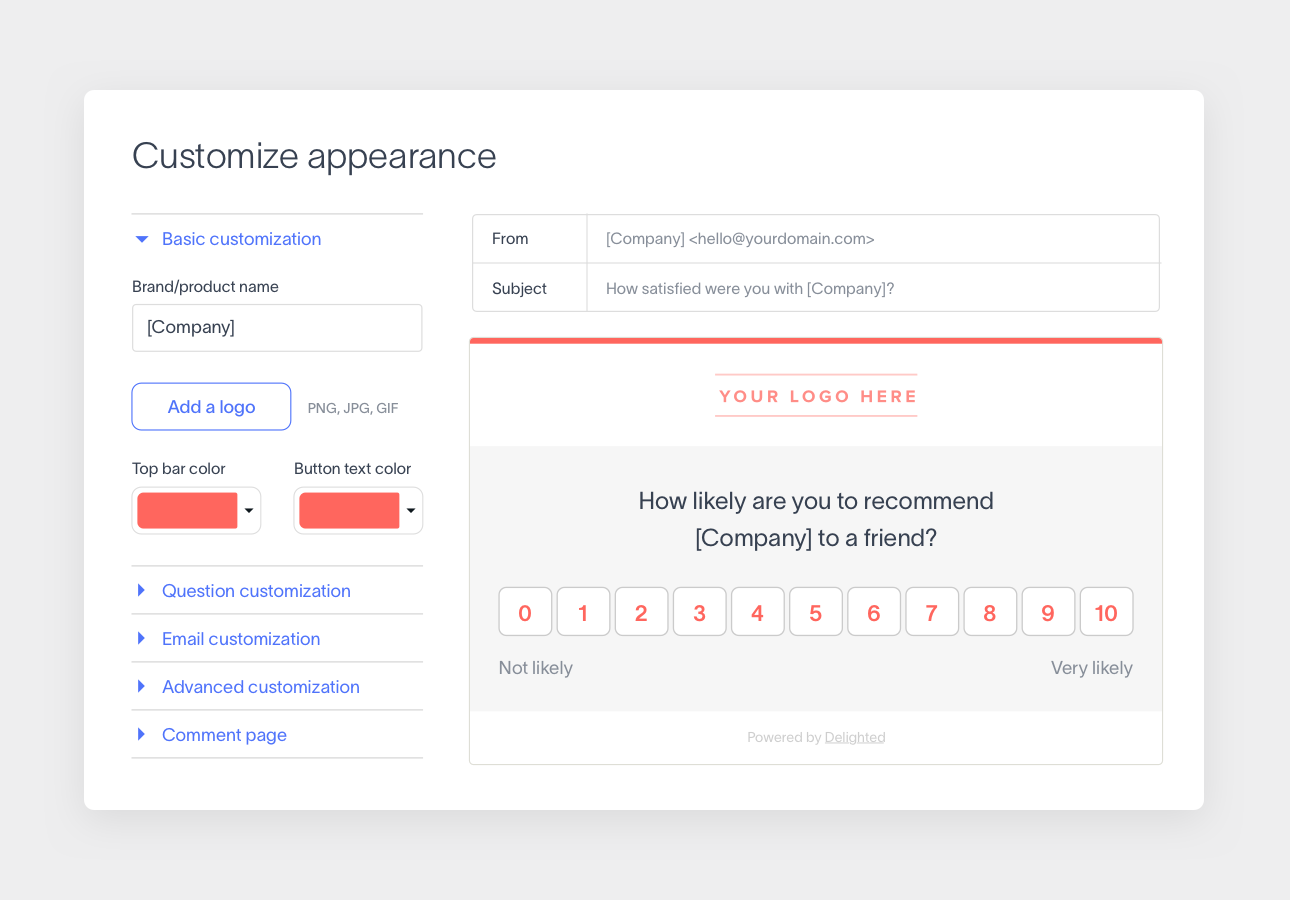
Include your logo in your survey, and choose one or two primary brand colors to add visual interest. The focus should be on making your survey question clear and easy to answer, so choose the colors from your brand kit that won’t distract from the survey itself.
When it comes time to write your questions, you’ve got a perfect chance to infuse your brand voice. You don’t have to sound overly research-y – simply try to avoid biased questions and don’t be afraid to speak the way you normally do with your customers.
Redirect respondents to your website
Once a respondent submits their survey, they will see a “Thank you!” message as the final part of the survey design. Take advantage of that Thank you page touchpoint to offer them value. You can customize the Thank you page and redirect them to a relevant page on your site, offer them a referral link, or provide your support team’s email address for easy reference in case urgent questions arise.
You can take this one step further by personalizing the message based on the score the respondent left. Maybe positive reviewers (promoters) get a referral link, negative reviewers (detractors) get the support email, and neutral reviewers (passives) head to your website.
Prime your respondents
Most free survey programs don’t allow you to send from a custom email address. If you’re sending surveys to recipients who have strict email filters, like the healthcare industry, it can be helpful to prime your respondents for the incoming survey to make sure the email is top-of-mind.
To do this, send an email letting your audience know that you’ll be sending out a survey, what email it will come from, and what you plan to do with the feedback. In fact, this can help increase response rates because respondents know you’ll be reading and responding to their feedback.
2. Involve your team
The more you share, discuss, and digest feedback with your team, the more value you’ll get from the insights. Get your team involved in your survey program to further a healthy feedback culture within your organization. Here are some simple ways to do that:
Invite users to your survey program
Key stakeholders who may want to review individual pieces of feedback, help you analyze response data, and even edit the survey itself should have direct access to your program. Invite those colleagues as users to your survey platform – the more, the merrier!
Set up Alerts to notify your team
Follow up with respondents on-the-spot by routing the feedback to the right places. You can automate email notifications to fire off to specific teams when responses come in that are relevant to them. For example, you can set up an Alert that will go to the support team when someone mentions “help,” “support,” or “customer service,” so that a support member can jump on urgent requests quickly.
Bring the feedback into your tech stack
Slack serves more than 12 million active users every day – does your team contribute to that stat? If so, expand feedback visibility to your team by integrating survey responses with team communication tools like Slack. Delighted’s Slack integration will notify Slack users whenever a response is submitted. You can assign follow-ups, brainstorm improvements, and celebrate wins, all in the Slack notification thread.
3. Power up your analysis
A common misconception is that free survey platforms don’t have powerful survey analysis features. There’s a good chance you can extract impactful insights from your data, as long as you keep a few tips in mind.
Pass as many properties as you can
You can advance your response data by grouping and segmenting feedback by customer type, purchase history, agent name, or any other detail relevant to your respondents. Are new customers more satisfied than returning customers? Are buyers happier than sellers? You can get these answers quickly when you capture details (properties) about your respondents during the survey-sending process.
Consider your score over time
Although it can be exciting to see feedback start rolling in, try not to worry about your feedback score day-to-day. Whether you’re capturing your Net Promoter Score, Customer Satisfaction Score, or another survey metric, 30 days is a great period to report on your feedback. As your program grows, you can compare the data month-over-month, quarter-over-quarter, and year-over-year to see how you’ve improved through free reporting options.
Never underestimate the power of open-ended feedback
Arguably, the most valuable parts of your feedback are the open-ended comments that respondents leave after selecting a score. This is the part of the survey where respondents explain the “why” behind their feedback rating in their own words.
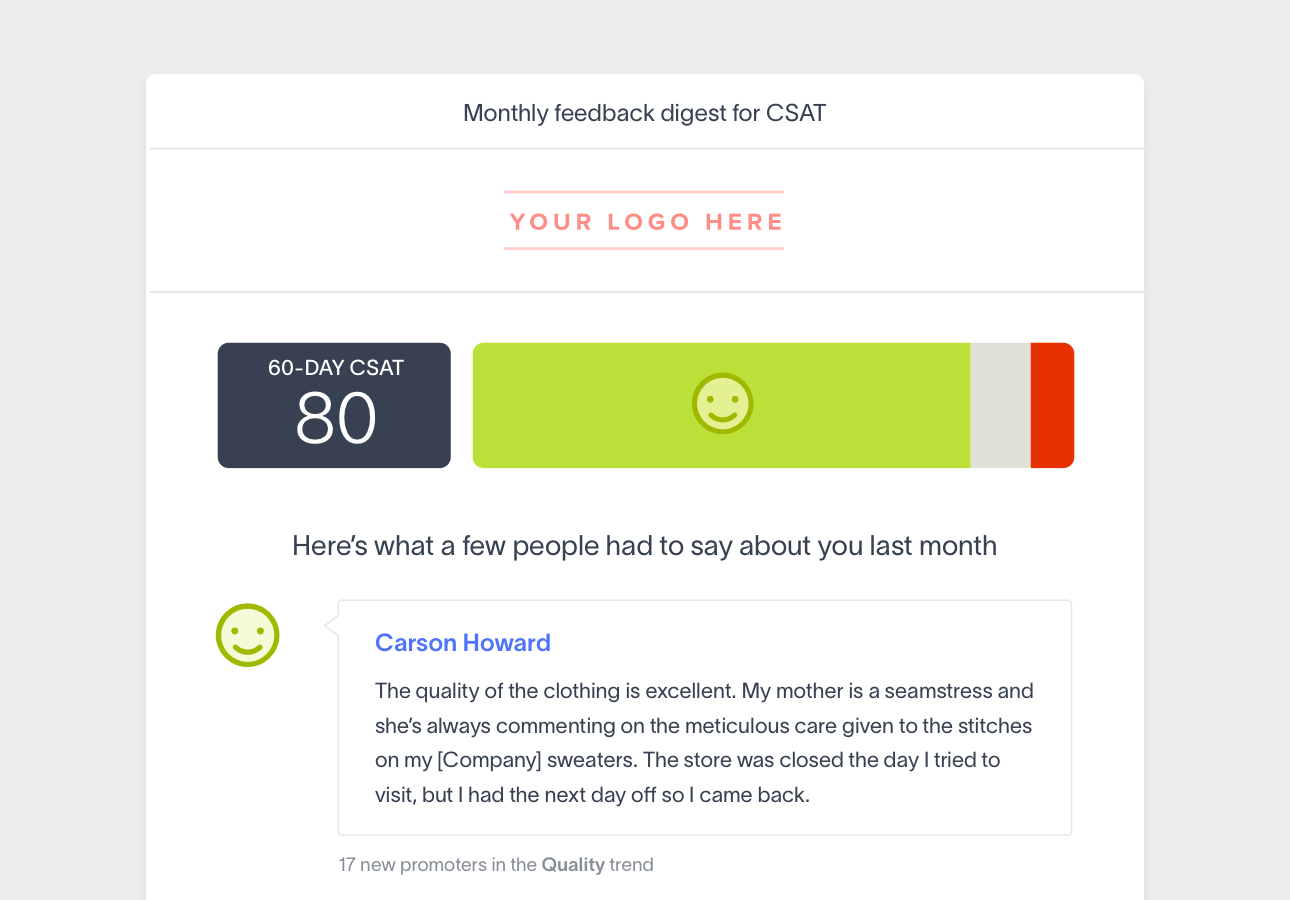
If you don’t have time to read every verbatim response, consider setting up a weekly digest. These digests will be regularly sent to your email and can include a selection of recent responses or narrowed-down response data based on selected keywords, and can help you dig into the verbatims quickly when you find an interesting trend in your numerical score.
4. Automate to trigger surveys and close the loop
Like all survey programs, you’re required to spend time setting up your survey, sending it out, and analyzing the feedback. That’s why it’s key to choose a survey platform that’s easy to use, with best practices baked in, and to automate as much as you can.
Choosing a survey platform with a powerful REST API, native integrations, and survey automation features for easy scheduling can save you time—and therefore money!
When is it time to upgrade?
If all of the above is possible with a free survey platform, when would you ever need to upgrade? Here are a few reasons to consider when switching to a paid program:
You want Additional questions
When you know you’re ready to expand your survey design and insights with more questions or run a key driver analysis, expand your survey to include up to 10 extra, customizable questions (but keep them as short as possible! Check our survey design guide for more tips.)
You’re looking for advanced reporting and analytics
AI-powered tools like Delighted’s Smart Trends reduce the amount of manpower needed to analyze feedback, freeing you up to implement the insights gained.
Employee feedback is an instrumental part of creating a feedback culture, which enables employees to understand exactly what they need to do to thrive in their role.
When done right, providing continuous employee feedback can dramatically improve employee engagement – guaranteeing improved productivity and employee success.
In this guide, we’ll take a closer look at what employee feedback is, why it’s important, and how to deliver positive, negative, or constructive feedback with examples, so that peers and managers alike will be able to give and receive feedback with confidence.
Employee feedback is information exchanged with employees regarding work performance, skills, or behavior. When facilitated correctly, delivering employee feedback (either by a manager or a peer) can boost individual performance, foster a better sense of belonging at work, and improve business outcomes.
Why is employee feedback important?
Fostering a culture of sharing feedback is a clear benefit to the companies that do – and an obvious detractor for those that do not.
Employees want feedback. In fact, 75% of employees believe feedback is valuable and critical to their work, and over a third (33.4%) of employees want more manager feedback.
It increases motivation and productivity. Companies that practice continuous feedback have employees that are 3.6 times more likely to strongly agree that it motivates them to do outstanding work.
It reduces turnover. Feedback has a positive impact on the bottom line. Companies that give continuous employee feedback can reduce their turnover by almost 15%.
However, when feedback is not delivered (or not delivered appropriately), it can be detrimental to an employee’s performance and well-being, to team morale and dynamics, and to overall customer satisfaction and business outcomes.
Let’s take a look at employee feedback examples and clarify how to give feedback to employees in a way that’s healthy and productive for your team and your company.
Types of employee feedback with examples
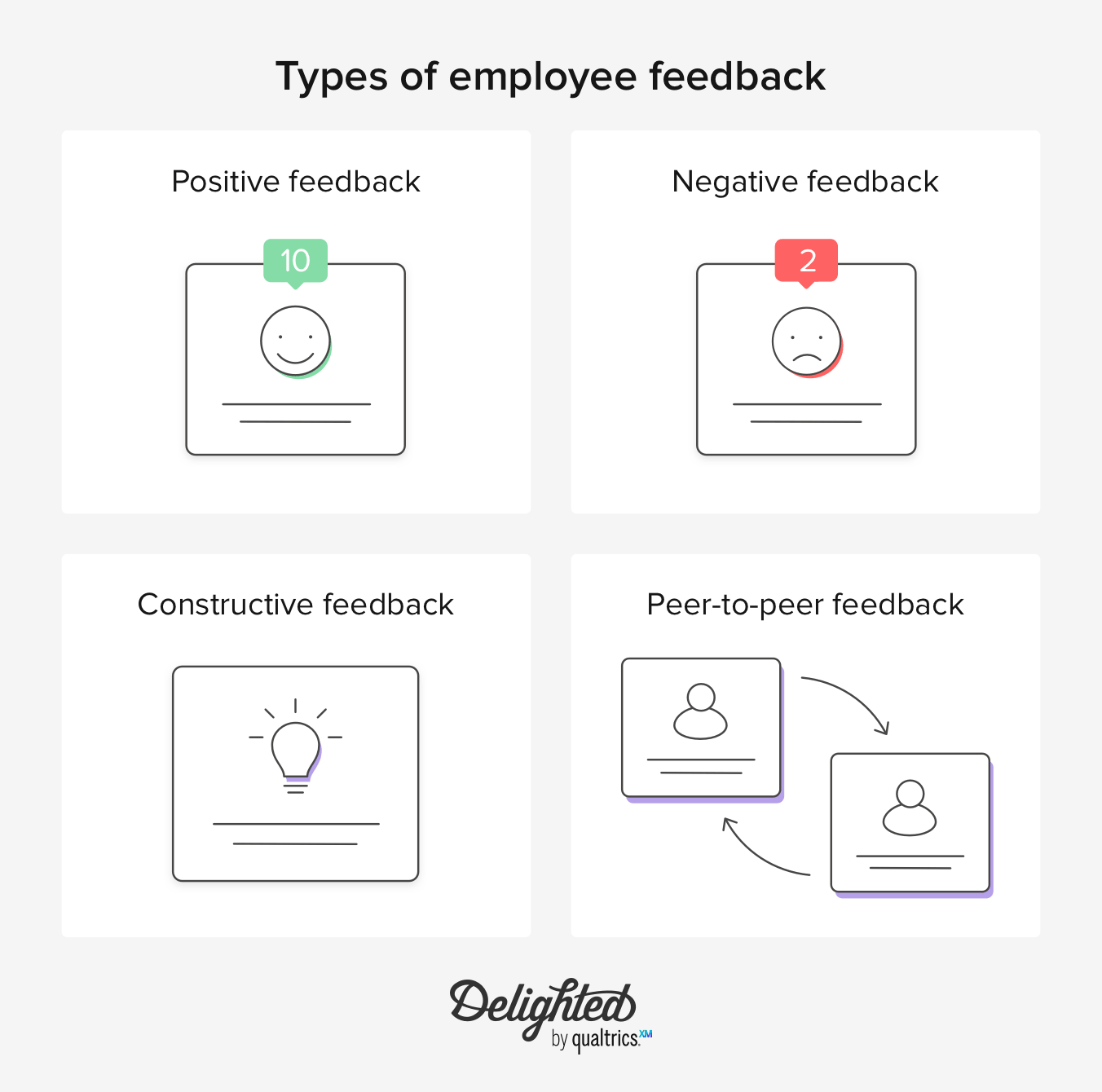
There are several ways to categorize feedback, from how it’s delivered (formal versus informal), who’s delivering it (manager to employee, or peer-to-peer), to feedback in terms of sentiment.
Positive employee feedback
Positive feedback reinforces the good work employees are doing. It celebrates their wins and accomplishments. Receiving positive feedback helps employees feel valued, and signals to them (and their team members) that their contributions are recognized. It also helps build a culture that fosters sharing positive feedback as a best practice.
Positive feedback examples
Here are some examples of positive feedback to share with your employees:
“You’ve been doing a great job and really delivered on that project. Everyone loved how you organized the deliverables and kept everyone on the ball with clear communication.”
“Great job! I appreciate that you went the extra mile on today’s presentation with the data deep dive. Thank you for doing that.”
“You have exceptional [enter skill here] skills, which have led to [outcome]. It’s a critical asset to our team’s success.”
Note that in each of these examples, the positive feedback isn’t a generic “Good job!” Whenever you give feedback, positive or otherwise, it should reinforce the specific behavior or attribute that led to the praise.
Constructive feedback
As the name suggests, constructive feedback builds upon an event to help an employee learn and grow from it. One of the best things about constructive feedback is that it can take positive or negative feedback (or a bit of both) and spin it into actionable guidance for the future.
Constructive feedback examples
Here are constructive feedback examples that you can use to improve employee performance in a meaningful way:
“You’ve been working on improving [enter skill here]. How’s that going? What support do you need in getting to the next level?”
“Your last presentation showed great improvement. Here are a few ideas I had for the next one.”
“I want to reflect on [your last deliverable]. What do you think went well, and what can be improved for next time?”
Negative feedback
Negative feedback points out when an employee has missed the mark. Although negative feedback should be addressed as soon as possible to avoid any repetition of the mistake and to allow the employee to work on improvements immediately, it’s important to keep in mind that negative feedback isn’t helpful on its own.
There’s value in giving employees feedback when things have gone wrong, but that can’t be the only way an employee receives feedback. When it is, the effects can be detrimental: more than 17% of people have left a job after receiving negative feedback.
Negative feedback examples
Here are some good feedback examples for delivering negative feedback:
“Today’s meeting didn’t go as planned. Let’s sit down and talk through what happened. What time works best for you?”
“You missed Friday’s deadline, and that hurt the team’s ability to meet our goals this week. Can we set some time aside to chat about this?”
“Your performance this quarter hasn’t been typical of what I expect from you. Let’s come up with a plan to course-correct during our next one-on-one.”
It’s important for a negative feedback session to be a discussion that both parties are prepared for. In each of the examples above, there’s an invitation to foster understanding and collaboration at a set time, so that the employee can be mentally prepared for a potentially uncomfortable conversation.
Peer-to-peer feedback
Peer-to-peer feedback is exchanged between employees. To avoid sounding demeaning or too personal, colleague feedback should give examples of when the employee’s actions have led to a positive impact on the team so the employee can feel confident repeating them. Peer feedback is important for building a team culture of trust, partnership, and growth.
Peer feedback examples
Here are a few colleague feedback examples:
“Thanks for taking initiative and managing this project!”
“Your organization skills really help the team track updates on the tasks associated with this project.”
“This launch performed very well thanks to your hard work!”
Although manager-to-employee feedback is crucial for employee development, peer-to-peer feedback is just as important in boosting morale and keeping employees motivated and engaged with one another and their work.
Still not sure how to give feedback to a colleague, positive or otherwise? Not to worry – we take a closer look at some strategies for giving and receiving employee feedback, below.
10 strategies for giving and receiving effective employee feedback
Remember that feedback is a powerful tool when done right. Even if the conversation might be a challenging one, the outcome will be worth the effort.
Here are 10 strategies for giving and receiving employee feedback depending on the feedback channel.
Strategies for giving feedback on employee performance
Once you know how to give employee feedback, you can start providing the feedback necessary to promote an ongoing cycle of feedback throughout your department or company.
1. Start by creating a formal performance review process.
These reviews, often called annual reviews, are one of the most common tools for giving employee feedback. They present an opportunity to evaluate an employee’s work against their goals and objectives set forth at the beginning of the year.
2. Use regular one-on-one meetings with employees to share both formal and informal feedback.
Creating a culture of feedback means making sure that both employees and managers receive feedback on a consistent basis. Feedback doesn’t have to be limited to performance reviews – it’s an ongoing process.
3. Share real-time feedback often, but not so frequently that the recognition loses meaning.
For example, a great time to share real-time feedback is immediately after an important presentation; speak with the employee right after the meeting to praise them for a job well done.
4. Give praise in group settings.
Team meetings, gatherings, and off-sites are great opportunities for sharing positive feedback on a specific department or employee’s contributions, so everyone’s on the same page for what constitues great work. It’s a great motivator to keep the ball rolling on what they have done well.
Have constructive or negative feedback to share? It’s probably better left for your one-on-one conversations.
5. Set up a team Slack (or other communication tool) channel to share praise and recognition.
Create a space on your communication tools to share positive feedback from customers or managers on employee performance. Not only does this improve employee advocacy, it keeps employees updated on their positive contributions so they can keep up the good work.
Delighted’s Slack integration is a great way to combine positive customer feedback and team visibility to celebrate an employee’s win.
Strategies for receiving employee feedback
In addition to delivering feedback, it’s equally important to ask for feedback on how to improve the employee experience.
The remaining 5 strategies go over how you can create a company-wide approach to asking for feedback on your own performance as a manager, and the company at large.
6. Send surveys throughout the employee lifecycle.
Utilize employee surveys at each stage of the employee lifecycle to give employees an opportunity to share critical feedback about your organization.
Some of the key points to ask for feedback are during the interview process, after employee onboarding, during career milestones, and of course, in the event that an employee decides to leave your company.
7. Capture employee satisfaction with eNPS surveys.
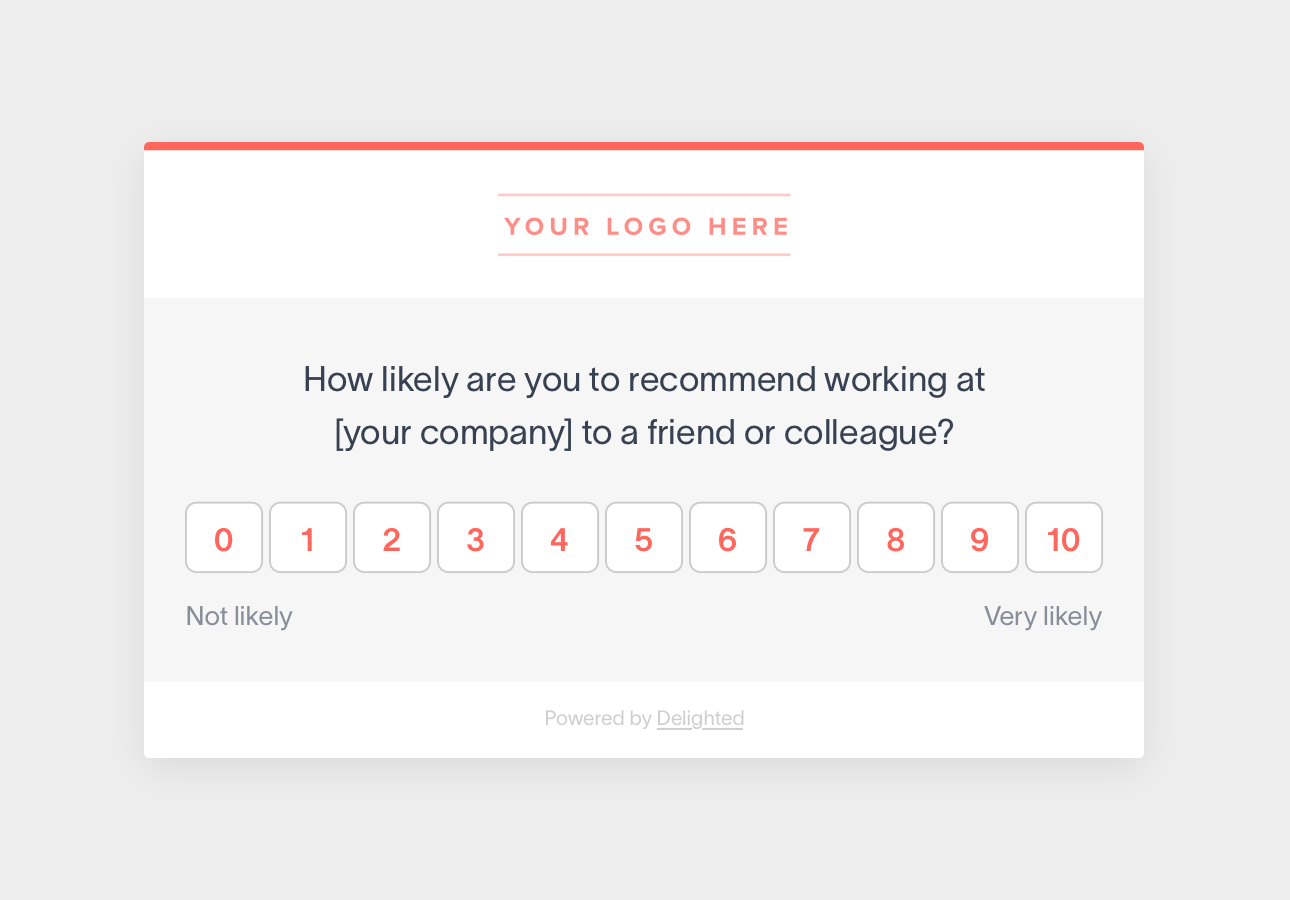
Use an employee Net Promoter Score survey, or eNPS survey, to learn how likely an employee is to refer another potential employee to your organization. This is a great signal for how happy they are at your organization, and invites employees to explain why.
8. Utilize employee pulse surveys for routine feedback.
Leverage pulse surveys to ask your employees for shorter, more frequent feedback. This type of survey is helpful for tracking the same item (such as employee sentiment or engagement) over time. Learn more about how to create an effective employee survey in our guide.
9. Prioritize two-way feedback during one-on-one meetings with direct reports.
Schedule one-on-one meetings with your direct reports to ask for feedback on specific topics on your performance as a manager, so you can understand how you can help your team member perform better.
Ask open-ended questions to encourage the conversation, and consider giving your direct report a heads up that you’d like some feedback so the feedback session can be as productive as possible.
10. Consider an enterprise solution for an employee experience program.
Once your organization has implemented some of the foundational strategies above, you may find it’s necessary to expand your employee experience management program, especially if your company has grown. Qualtrics’ Employee Experience suite of EX solutions can help systematize how you ask for employee feedback, including 360 performance feedback.
Taking action on employee feedback
While giving and receiving feedback is important for employees and managers alike, perhaps the most critical part of the equation is taking action on feedback.
Why? According to Qualtrics, asking for employee feedback without taking action on it actually results in worse engagement than if you don’t have an employee experience management program at all.
You want your employees to know that you’ve heard them and will take their feedback seriously. Taking action on feedback after your employees have volunteered their time to provide it builds trust and shows them that you value their insights.
As you’re building out your employee feedback program, be sure to also think through the resources (e.g., talent, technology, and so on) you’ll need – and the communication strategy you’ll utilize – to take action, as well.
Ready to put your knowledge of employee feedback to use? Start gathering feedback with Delighted’s experience management software and send free eNPS surveys in minutes.
Welcome to Delighted’s Q3 product recap! This quarter, we have updates all over the Delighted platform, ranging from the release of iOS Widgets to brand new ecommerce integrations. Let’s get right into it.
iOS Widgets
Delighted’s iOS Widgets offer the easiest way to view your key CX metrics on the go.
Whether reviewing your Net Promoter Score, or taking a quick glance at your post-support CSAT, it’s never been easier to stay on top of your most important customer metrics. To get started, download the Delighted iOS app via Apple’s App Store.
New ecommerce integrations
If you’re an ecommerce company, we have some updates built just for you.
We’re excited to announce that Delighted now fully supports two of the largest ecommerce platforms on the market – WooCommerce and Shopify – with both new and updated integrations.
Now listed in the Shopify App Store, you can set up your Delighted integration and start sending surveys in just a matter of minutes. We’ve also released a WooCommerce plugin that includes all the same functionality as our Shopify integration, such as triggering after order completion, delay options, backfilling, and more. If you have a WooCommerce shop, this integration is a must-have. Check out our WooCommerce plugin today!
Export options
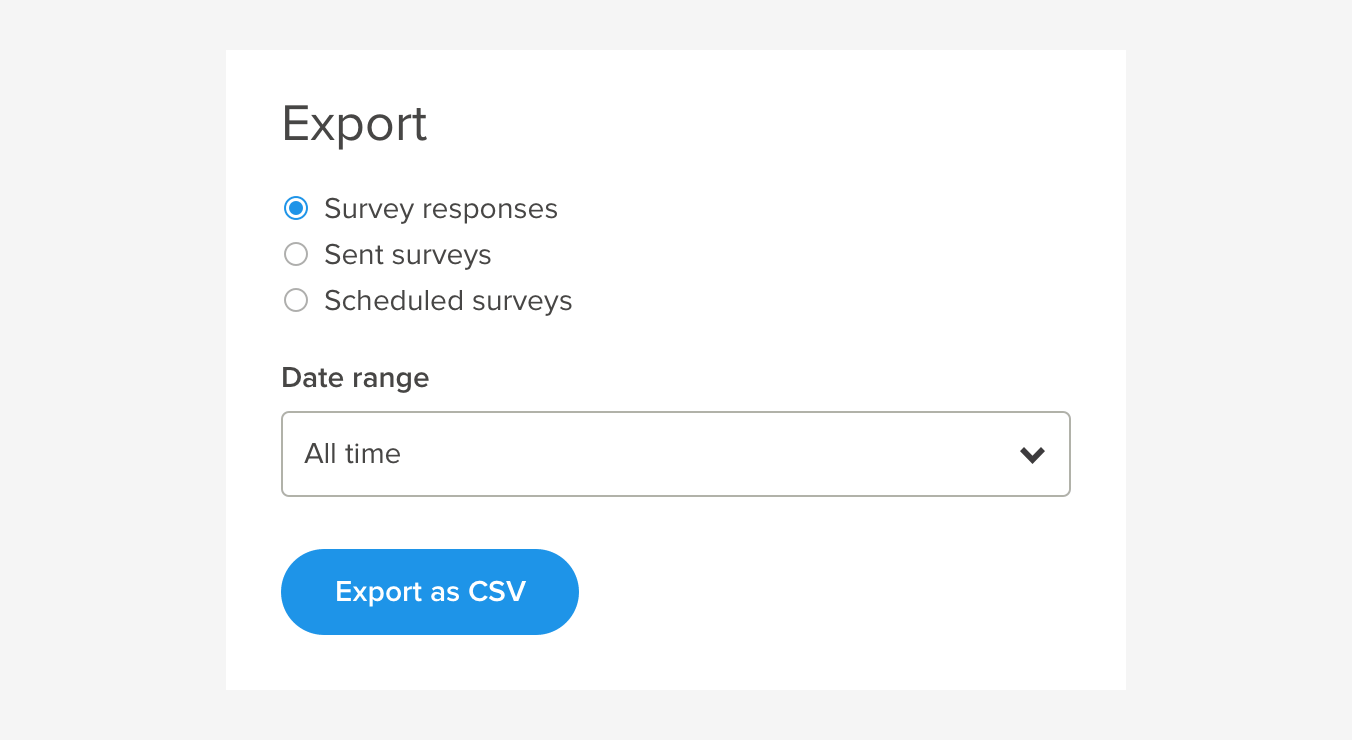
With Delighted’s new export options, you can now get even more insight into your survey performance and scheduling, including:
Survey responses: Pull a list of responses in your account – either covering all-time or for a specific time window
Sent surveys: Pull a list of everyone who has been recently surveyed, even if they haven’t responded
Scheduled surveys: Pull a list of everyone who is scheduled to be surveyed, but has not yet received their survey
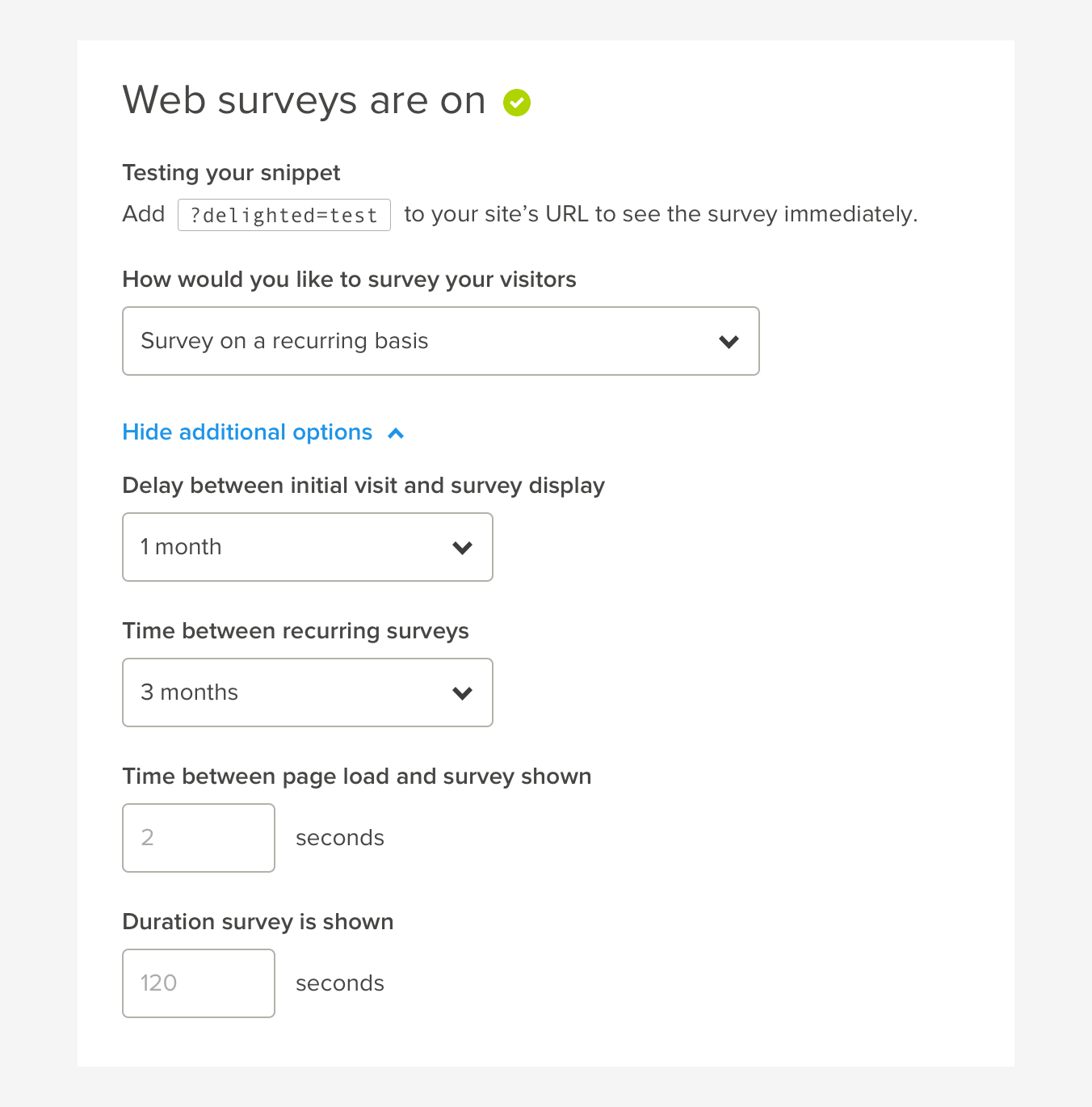
For our Web surveys, setting more advanced configurations previously required you to share Javascript docs with your engineering team and/or web developer. We have some good news – the controls are now in your hands!
Delighted has recently rolled out a series of new Web settings that make it easier than ever to adjust your Web survey with little-to-no engineering help – ranging from defining how long someone needs to be on a page before they’re surveyed, or specifying the initial delay before that first survey is displayed. Explore all those new settings in our Help Center.
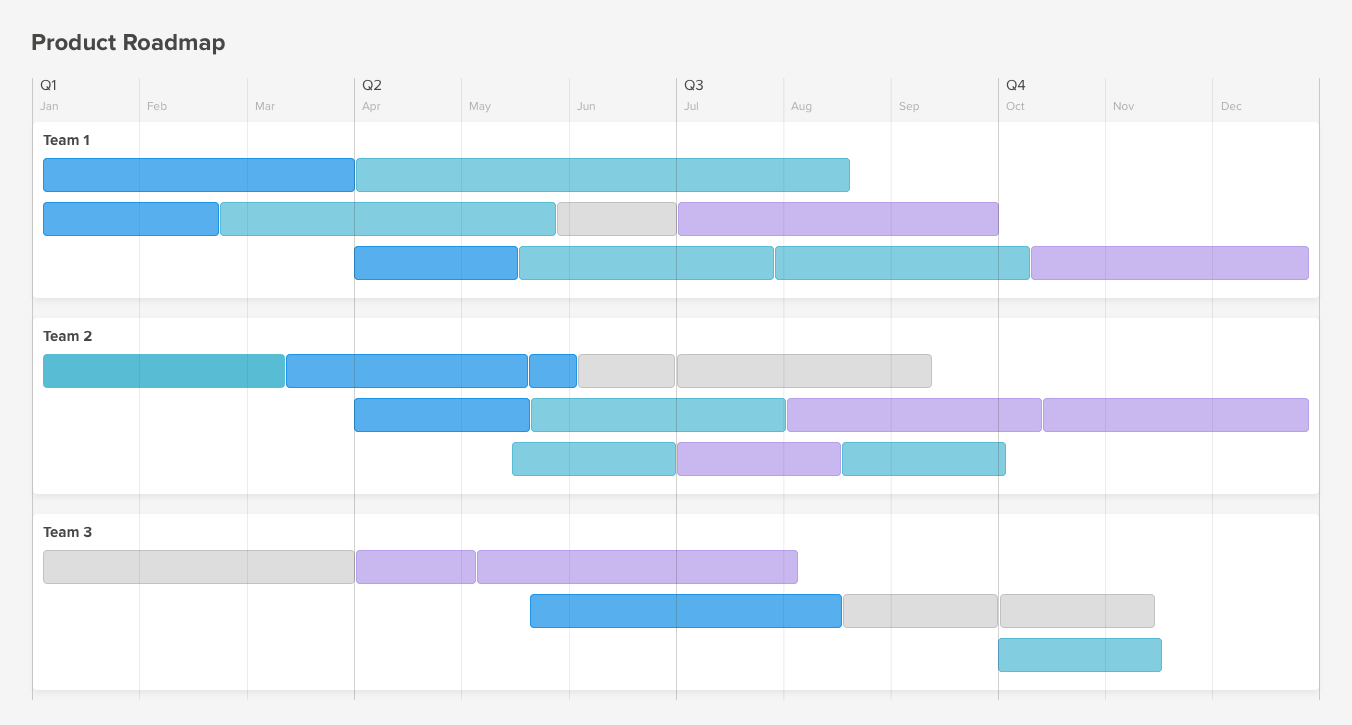
That’s it for Q3! If you’re interested in learning more about these updates, or what else we have on our roadmap, send us a note at hello@delighted.com. See you next quarter!
This article was written by Christopher Beck, Senior Product Manager at GoodRxand former Product Manager at MediaMath.
If you want to create a great product that your customers will love (and continue to buy), you first need a great product roadmap. It’s the playbook that answers how decisions should be made, which stakeholders need to be involved, and what happens next as you build your product.
Haven’t built or managed a product roadmap before? You’re in luck – this guide details everything you need to know about what a product roadmap is, why it’s important to have one, the steps you should take to build one, plus tips for designing the most effective roadmap possible.
What is a product roadmap?
A product roadmap is a tool that outlines the vision, priority, timeline, and progress of products or projects a team plans to work on over a period of time. Used as a source of truth, a roadmap also details a product team’s goals and is an action plan for how those goals will be met.
A product roadmap is an opportunity to expand visibility to stakeholders – it can detail how and when an organization is going to implement new features or launch subsequent versions of your product, as well as a product team’s specific short-term and long-term goals for achieving business objectives.
Why is a product roadmap important?
A product roadmap is your plan of action for the future of your business. Here are a few reasons why creating one is critical for success.
1. It allows you to solidify your strategy.
Creating a product roadmap allows you to rationalize why each project – and its timeline – makes sense for your business.
By completing the exercise, you’ll also gain clarity around questions like: what goal can we achieve with one project over another? Why is this goal more important than another project’s goals?
2. It enables communication and coordination.
Product roadmaps can help you demonstrate to investors that your project is worth funding.
They’re also an indispensable tool for project managers, your development team, team leaders, and other important employees in your organization who need to communicate about – and coordinate on – project goals.
3. It will help you make better decisions.
Does the upcoming roadmap justify the need for a new hire? What’s the highest priority for this week?
Consulting the product roadmap can help you gain clarity on what’s important and time-sensitive so you can make better decisions for your business.
Who is responsible for the product roadmap?
Designing a product roadmap should be a group effort (more on this topic in the tips section, below). But ultimately, the product management team – ideally, spearheaded by a product manager – is responsible for bringing stakeholders together, creating the roadmap, and maintaining it.
As the product manager, It’s important to ask yourself: “What sort of input are you looking for from other team members?”
For example, you might want to:
Ask your programmers what they think of your list of new features.
Ask your product team members if the time frames are reasonable (especially if they are working on multiple products).
Ask your marketing team if they are aligned on the launch strategy and if the timeline fits with the marketing calendar.
Getting input from these team members (and others) will also help secure early buy-in. Meanwhile, establishing who owns the roadmap will help keep your projects on time and your stakeholders on task.
How to build a product roadmap
So, how do you create a product roadmap from scratch? I’ve outlined three critical steps for getting started below.
Step 1. Gather context and information
Before you begin creating your product roadmap, you need to understand your product/market fit, or PMF. With a product/market fit survey, you can learn how your customers feel about your product and what they’d like to see from it in the future.
Subsequent customer surveys and other research tools can similarly enhance your understanding of your target audience, your competition, and other variables that will play a role in your product development.
Step 2. Outline your roadmap
After you’ve gathered and analyzed your product and customer experience data, you can start outlining your product roadmap.
Depending on your business goals and the nature of your organization, that could mean putting together a simple document with all the details or investing in more interactive visuals. I recommend considering multiple roadmap types and design tools (many product managers like using Gantt Charts to get organized), to determine which works best for your needs.
Then, bring together your team, likely from a few departments, to think about what this information might mean for your product strategy and the specific features you’ll create. Next, you’ll want to whiteboard these items, possibly across multiple sessions. From these meetings, you may find you need more information, or you may be ready to hit the ground running.
Step 3. Focus on prioritization
Now that you understand the strategy and scope of the projects you have, it’s time to prioritize.
Frameworks like the RICE Scoring Model – that is, Reach, Impact, Confidence, and Effort – help product managers avoid biases during decision-making, defend their prioritization and timeline with stakeholders, and make better business decisions with evidence.
How the RICE framework works:
To start, score each individual project across the first three dimensions. According to Intercom, the breakdown looks like this:
Reach = Number of customers/events this project will impact over a period of time
Impact = The estimated impact of the project on a customer, based on a self-determined scale (for example, a rating of 0-10)
Confidence = Your confidence, defined as a percentage, that the feature will have the Reach and Impact that you expect (It might help to determine your high, medium, and low confidence ranges on a 0-100% scale)
Then, add the scores together and divide the number by the Effort.
Effort = The total amount of time (in days, weeks, or months) that the project will require from the entire team
Each project has its own RICE score, and those with the highest score should be at the top of your prioritization list.
Best practices for creating an effective product roadmap
Not all product roadmaps are equally effective. If you want your roadmap to be more informative, more accurate, more persuasive, and/or more strategically sound, follow these tips.
1. Get input from the entire team
Designing a product roadmap should be a collaborative effort. Your product roadmap is going to influence the work of people on various internal teams, so it’s important to get input from the entire team when putting together your product vision.
2. Remain as objective as possible
There’s room for speculation and creativity when putting together a product roadmap, but for the most part, you should remain as objective as possible. Don’t just hypothesize about what your customers want – look at the numbers. Don’t trust your initial assumptions about your competition – do your research to see what they’re doing. Most of your product roadmap should be grounded in observational data.
3. Estimate timelines conservatively
It’s a good idea to estimate your timelines conservatively, even if you’re planning for an aggressive rollout. Giving yourself an extra week, or even just an extra day, can be the difference between exceeding expectations and disappointing your stakeholders. The most experienced and agile teams do this.
There are too many variables in product development to reliably predict – and all it takes is one major change, like the loss of an employee, to make all your timelines collapse.
4. Include core goals and stretch goals
Your product roadmap should have several outlined objectives, including core goals that you want to achieve no matter what, as well as stretch goals that you’d like to hit – but aren’t strictly necessary.
For example, your core goal might be to prepare to launch version 2.1 of your product by June 15. Your stretch goal could be to include an extra feature or to aim for June 12 as an optimistic launch date.
5. Make the roadmap easy to understand
You should also make an effort to make your product roadmap as easy as possible to decipher. Someone looking at the roadmap for the first time should be able to get the gist of your outline without a detailed explanation. Employ helpful visuals, minimalistic design, and/or a roadmapping tool to help you achieve this.
This approach won’t necessarily help you set or achieve your goals better, but it will make it easier to use your product roadmap as a communication tool with employees, stakeholders, and other leaders in your organization.
6. Get feedback
Don’t hesitate to get feedback for your product roadmap, especially from the people working in product development.
Ask questions like: Do they think that your timeline is too strict or too aggressive? Do they feel like the new features have been grouped efficiently? Do they have other ideas for improvement?
The answers to these questions can illuminate gaps in your processes and timelines.
7. Work specific to vague
The further into the future you plan, the vaguer your plans should become. For example, if your next release is coming in a month, you can afford to make a concrete list of coming features. But if you’re planning a version of your product five years into the future, it’s important to leave some room for modification.
8. Be prepared to make adjustments
In line with the above tip, be prepared to make adjustments to your product roadmap. Over time, you’ll learn new information, new variables will emerge, and some of your assumptions may be proven wrong. It’s important to stay flexible so you can make tweaks on the fly – and avoid getting relegated to a product backlog.
Are you ready to create your product roadmap? Start by gathering feedback with Delighted’s self-serve experience management software. Customer surveys, product/market fit surveys, and even customer effort scores can all help you better understand customer perceptions of your product.
New to Delighted? No problem. Sign up to send employee surveys in minutes.
Christopher Beck has over 4 years of experience in product management at GoodRx and MediaMath, with a background in Account Management. Christopher is also a Product Gym senior member and mentor.
Offering a highly targeted customer experience is much easier when you create buyer personas that reflect your target customers. Learn more in our best practice guide below, with tips on what to include in your buyer personas and how to use them to better your business.
A buyer persona is a fictional representation of your ideal customer. Buyer or customer personas capture traits of existing customers to serve as a blueprint for strategizing your marketing efforts. Based on market research and customer data, personas help you understand your customers’ needs and how you can meet them.
Your buyer personas can help you identify the expectations of your target markets and the key strategy to focus on to improve marketing, sales, and overall customer experience.
Whether you call them buyer, customer, or marketing personas, they all have the same objective: identifying key traits of loyal customers to help effectively target new potential customers.
Why are buyer personas important?
Buyer personas are an important part of customer journey mapping, as they help you determine how a certain type of person might travel through your customer experience touchpoints.
Without having a clear idea of who you’re creating your products, marketing, and customer experiences for, your customer journey might be less effective – making it harder to reach your goals.
Your aim is to nurture your ideal customer to a sale or a signup – and if your journey isn’t what your potential customers are expecting or looking for, chances are they’ll go elsewhere. With a fully fleshed-out marketing persona, you can answer the following questions:
What is my potential customer looking for, and what do they expect from my customer experience, products and services?
What problems are we solving for them?
What would convince this customer to buy from us?
What would make this customer choose us over our competitors?
What are the benefits of creating buyer personas?
It’s much easier to design products and create digital marketing or customer experience strategies when you have an example customer in mind.
Rather than guessing or just offering what you think will work, you’re better able to plan your approach to various customer segments and bring your marketing strategy to fruition.
There are several benefits to creating a customer persona:
More focused products and services
Your buyer personas highlight the reasons why your customers are looking for a product, and what they expect to find. Your product development will become more focused when you’ve aligned your designs to your buyer personas and the solutions they’re looking for.
More targeted marketing
If you know what your potential customers value and are seeking from your product or service, you’re successfully able to attract them with your marketing campaigns.
Your content marketing and social media outreach are easier to personalize to your customers when you’ve collated their information into a buyer persona. Rather than aiming for a generic target audience, you can customize marketing messages for specific types of customers based on their demographic and channels of choice.
Tailored customer experience
Your customers have preferences for the channels they use, the way they solve problems, and how they prefer to contact you. They also have likes and dislikes when it comes to purchasing processes, such as how they prefer to browse products or pay.
When you’ve narrowed down your customers’ preferences and created a buyer persona, you’re more easily able to create a customer experience and journey that feels tailored to individual consumers or specific business customers. Even though you’re targeting a whole segment, your single-persona approach will feel more authentic to your customer.
Better problem-solving and lead generation
With a buyer persona, your customer service teams will have a deeper understanding of your customers’ background and pain points. Their handling of issues will be backed by the information you can provide on the types of problems customers encounter, and the way customers prefer things to be resolved.
Not only that, but your sales teams will have an easier time creating leads, as they’ll know how to approach potential customer problems and offer solutions via your products and services.
What does a buyer persona include?
A great buyer persona has a lot of information about the kind of customer you’re aiming to attract with your products and services. To build out a thorough persona, you’ll need to source the following information:
Your target demographics, such as age, job title, and ability to make purchase decisions
Your customer’s location
Their goals, such as product purchase, profit, or business growth
Their top factors for choosing a provider of products and services
Providers or brands they might already buy from
Their main problems or pain points
Their basic needs, such as a product that solves a particular problem
Which channels they prefer, such as email, social media, face-to-face contact, chatbots, etc.
With this data, you can create a buyer persona that feels authentic to a real customer and their needs.
Types of buyer personas
While the types of buyer personas could be limitless, we narrowed it down to two types: B2B and B2C. B2B personas focus on the needs and wants of businesses, whereas B2C personas should focus on the types of customers you want to market to.
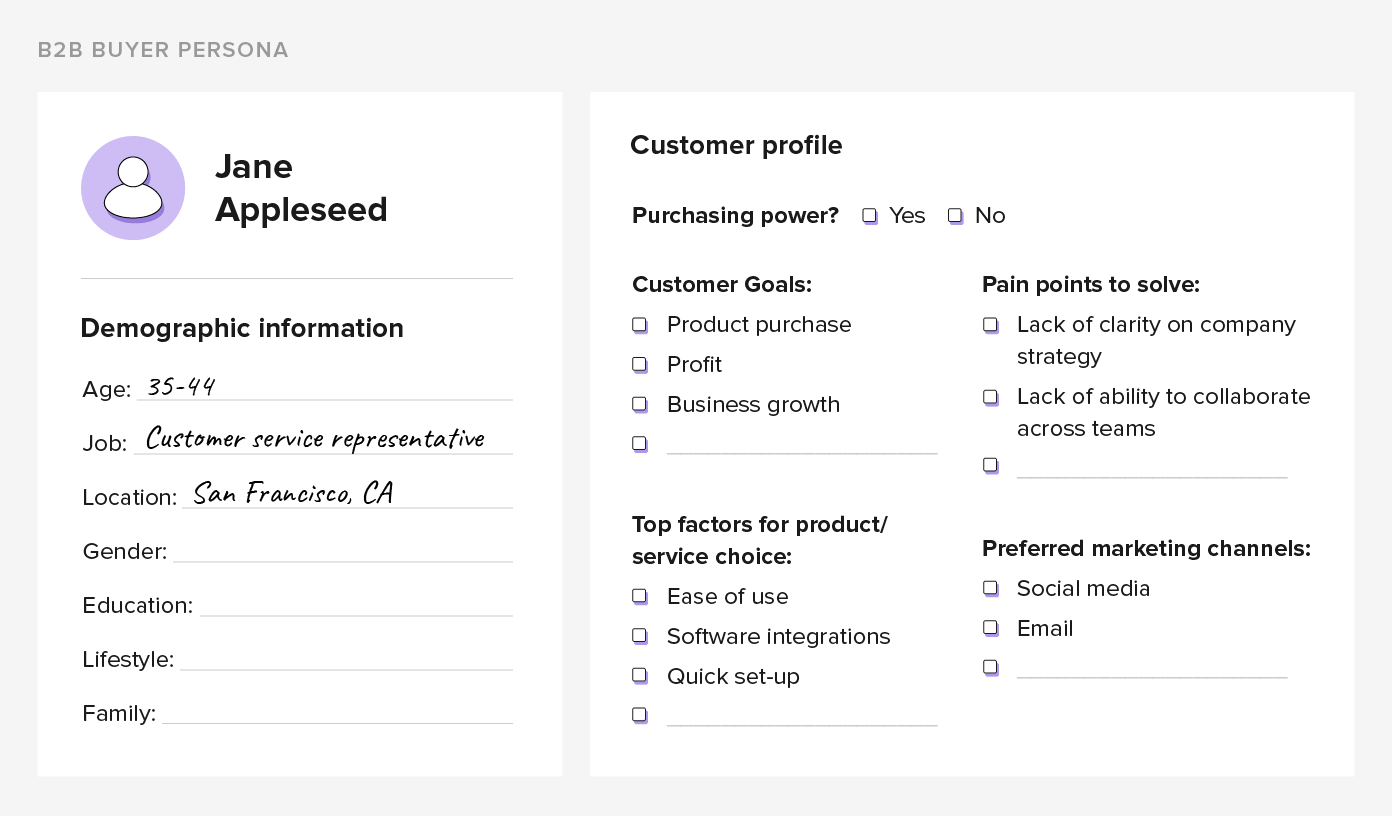
B2B buyer persona example
The example above outlines a buyer persona template for an employee at a company looking for new software. The specific goals and pain points will vary depending on the role of the persona within the company, but overall, B2B personas focus more on aspects of business strategy and how to maintain operational efficiency.
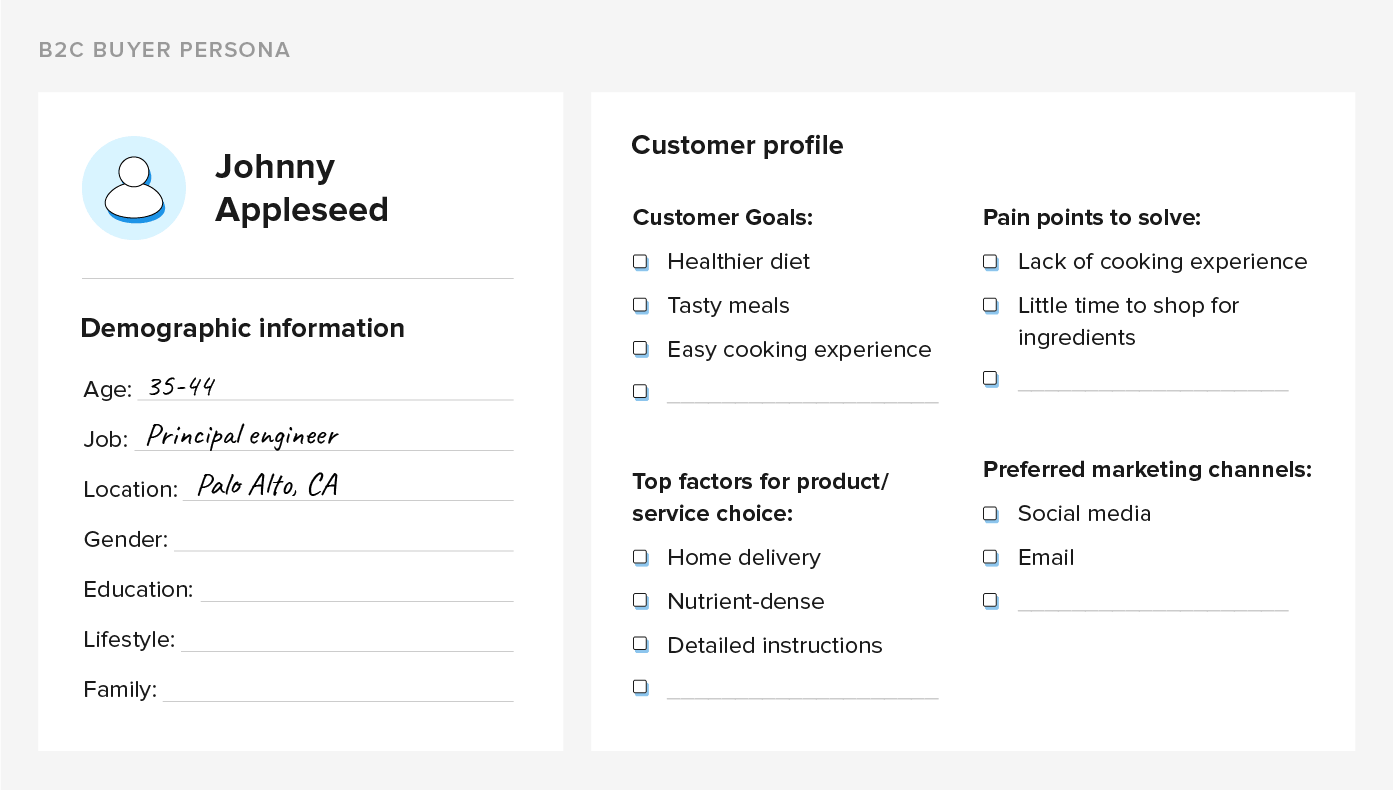
B2C buyer persona example
On the other hand, B2C personas outline the priorities of an individual as opposed to a business. The above example of a buyer persona for a meal kit delivery service focuses on what the individual customer needs, which would help a consumer-facing business understand how to make their product or service the most appealing to those customers.
Now that we’ve outlined the two overarching types of buyer personas, you’re ready to start creating them.
How to create a buyer persona in 3 steps
The following steps will help you to create a thorough buyer persona, whether you’re a small business or a growing organization.
1. Study your current customers and ask the right questions
Knowing your current customer can help you target potential new customers with similar wants and needs in a product or service. As mentioned earlier, you’ll need to collect crucial data from your current customers like their age, job title, location, purchasing power, and pain points. Think of this exercise as creating the resume of your ideal customer, which ultimately helps you market to them.
Here are some examples of questions to ask your current customers in an interview on the phone, in person, or through a survey.
What is your profession? What are your responsibilities on a day-to-day basis?
What are your biggest challenges when it comes to [product/service]?
What is your preferred method of communication with vendors? Email, social media, etc.
What industry does your company operate in? What size is your company?
Check out this Qualtrics blog post for more ideas on what questions to ask customers for B2B buyer personas.
2. Categorize your ideal customers into different segments
With enough data from current customers, you’ll start to notice patterns in their goals, location, age, or even their profession. Segmenting your audience by a trait of your choice can help you create multiple personas if you need to.
For example, you might want to create different personas for different age ranges because younger customers may prefer to be contacted via text, while older customers may prefer email.
How many personas you end up creating can very well depend on the different types of customers you want to market to, especially if you have multiple product lines. If you’re struggling to decide which personas to focus on, start with 1-3 customer profiles that represent your largest revenue sources.
3. Create your buyer personas
With the data you’ve collated neatly divided into customer segments, begin to create a fictional persona that will represent the buyers from that group.
Your buyer persona should feel as real as possible. If it helps, you can add a name, images, quotes, and more to make this “person” easier to imagine.
With the level of detail you’ve gathered, your buyer persona’s motivations, needs, and goals should be clear and easy to understand.
Be sure to share your buyer personas with different departments so they’re familiar with who they are marketing to, and to align the entire business strategy.
TIP: Remember that though B2C customers might be easy to translate into a buyer persona, your B2B clients might not be. With multiple stakeholders and more complex requirements, you may need multiple buyer personas to help you meet their needs.
From creating your buyer persona to mapping a customer journey, Delighted surveys make it easy to understand your audiences and perfect their experiences at every stage of the customer lifecycle. Sign up to dive deeper into Delighted today at no cost to you!
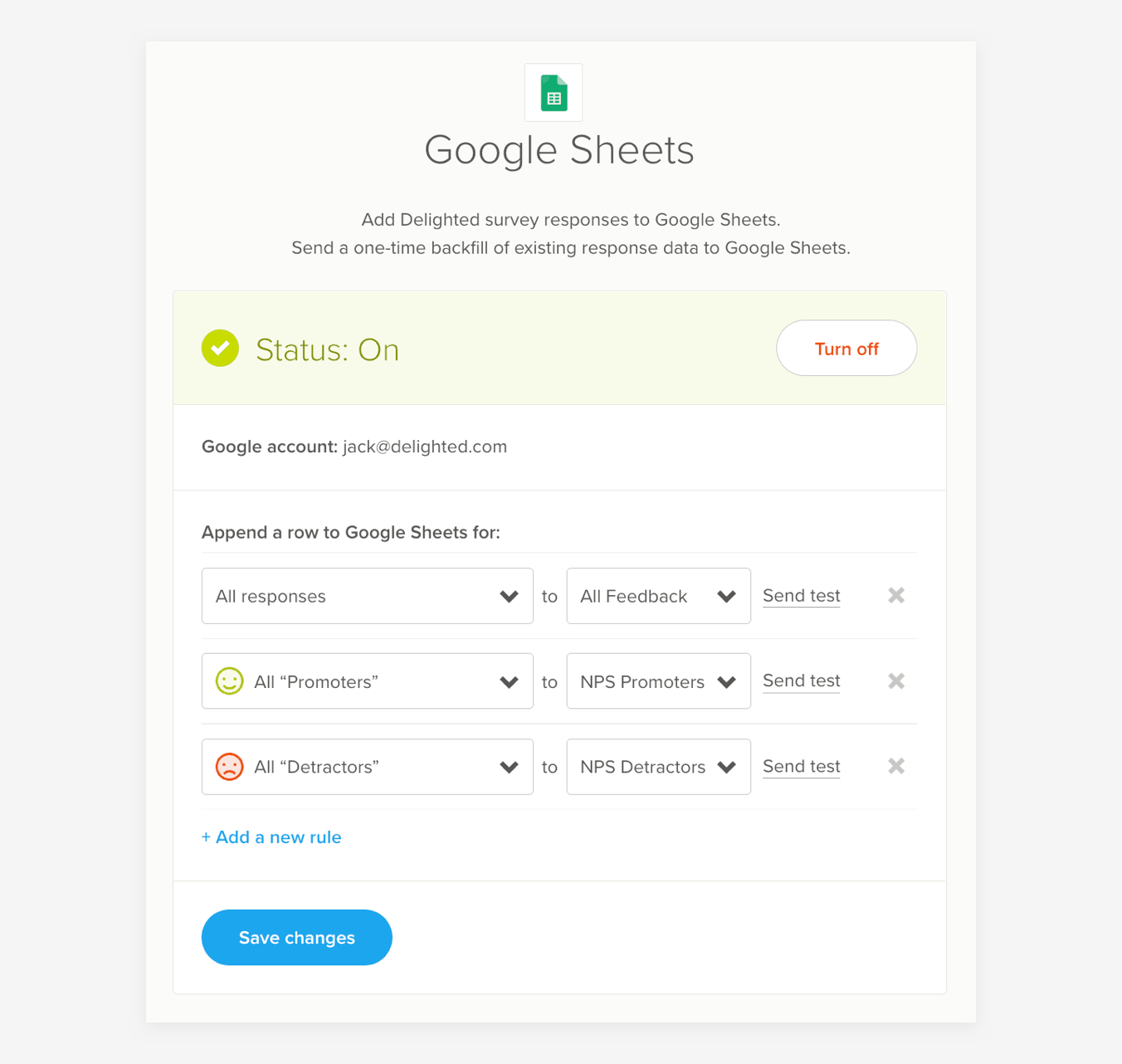
Collaboration has never been easier: the new Delighted + Google Sheets integration takes survey responses from Delighted and syncs them into Google Sheets for custom reports and seamless collaboration outside of the Delighted app. With this integration, you’ll never need to manually export and upload your Delighted data into Google Sheets again.
Ready to get started? Let’s dive in.
How the Google Sheets integration works
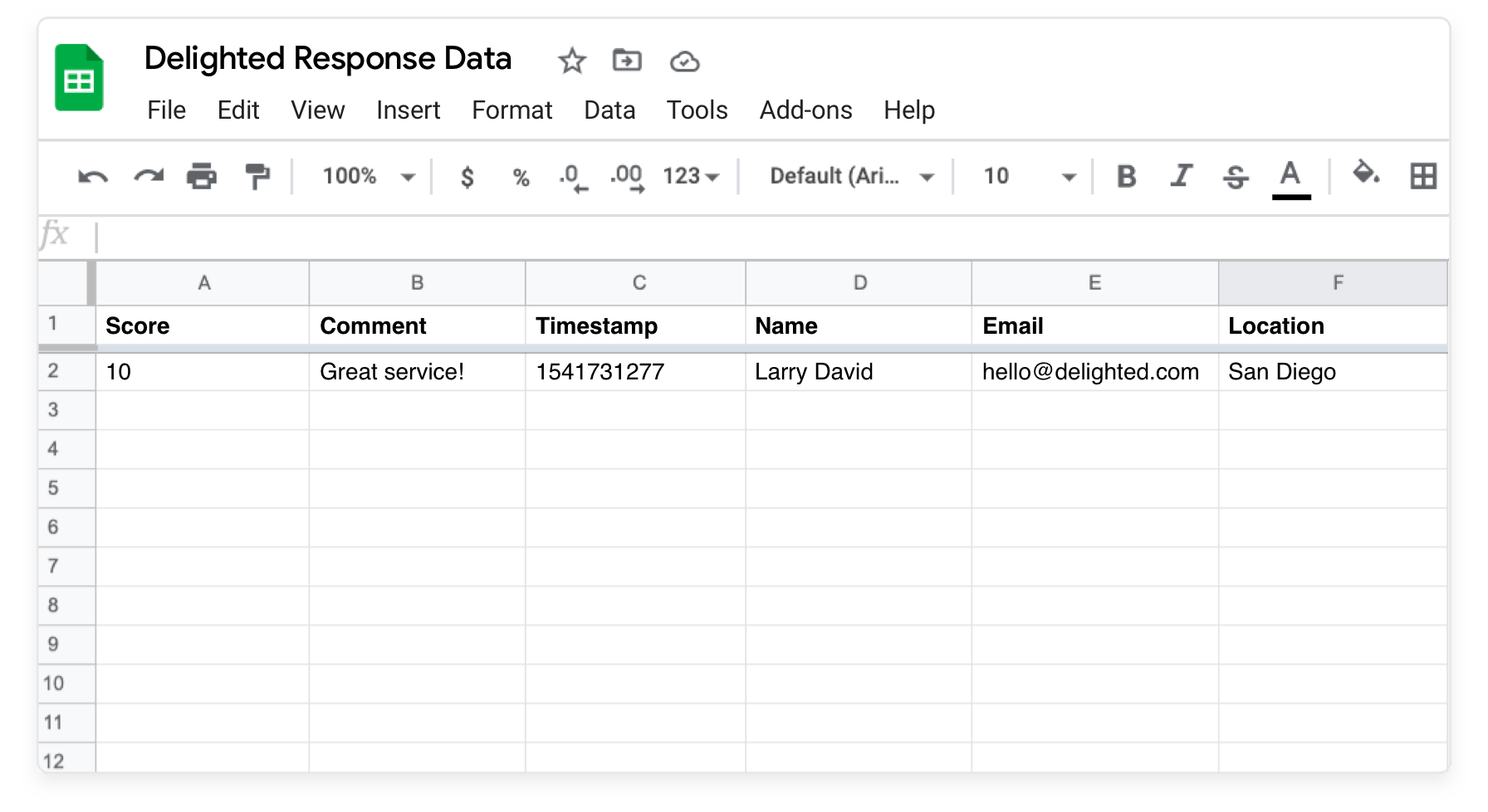
Once the integration is activated, it pulls response data from Delighted into a sheet of your choice. For each response, the integration creates a new row in the sheet with information like the contact’s name, email, score, comment, and Additional Questions answers.
Using the integration
Aggregate and report on data across projects. Since Delighted Dashboards and Reporting are project-specific, this integration expedites reporting across multiple projects outside of the app.
Build custom pivot tables and reports. Create pivot tables with Delighted data from all surveys or a few select projects. Combine Delighted data with the other business and user experience metrics you’re currently tracking for the full landscape of the impact of your CX program.
Sync with additional Google cloud programs. Automatically sync survey data across projects to create quarterly or monthly reports to share with stakeholders. Seamlessly transfer data from Sheets to other programs in the Google cloud.
Activating the integration
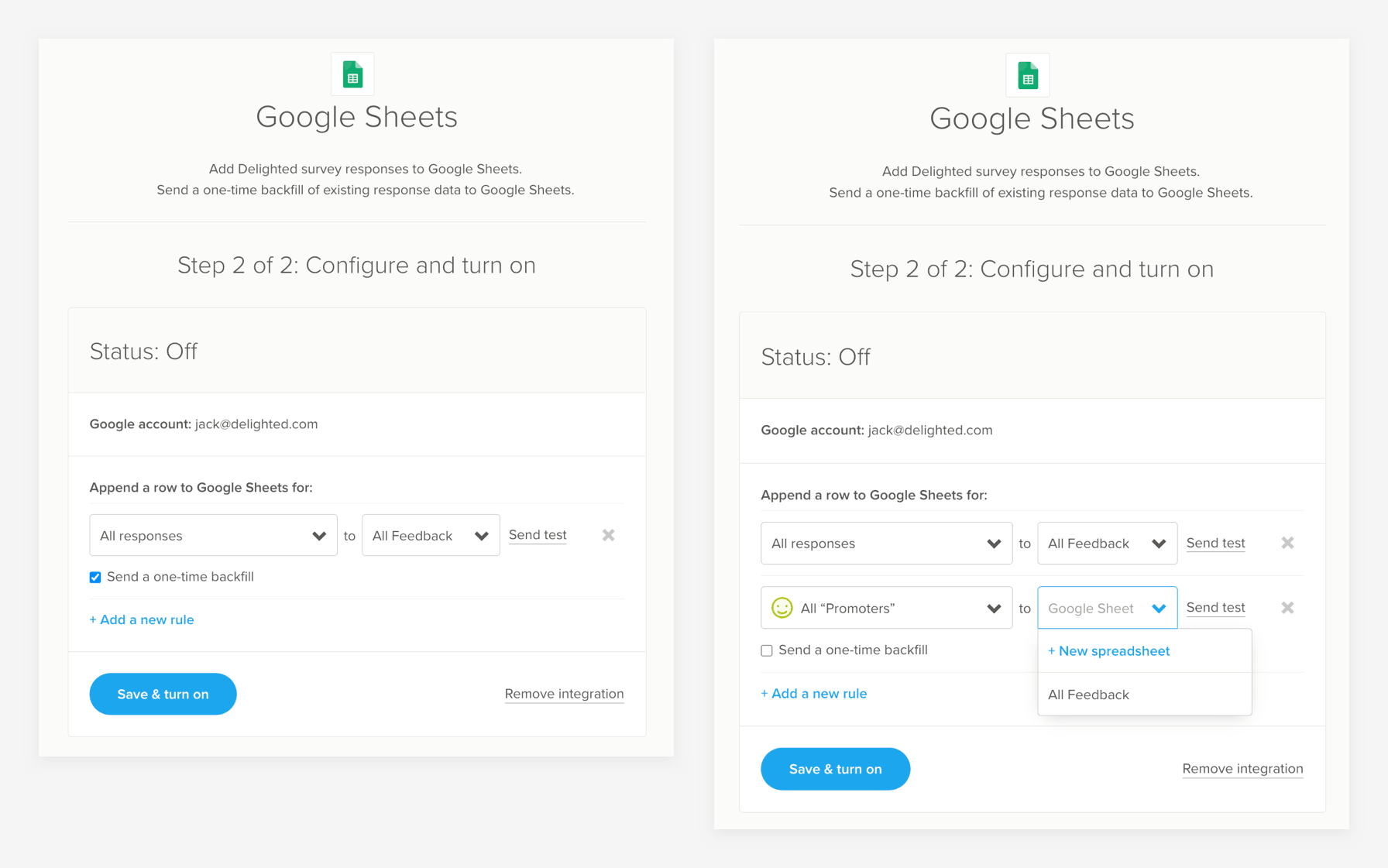
To activate the integration, start by navigating to the Integrations tab in Delighted.
Select the Google Sheets integration and specify which responses from a selected project to sync into GSheets. You can choose to sync all responses, a subset of responses, or responses from specific Trends you’ve set up.
Next, you’ll select which sheet you’d like to populate with Delighted data.
Finally, choose “Send a one-time backfill” to sync existing responses to the connected sheet before selecting “Save and turn on.”
And with that, the integration is active! Survey responses from Delighted will populate your spreadsheets in no time.
For more detailed setup information, check out our Help Center guide.
Start populating Google Sheets with Delighted data
In summary, with the Google Sheets integration, you can:
Expedite your external reporting processes
Make Delighted data easier to share
Analyze feedback across projects
Collaborate with your team
Activate the free integration and start collaborating today!
Already have a Delighted account? Sign in and activate the integration.
New to Delighted? Sign up for a Delighted account to start collecting survey feedback and improve customer experience across the board.
You’ve collected survey data and analyzed it – now what? The customer will be waiting for acknowledgment or an update from your company, so creating an efficient, organized, and candid closed-loop feedback system to tie up loose ends with your customers is vital.
Ultimately, customers need to feel heard and understood. To have taken the time to answer your surveys and provide you with feedback but not see any significant change or follow-up is discouraging – and, can lead to disloyal customers who will choose a competitor over you moving forward.
That’s why it’s essential to understand what closed-loop feedback is, why it’s important, and how to create successful closed-loop feedback systems.
What is closed-loop feedback?
Closed-loop feedback is the practice of responding to a customer’s survey feedback in order to understand their feedback better, resolve their pain point, or let them know that their insights will be used to make improvements to your product, service, or customer experience strategy.
Why is closed-loop feedback important?
Let’s take a look at the additional reasons why every organization should prioritize a closed-loop feedback system.
Reduced customer churn
What you do with customer feedback has a bigger impact than you think – in fact, a study done by PWC reported that 32% of customers would stop doing business with a brand they otherwise loved after just one poor experience.
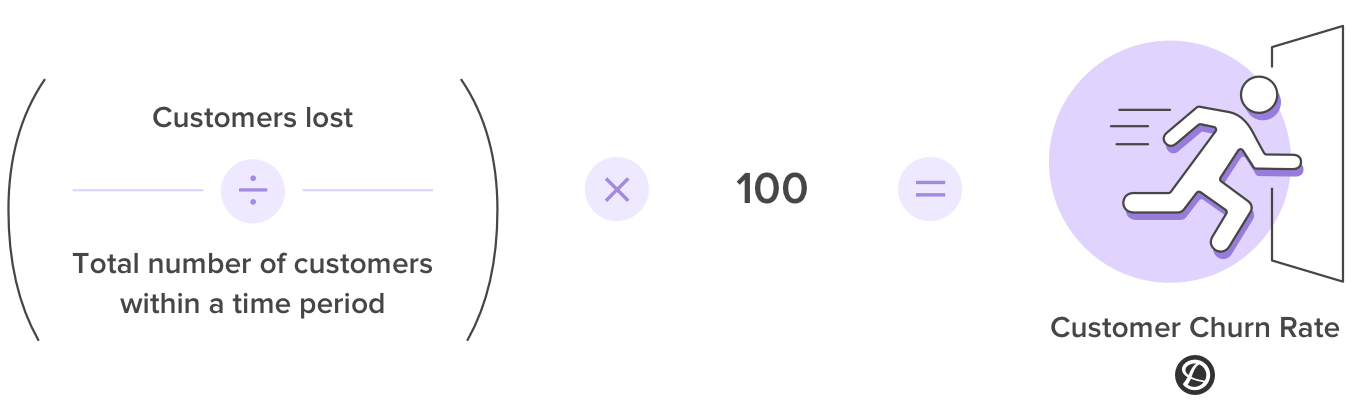
Customer churn, or when customers choose to no longer use your product or service, can happen for a variety of reasons. However, if the reason is a poor customer experience, you have a large opportunity to repair the relationship by following up with customer feedback.
To close the loop with your customer, you can resolve their issue directly over email, or hop on a call and let them know that their feedback will be taken into consideration for future service or product improvements.
Companies with open-loop feedback systems (meaning, feedback is never resolved or acknowledged) leave customers feeling that you’ve wasted their time because it didn’t warrant a response from the brand. When you ask for feedback, you set an expectation that you will address it. When organizations let feedback fall through the cracks, they risk losing their customer for good.
Closing the feedback loop helps resolve issues at the source, allows the customer to feel heard, and provides valuable insights to improve the overall customer experience and ultimately reduce customer churn.
Improved overall reputation
How customers speak about your brand online matters. Why? Because customers can get an impression of your business from public-facing reviews within seconds and will decide if they want to do business with you based on your reputation.
Following up on feedback can prevent disgruntled customers from posting a negative review online following a less-than-satisfactory experience. If a negative review about you has already been published, how you respond to that review can put your brand back in a positive light. In fact, 45% of customers are swayed to visit businesses that respond well to negative reviews on sites like Yelp, Google My Business (GMB), or WebRetailer.
As the data shows, customers are more likely to recommend a product or service if they have a pleasant experience after submitting feedback or making a complaint. A brand that goes above and beyond to resolve a customer issue ultimately earns a positive reputation in the eyes of the customer.
Increased revenue
Closed-loop customer feedback improves the customer experience from the ground up. When customers are happy, and their insights are acknowledged, they’re more likely to recommend you to others and speak highly of their experience with your company. And, as noted above, their public opinions can go a long way with on-the-fence buyers.
Other retailers may offer the same product or service, but customers will gravitate towards the brand that delivers the best customer experience and has the evidence to prove it – in fact, they’re willing to pay more for it.
Customer experience is what differentiates your brand in a competitive market and can lead to increased revenue.
Now that we’ve covered the impact of closed-loop feedback systems, we’ll lay the groundwork for how you can build your own.
How to build a closed-loop feedback program in 4 steps
Staying in tune with your customers means collecting and reporting back on customer feedback, interpreting the data, and routing the insights to the people who can make the biggest impact with the information.
Here are the 4 steps to successfully close the loop every time and create a scalable, comprehensive closed-loop feedback system.
1. Make feedback-informed decisions
Collecting feedback from customers is the first step to a closed-loop feedback process. Surveying customers in an intentional way leads to accurate data for understanding your customers’ expectations.
Here are a few feedback collection survey types to consider:
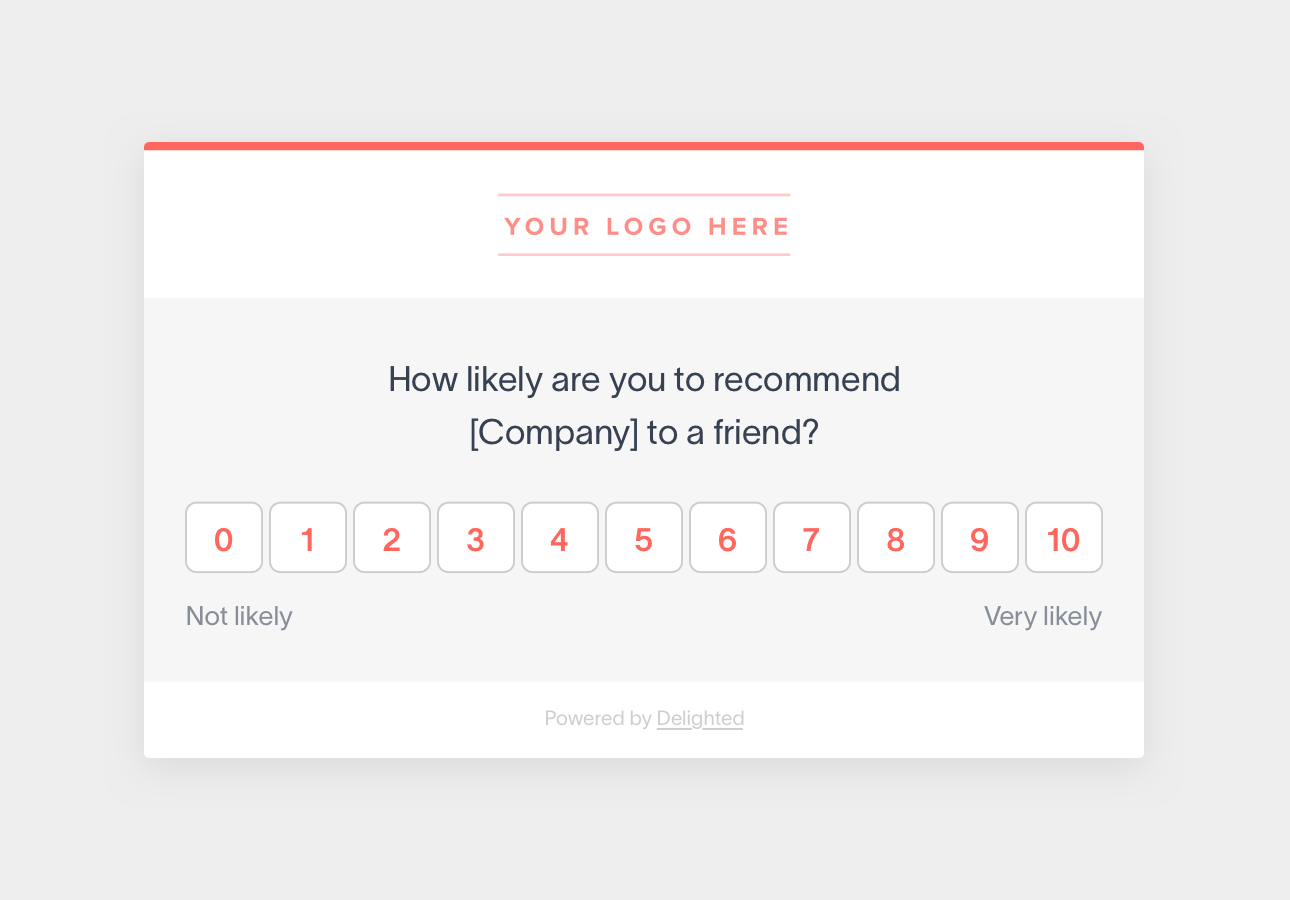
Net Promoter Score (NPS) surveys. Measures customer loyalty and asks the customer whether or not they would refer your brand to a friend or family member.
Once you’ve chosen the metric you want to use and sent the surveys through the distribution method that fits your needs, you’ll have a steady stream of real-time feedback that uncovers what parts of the customer experience need to be improved and how to improve them.
2. Close the loop with detractors
The Net Promoter Score survey metric groups customers into three types: promoters (people who are likely to recommend your brand), passives (people who are neutral about your brand), and detractors (people who are unlikely to recommend your brand).
As detractors are least likely to recommend your brand and more likely to spread the word of their negative experience, following up with them to resolve the issue or address their feedback is paramount.
You can find your detractors (or negative feedback in general) directly on your feedback dashboard and reach out to them individually. As part of the survey experience, you can also set up specialized Thank you pages for customers who rate you poorly to ask them what you can do to improve.
Another great way to address negative feedback quickly is to route the feedback directly to your customer service team. By integrating feedback with team communication tools like Slack or help desks like Zendesk and Gladly, your support team will see real-time verbatim feedback directly in the channels they use most.
This not only encourages your team to resolve customer concerns in a timely fashion, but it also helps your team glean overarching trends in your customer experience. If there are common issues across your customer base, you may need to address issues at the root cause and consider larger-scale customer experience changes.
3. Engage with promoters
Promoters are the cheerleaders of your brand. Don’t just let that positive sentiment sit in your feedback dashboard – engage your promoters to see if they’re willing to take that next step and advocate on your behalf.
One way to engage with promoters is by asking for a testimonial or review. Customer testimonials can be the deciding factor that determines whether or not someone buys your product or service. In fact, 92% of consumers report that they read online reviews and testimonials when considering a purchase. And, you can easily ask permission to publish positive survey feedback on your website with testimonial software.
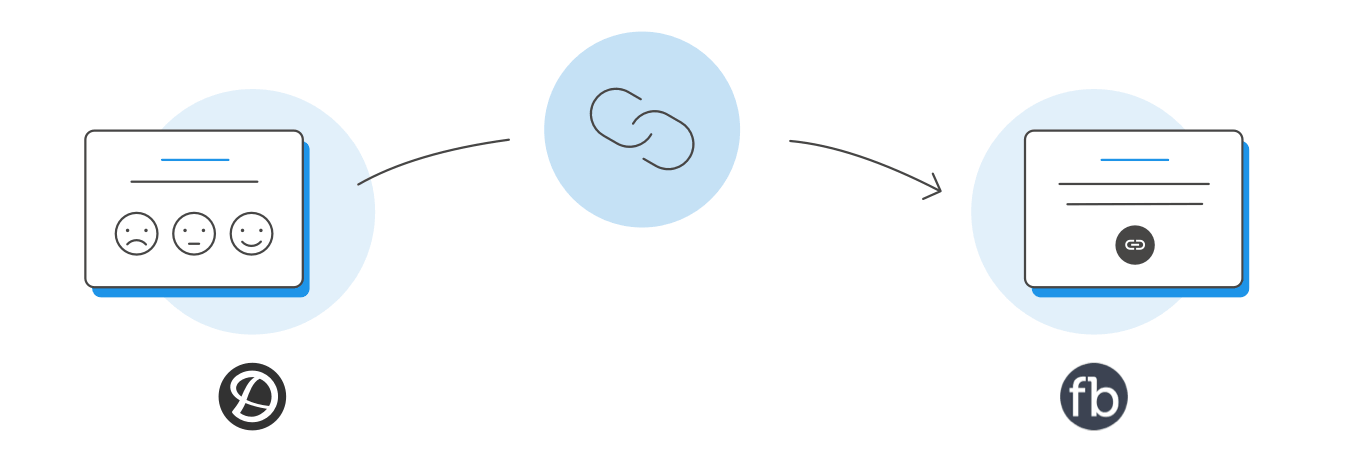
To encourage promoters to spread word of mouth, you can also offer them referral incentives after they give positive survey responses or scoring. Delighted’s Friendbuy integration rewards promoters who refer a friend by providing them with a reward incentive and a referral link after completing a survey.
Lastly, if you really want to make your promoters feel valued, invite them to special events, grant them early access to new features and products, and invite them to participate in the direction of your brand.
When it comes to your CX program, closing the feedback loop with your happiest customers is just as important as following up with your unhappy ones. Making all of your customers feel valuable ensures a positive, recurring return on investment.
4. Follow up with passive customers
Even though a neutral assessment doesn’t hurt as much as an outright negative review, passive and neutral customers should not be ignored. These ratings essentially translate to “Meh, it was okay. It got the job done.” But they also offer the opportunity to consider, “What could we have done to make this customer rave about us?”
In fact, a passive rating also means that another interaction can sway them towards a different end of the spectrum. Closing the loop with this group of customers can build trust (and show that you care) while also providing crucial insights into how you can improve your customer experience strategy to turn more passives into promoters in the future.
3 best practices for closing the loop
Below are some tactics to keep in mind when closing the loop on customer feedback.
1. Follow up promptly (ideally within 24 hours)
Companies that quickly respond to customer requests or feedback are typically seen more positively in the customer’s eyes. Following up with customers promptly after they express a concern or problem is one way to close the feedback loop and minimize dissatisfaction. Any customers who report a neutral or negative experience should be connected with a customer service representative as soon as possible.
TIP: As mentioned above, integrating and automating customer feedback with your team communication tools will help to ensure that all negative feedback is routed to the correct people quickly. Read more about survey automation tactics here.
2. Track recurring issues in real time
If customers encounter the same problem with your website or app over and over again, they’re unlikely to continue interacting with your brand. Keeping track of the feedback collected using a customer experience management platform can help you glean overarching issues and fix them promptly.
3. Turn passives and detractors into promoters
Passives and detractors often provide the most crucial insights into pain points on the customer journey. Companies that listen to the feedback from detractors and passives, make their customers feel heard, and make their best effort to resolve the issue will have the most luck turning them into promoters.
Close the feedback loop with your customers today
Insights are just numbers and words without action. To apply your newfound data insights, it’s important to create an efficient closed-loop feedback process to get back to your customers quickly and enact change.
Use surveys to gather customer data and insights that inform your business strategy and any improvements to be made on the road to a stellar customer experience. Getting feedback from customers at the right time and place is easier than ever with Delighted.
New to Delighted? Use our survey templates to collect and close the loop on customer feedback.
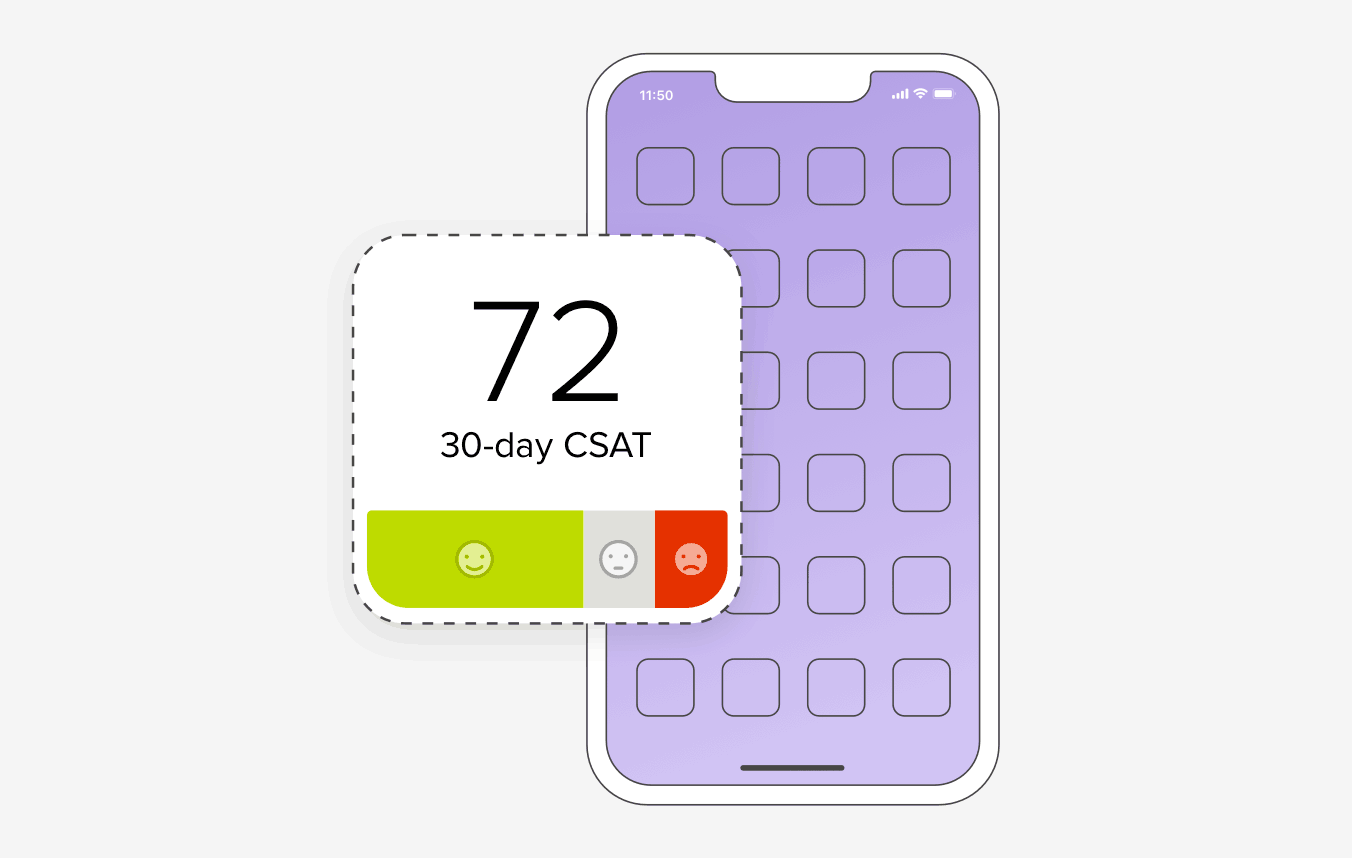
This just in: the newest update to the Delighted iOS app allows users to add Widgets to their home screen or Today view. As the first and only CX survey platform to offer iOS Widgets, Delighted Widgets makes your CX metrics more accessible than ever before.
Add as many Widgets as you need to keep a pulse on the metrics most crucial to your overall customer experience.
Without the Widgets feature, users must download and open the Delighted iOS app or log in to Delighted from a mobile browser to view Delighted data. Adding Widgets to any iOS device cuts out that interim step so you can get to the metrics that matter – faster.
Use iOS Widgets to…
Keep a pulse on individual store performance for different retail locations
Monitor and track CSAT scores based on customer support interactions
Track PMF score for new or existing products on your ecommerce site
Evaluate employee experience with eNPS survey results
Showcase your real-time NPS with a detailed view of promoters and detractors
You’re faced with many options (and questions) during the survey creation process: What survey type should you use? How should you send your survey? What questions should you ask? And of those, which should be open-ended versus close-ended questions?
Today, we’ll tackle the last topic: how close-ended questions differ from open-ended ones, plus how, when, and why to use them. We’ve also included types and examples of close-ended questions, so you can feel confident creating your own.
What are close-ended questions?
Close-ended questions are designed to elicit straightforward, limited responses from respondents, typically formatted as “yes/no”, “true/false”, or from among a set of predetermined multiple choice options.
For example, a question might ask, “Have you used our service before?” requiring the respondent to select either “Yes” or “No”. These questions work best when you understand the exact topics you want feedback on and aim to gather quantitative data that can be easily segmented for reporting purposes.
Types and examples of close-ended questions
To gather actionable data, it’s important to use the right type of survey question. Here are a few close-ended questions to know:
1. Dichotomous questions
Dichotomous questions, by nature, can only be answered in one of two ways (i.e., a dichotomy is the division between two things that are opposites or entirely different).
Common answers to dichotomous questions include “yes” or “no”; “true” or “false”; “agree” or “disagree”; and so on.
These questions are short and to the point, offer a simple survey experience, and allow for quick and effortless analysis – it’s either one answer or the other.
Some examples of dichotomous close-ended questions are:
Was your support issue resolved?
Were you satisfied with your latest purchase?
Have you purchased/used [company’s] product or service in the last 30 days?
Have you ever used [company] website to purchase a product or service?
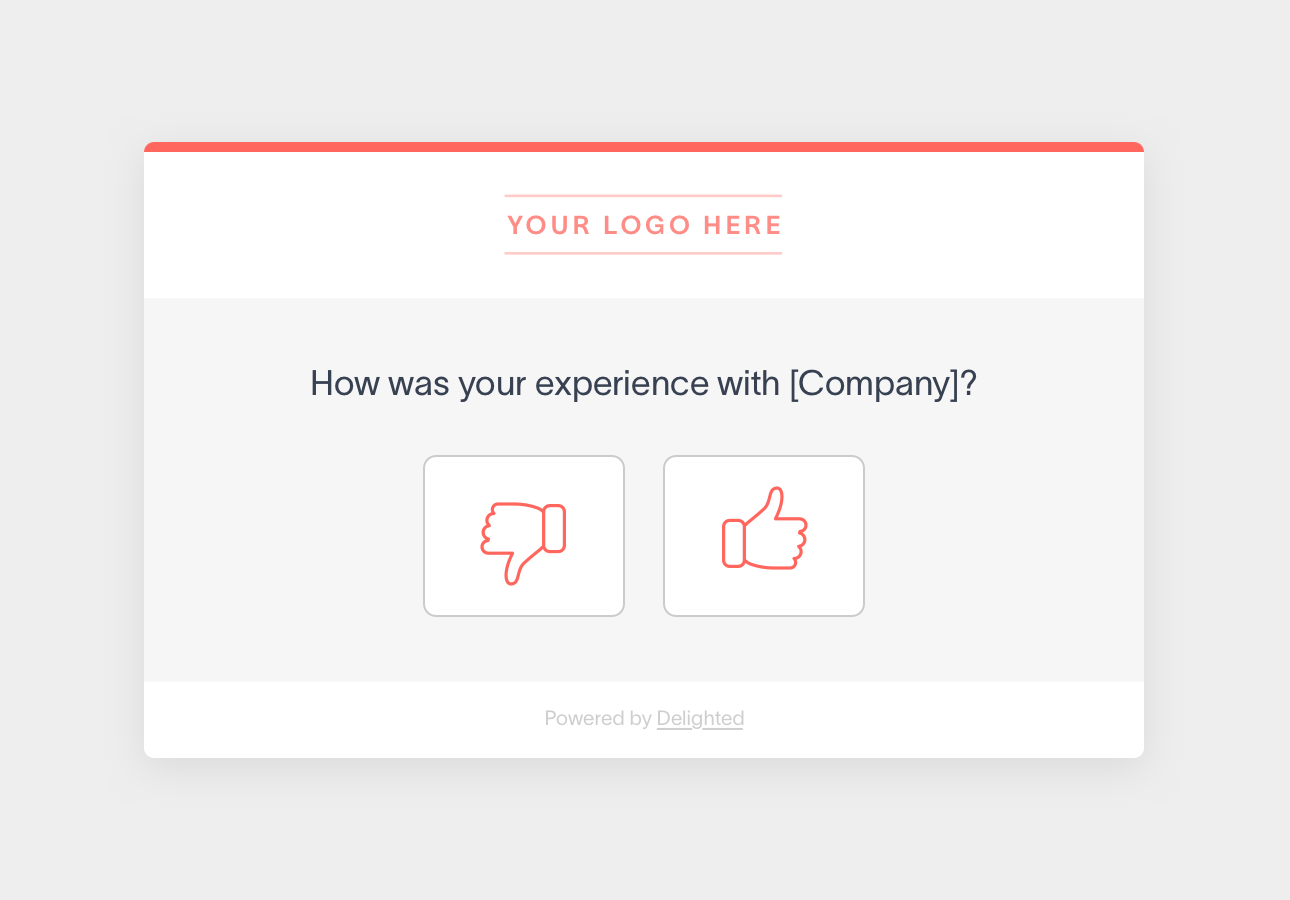
Delighted’s Thumbs survey is an example of a dichotomous survey where respondents choose a thumbs up or thumbs down. When used as the initial question, it is always followed by an open-ended question (more on those, below) so people can further clarify their answer. You can also create your own dichotomous questions using the Additional Questions feature.
2. Multiple choice questions
Multiple choice questions provide survey participants with a selection of answers to choose from. Getting specific with the answer options allows for clearer data collection, and therefore, results that are easier to analyze – and take action on.
Multiple choice questions are a great way to gather extra information to help you make new product decisions, understand where you can improve the customer or employee experience, or decide where to advertise to reach your audience.
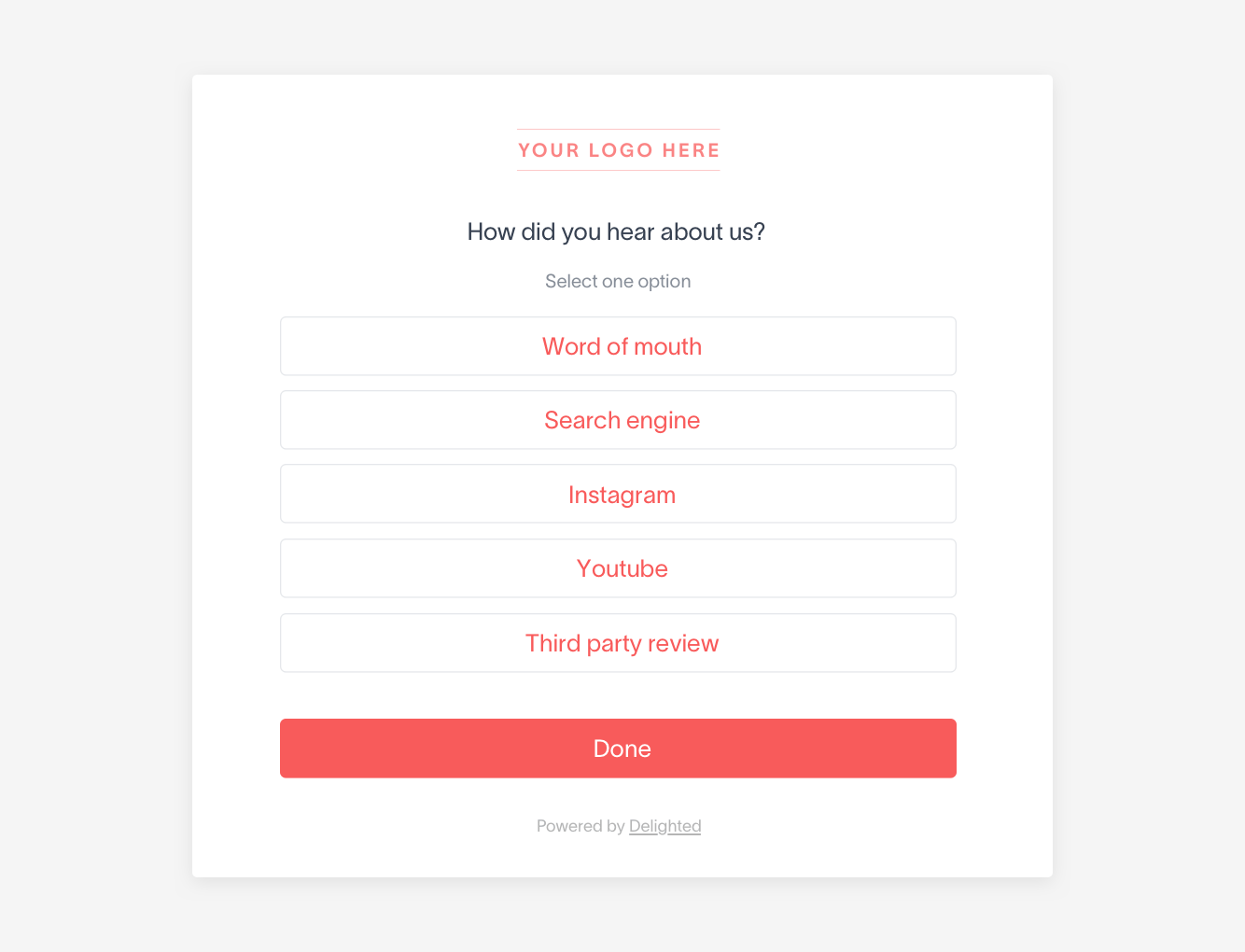
Delighted’s Additional Questions allow for flexible multiple choice options.
Some examples of multiple choice questions (and possible answers) are:
How often have you visited our store in the past 12 months? [answers could include options ranging from more than once a week to I do not visit your store]
How can we improve our benefits package? [answers could include perks or benefits your company is considering for employees]
How did you hear about us? [answers could include common sources, such as social media, word of mouth, TV, and so on]
The next three question types are all variants of multiple choice questions.
3. Rating scale questions
Rating scale questions help determine how people feel about your company, product, or service. By asking for a rating, you can quantify overall sentiment or agreeableness.
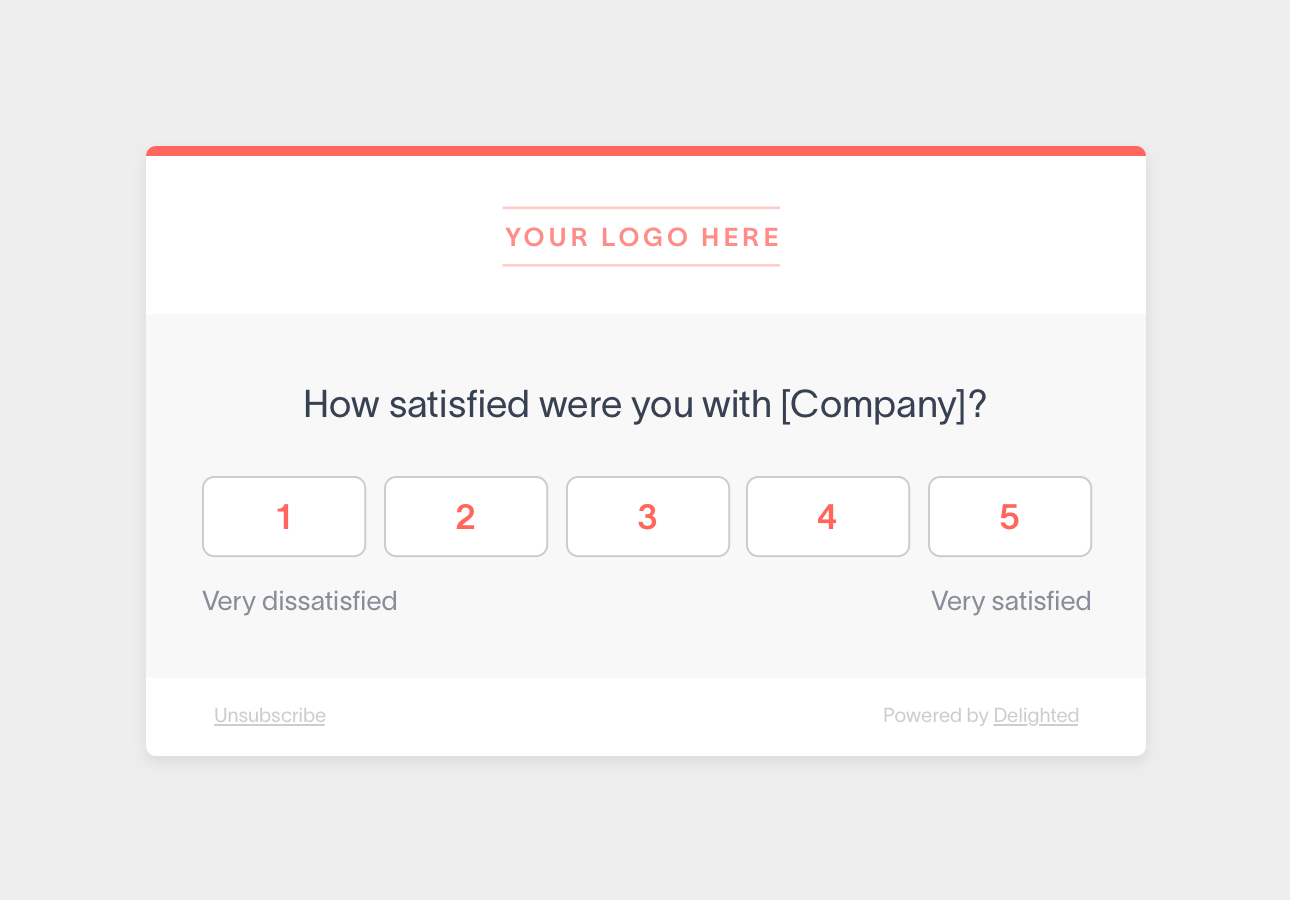
For example, you could ask customers: “How satisfied were you with your ability to find what you were looking for?”
And answers could be:
Very dissatisfied
Dissatisfied
Neither satisfied nor dissatisfied
Satisfied
Very satisfied
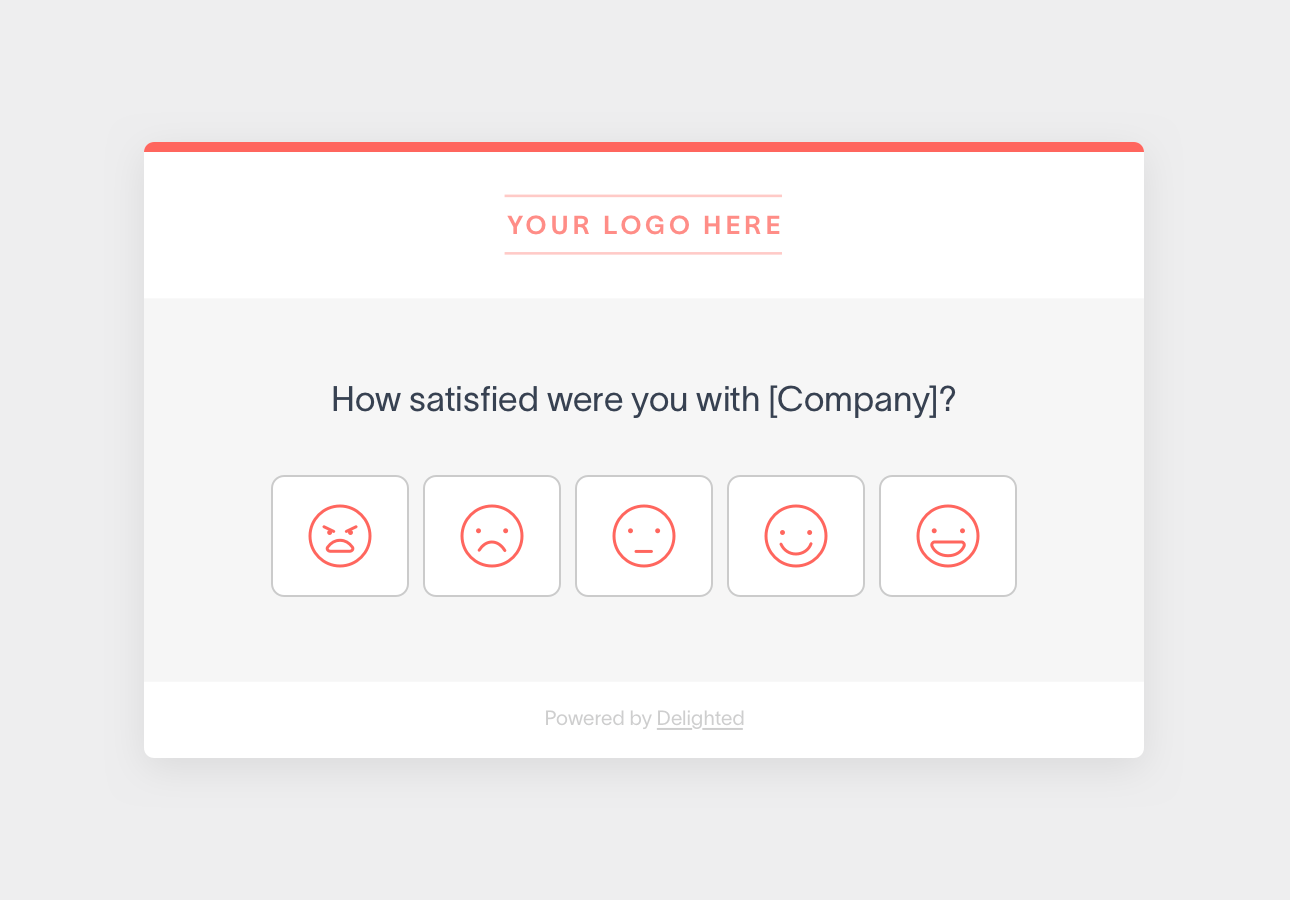
Your scale doesn’t always need to be represented as a range of numbers – you could use stars, smileys, or any other visual representation that is easily understandable and suits your brand.
If the above looks familiar to you, you might be thinking of satisfaction surveys, which contain a series of survey questions to gauge customer and/or employee satisfaction.
Likert scale questions
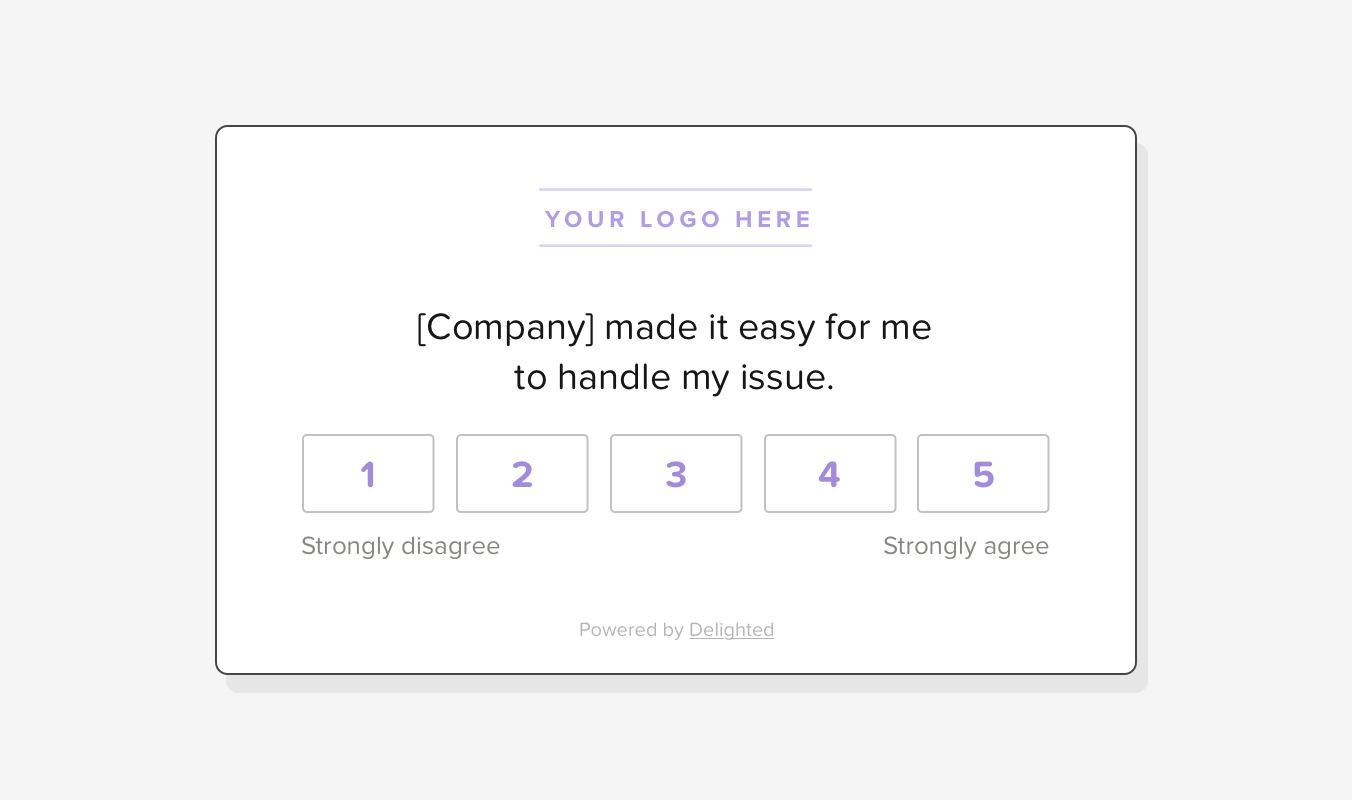
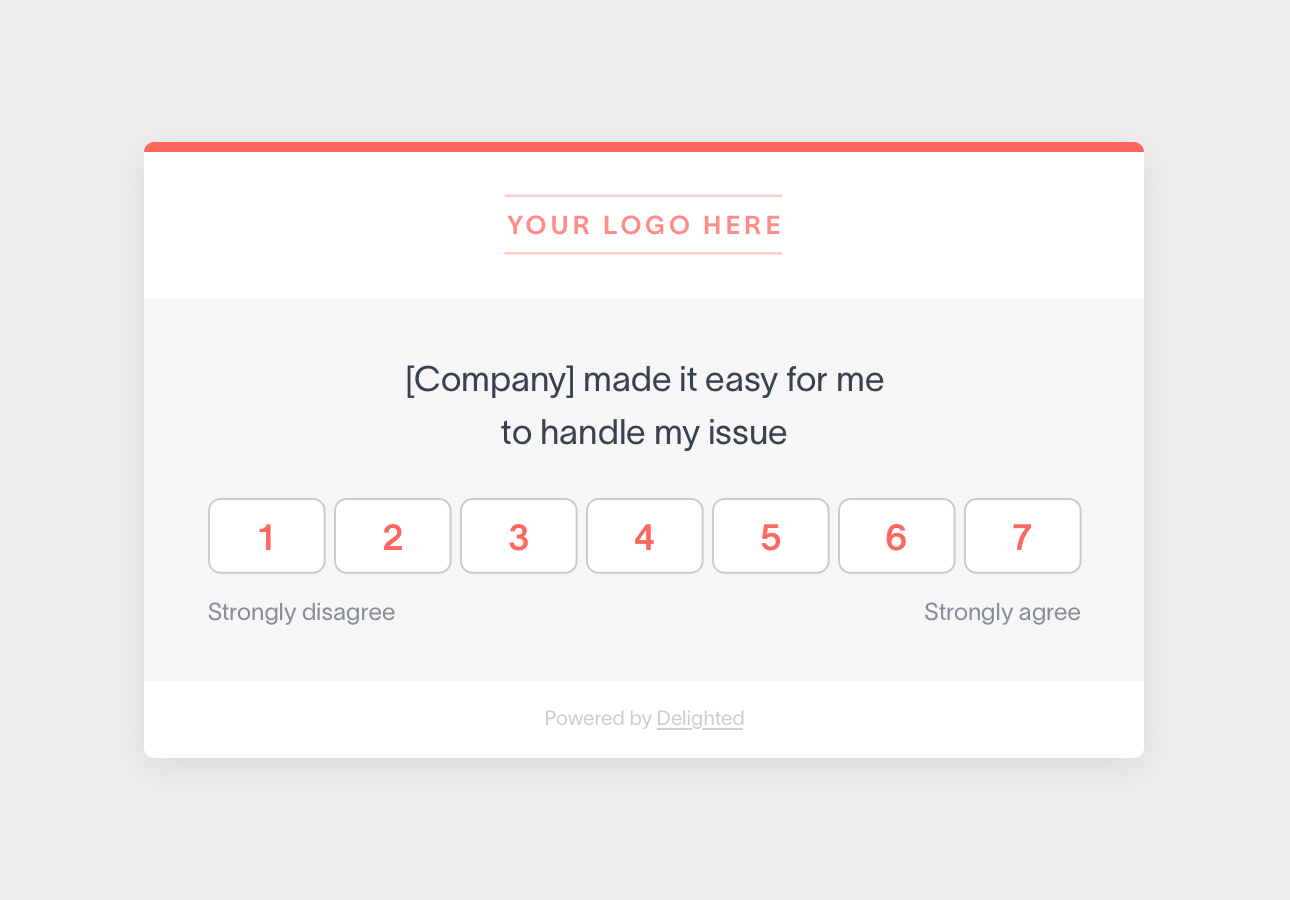
Likert scale questions, a type of rating scale question, employ a 3, 5, or 7-point scale that asks respondents how much they agree or disagree with a statement.
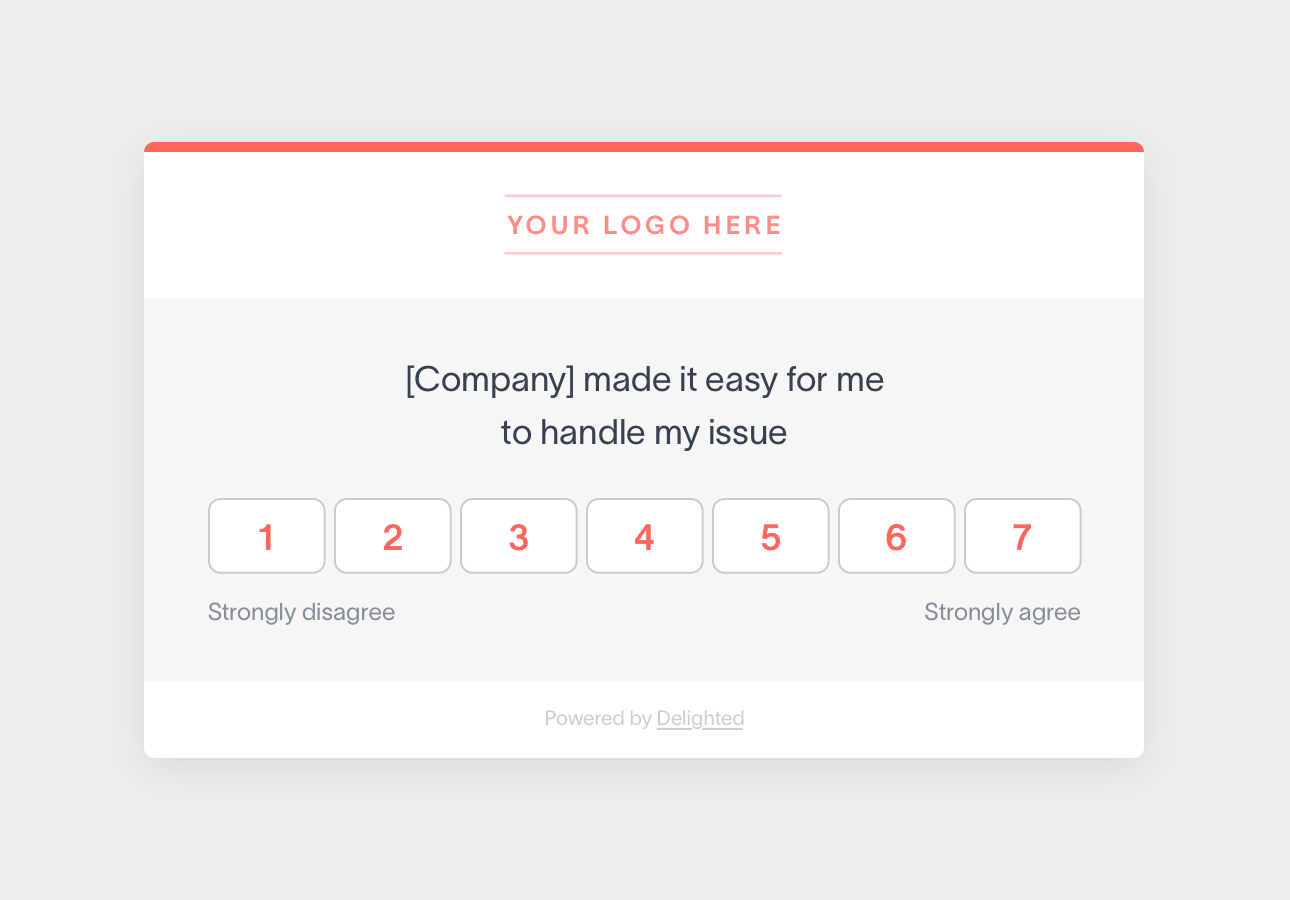
Delighted’s CES survey is a Likert scale example
For example, you could say: “[Company] made it easy for me to handle my issue.”
Answer choices could be:
Strongly disagree
Disagree
Neither agree nor disagree
Agree
Strongly agree
4. Rank order questions
Rank order questions are questions that ask the participant to list their preferences in ascending or descending order.
For example, you could say: “Please rank how familiar you are with the features of our app.” And then list your app features for respondents to rank in numerical order.
5. Checklist-style questions
Checklist-style questions allow survey respondents to select multiple options from a predetermined list of answers. These types of questions require careful analysis, but they’re helpful for capturing a more holistic picture of customer and/or employee sentiment.
When to use close-ended questions
Now that we’ve covered the types of close-ended questions, here are three instances of when to use them:
You want to collect quantitative data
Because close-ended questions offer predetermined answers only, they enable survey creators to assign values (often numerical) to answers that can then be tallied into scores, percentages, or statistics. With quantitative survey data, you can categorize responses quickly and easily pinpoint correlations and trends.
Close-ended questions help you narrow in on a set of responses so you can quantify your data and take action on it.
Here’s an example: You want to understand how much money your employees spend on commuting costs each month. If you asked an open-ended question like, “Tell us how much you spend on commuting.” and employees can answer freely in an open text box, you might get answers that are all over the place—and that would be hard to quantify when it comes to your analysis.
Instead, ask a close-ended question like, “How much do you spend on commuting costs each month?” followed by a range:
$0-$199
$200-$299
$300-$399
$400-$499
$500+
The range, AKA a specific set of responses, will help you more accurately analyze and take action on the data you collect.
You’re conducting a large-scale survey
When it comes to surveying, the easier it is to answer your questions the better, specifically for your survey response rate. And this is especially true when you’re conducting a large-scale survey. You want to be able to quickly and easily analyze the data you collect, without having to do much (or any!) manual calculations.
By nature, close-ended questions enable you to do this by supplying participants with preset answers from which to choose.
What are the advantages of using close-ended questions?
There are many advantages to using close-ended questions in your surveys, including:
The data is easier to analyze and quantify overall sentiment, which means you can act on the feedback faster
You won’t need to manually sift through qualitative responses and can understand if you’re meeting expectations almost instantly
As you can tell, the advantages are all about ease of use: for participants, the ease of taking the survey; and for you, the ease of analyzing the results.
That said, you might want some qualitative feedback to better understand the “why” behind your data.
What are open-ended questions?
Open-ended questions collect qualitative feedback, which is less about measurement and more about collecting customer and/or employee impressions and opinions. While these types of questions won’t always translate to easy data analysis, they do give you insight into attitudes and motivations.
Examples of open-ended questions
Open-ended questions allow customers and employees to give feedback in their own words. They’re perfect for following up on close-ended questions, so respondents can give more context for their answer.
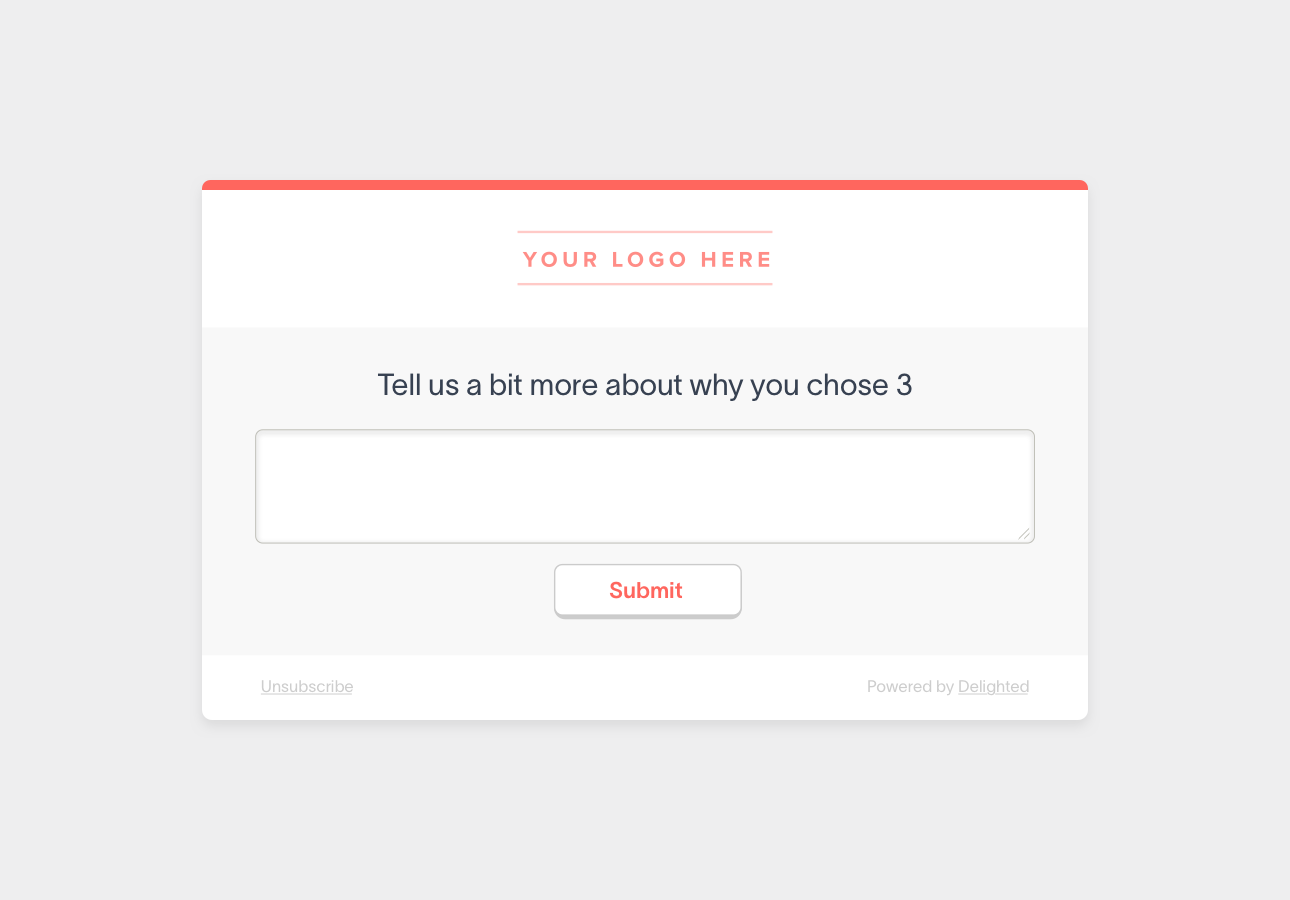
Respondents can explain their reasoning in an open-ended text box.
Here are a few examples:
Tell me more about why you chose [rating/option].
How can we improve?
Is there anything else you would like us to know?
What’s the difference between close-ended and open-ended questions?
Closed-ended questions are more quantitative, and ask survey participants to choose from a list of statistically significant answer options. Open-ended questions are qualitative, and while they don’t easily lend to statistical analysis, they do provide verbatim insights into your company that you may not have been aware of.
Find patterns with your close-ended questions and learn why they’re occurring with an open-ended question
Gather anonymous data with close-ended questions and then capture the specific email or product purchased data with open-ended questions
Get insights from your audience with open-ended questions to create a theory, and then use close-ended questions to determine if your theory was correct
TIP: In case the options you supplied aren’t applicable to the respondent, add an “other” or “fill in the blank” field as part of a multiple choice question. An “other” option is also considered an open-ended question and can reduce the chance of survey bias!
Creating surveys with a mix of close-ended and open-ended questions gives you the best of both worlds – quantitative data you can take action on and qualitative data to understand your customers and employees better.
Ready to put your knowledge of survey questions to use? Start gathering feedback with Delighted’s free online survey maker.
In a world where a remote or hybrid work experience is the new normal, employees now have greater flexibility when choosing where they want to work and employers have added pressure to avoid turnover and improve employee retention.
The good news? Actions can be taken to help keep your talent around for longer. In fact, according to a recent Work Institute report, more than three-quarters (77%) of the reasons why employees leave are preventable. That’s why investing in employee retention strategies is time well spent.
Below, we take a closer look at what employee retention is, why it matters, and 10 strategies for boosting employee retention at your organization.
What is employee retention?
Employee retention is the ability to keep employees at your organization. There are myriad factors that influence employees’ desire to continue working for you; many are directly tied to their overall employee experience.
Some of the factors include:
Pay and benefits
Flexible work environment (e.g., working from home)
Company culture
Job satisfaction
Feeling included and a sense of belonging at work
Measuring employee retention
Organizations calculate employee retention in order to benchmark and monitor their retention rates over time. Measuring retention will shed light on whether improvements need to be made to your employee experience management and help determine if your improvements were successful.
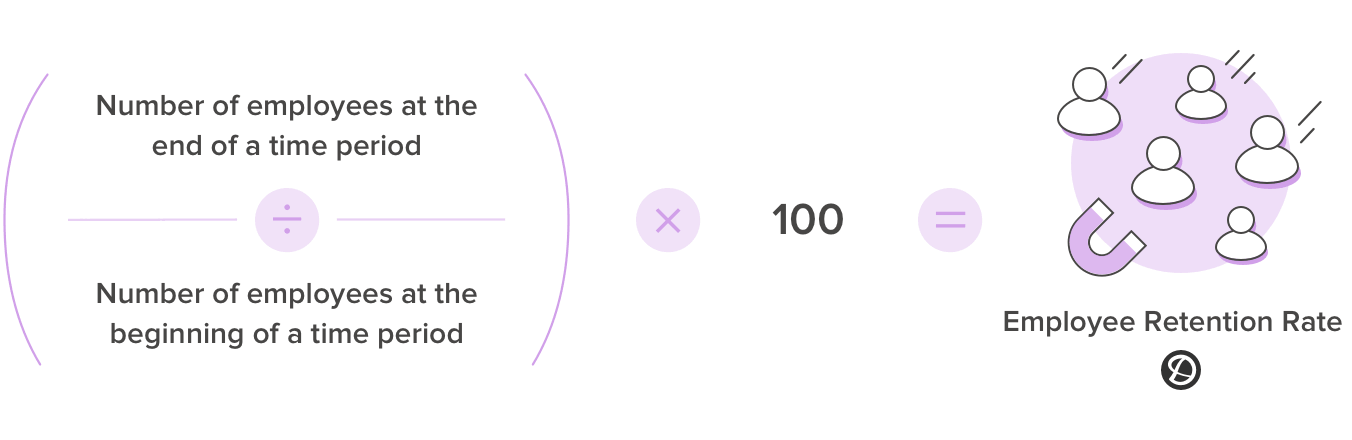
To measure your company’s employee retention rate (the percentage of employees who stay), you can use this simple formula:
(Number of employees at the end of a time period)/(Number of employees at the beginning of a time period) x 100 = employee retention rate
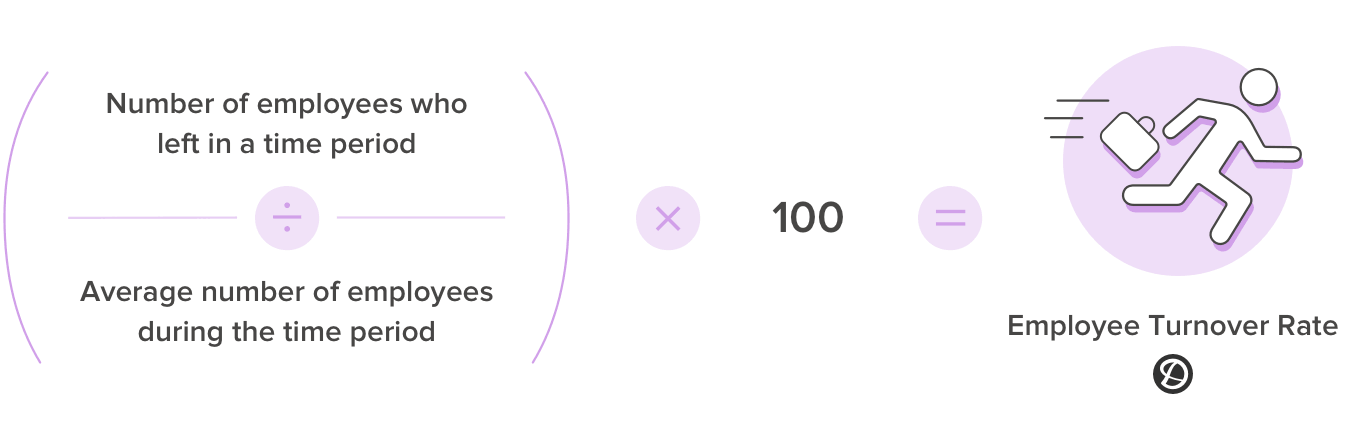
To complement this calculation, you may also want to calculate employee turnover rate (the percentage of employees who leave):
(Number of employees who left in a time period/average number of employees during the time period) x 100 = employee turnover rate
For example: If you had 10 employees at the start of a time period, and 8 employees at the end of a time period, the calculations would look like:
Employee retention rate: (8/10) x 100 = 80%
Employee turnover rate: (2/10) x 100 = 20%
You can also measure employee turnover by surveying your employees about their intent to stay. According to Qualtrics, intent to stay is one of the five key performance indicators (KPIs) of the employee experience. By measuring your employees’ intent to stay, you can better understand how long your employees plan to work for your organization and proactively learn why.
Why does employee retention matter?
When employees feel that their experience at work doesn’t measure up to their expectations, they’re likely to become less engaged in their work – and ultimately, will look to the job market for opportunities that better suit their work-related needs.
One or two employees leaving is natural attrition. But when many are unhappy and leave, business performance can be put at risk.
Here are a few research-backed reasons why companies should work at retaining top talent.
1. Happy employees lead to better business results
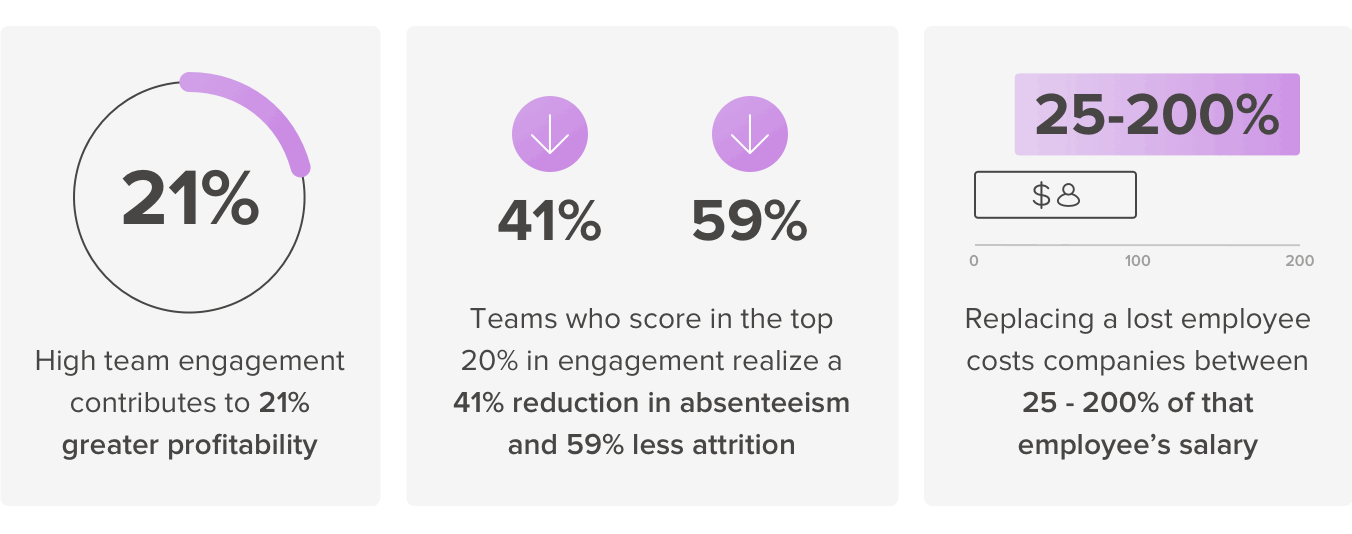
According to research conducted by the Society of Human Resource Management (SHRM), people who are engaged in their work are more likely to help the company achieve its goals. In fact, a study by Gallup showed that high team engagement contributes to 21% greater profitability.
2. Engaged employees are more present and productive at work
The same study by Gallup revealed that teams who score in the top 20% in engagement realize a 41% reduction in absenteeism and 59% less attrition.
3. Losing employees is costly
Replacing a lost employee costs companies between 25 – 200% of that employee’s salary. In other words, if you need to replace a manager making $100,000 per year, your company will spend between $25,000 – $200,000 just to hire their backfill.
10 strategies for increasing employee retention
Identifying strategies that help your company retain employees over the long term might not always be immediately obvious.
Below, we’ve rounded up 10 employee retention strategies to help you keep your top talent happy, engaged, and productive.
1. Focus on the onboarding experience
Have you ever gotten a call or email from HR reminding you that your new full-time employee starts today – and you haven’t started their onboarding paperwork or technology set-up? Hopefully not, but it happens every day to new employees (and to new remote employees, in particular).
The onboarding experience can make or break an employee’s desire to continue working with your company. Even on day one, employees are absorbing your company culture, and assessing whether they’ll be happy long term.
Don’t miss this critical point in the employee lifecycle. Make sure every new hire is set up for success.
2. Reward and recognize employees
In a survey conducted by SHRM, 68% of HR professionals said that recognition was important for employee retention.
Rewards and recognition programs don’t have to be complex to be effective. They should:
Be specific to the employee being recognized
Occur close to when the action being recognized took place
Happen with an appropriate frequency (not too little and not too often, as both limit the desired effect)
Be visible to be effective, e.g., saying thank you in person, via email, or in a Slack channel (hint: whichever the employee prefers!)
3. Offer professional development and growth opportunities
According to LinkedIn, almost all employees (94%) say they would stay with their company longer if it invested in their career growth and development.
To tap into this proven (and highly desired) strategy, consider:
Creating an employee mentorship program to facilitate networking opportunities and build meaningful relationships within your workplace.
Offering online education courses that employees can access to grow existing skills or develop new ones.
Offering a tuition assistance program(TAP) to help employees pay for university courses.
4. Ask your employees for feedback
Organizations that utilize an employee experience management program report a 16-point increase in engagement compared to those without one. Plus, the more frequently you ask for feedback the better; asking employees for feedback once a week can boost your company’s engagement score by up to 10%.
The takeaway? Asking employees for feedback helps your people feel happy and valued.
One caveat to the above strategy: You must take action on employee feedback in order for your people to feel heard. Why? Because listening without taking action can actually result in worse engagement than if you don’t have an experience management program at all.
6. Offer flexible work arrangements
When the pandemic hit, many companies pivoted to fully remote work models. Since then, some organizations have maintained their remote work policy, while others adopted hybrid work arrangements (and still others have fully returned to the office).
So, what’s the best model for retaining employees? Future Forum research shows that flexibility is one of the top factors influencing attraction and retention at organizations. Indeed, nearly all (93%) knowledge workers want a flexible schedule, and 76% want flexibility in where they work.
The bottom line: People want flexibility, and they’ll leave if an organization doesn’t offer it.
7. Support employee well-being and burnout prevention
Burnout and stress are among the top reasons why employees say they will look for a new job in the next year.
And while some companies are addressing burnout with short-term fixes (e.g., wellness apps or a surprise day off), a change in the culture and a focus on employee well-being will move the needle in a big way.
Some examples include helping employees balance their workload, encouraging them to take time off (and really log off), as well as empowering managers to make decisions about business priorities that help team members maintain their well-being.
8. Equip employees with the tools and technology they need
In a study of 200 CIOs, 90% of senior technology leaders believe the IT experience is important when it comes to retaining talent, with 53% of respondents believing IT experience is extremely important.
A modern technology experience not only supports productivity, it also helps employees, especially top performers, feel engaged and valued.
Not sure what your employees need with regards to workplace tech? Just ask them.
It’s essential, now more than ever (especially with remote working models), to build a sense of inclusivity across teams and across your organization.
Research conducted by Qualtrics shows that only 20% of employees who feel they don’t belong are engaged versus 91% of those who feel they do – a three and a half times difference. Their research also indicates that a sense of belonging not only meets employees’ basic needs but also inspires their work and drives better business results.
10. Conduct exit interviews
It’s inevitable that employees will leave your company, but it can also be a learning opportunity. Exit interviews are prime opportunities to gather insights as to why employees leave and they also shed light as to which of your current employee retention strategies are working – and which ones need improvement.
Ready to improve employee retention? Start by gathering feedback with Delighted’s self-serve experience management software and send routine eNPS surveys to measure employee happiness.
Every business wants loyal and satisfied customers. The reality? Every business loses once-loyal and no-longer-satisfied customers for one reason or another.
Customer churn is an inevitable part of running a company – but by measuring it, understanding it, and taking action to improve it, you can turn lost customers into opportunities. And by collecting customer experience data, you can also learn to anticipate when customers are thinking of leaving and work to proactively repair the relationship.
What is customer churn?
Customer churn, also called customer attrition, occurs when a consumer chooses to stop utilizing your product or service. Ultimately, for one reason or another, they’ve decided that they no longer want to be your customer.
What is customer churn rate?
Customer churn rate is the primary metric used for measuring customer churn and is expressed as a percentage. It is highly dependent on the time period in question and measured with this churn calculation formula: (Customers lost ÷ total number of customers within a time period) x 100 = customer churn rate
You can use this calculation to measure your churn rate on a monthly or quarterly basis, to better understand how your business’s initiatives are impacting customer attrition.
For example, the churn calculation for your January churn rate would be:
((Customer count at beginning of January – customer count at the end of January) ÷ customer count at beginning of January) x 100 = customer churn rate for January
If Company A had 400 customers at the beginning of January and 380 customers at the end of January, the churn rate would be:
((400 – 380)/400) x 100 = 5%
Keep in mind that when conducting a customer churn analysis, you want to be clear on your definition of when a customer has churned. Some products are created for a one-time purchase, while others are subscription-based.
If your customers haven’t purchased from you in a while, it might not be that they’ve churned, per se, it could just be that they don’t need to make frequent purchases from you.
What causes customer churn?
There are myriad reasons why you might be losing customers, and many will be unique to your company and the way you run your business.
Here are a few to consider.
1. You’re hyper-focused on new customers
Customer service teams can often beat churn behavior before it happens. And yet, a lot of the time, companies will hyperfocus their resources on new customers only, and forget to nurture existing customer relationships.
The fix? Ensure your customer-focused teams provide white-glove service to all customers, new and existing, to avoid a suffering customer retention rate.
2. You’re not taking the time to understand your customer journey
Understanding your customers’ needs and key stages in their journey with your company is essential to retaining customers long term and reducing churn.
If you haven’t done so already, create a customer journey map so you can understand your customers’ intentions, motivations, pain points – and why they choose your company among competitors.
3. Your competition offers higher quality solutions
If your lost customers go to a direct competitor, this might mean you didn’t offer a unique value-add. When this happens, take the time to evaluate (or re-evaluate) the features or services you’re offering to your target customers. It might be time to make some changes to your business model.
TIP: Take another look at your buyer personas to revisit questions like, “What is my potential customer looking for?” and “What would make this customer choose us over our competitors?”.
4. Your customers no longer see your product as a value-add
As your customer uses your product or service over time, it’s normal for them to relook at their budget and consider, “Do we really need this?”.
That’s why it’s critical to remind your customers on Quarterly Business Reviews or customer calls of the benefit that your product has on their lives; whether that’s finding ease through automation or filling in a gap that would be wide open if they churn. Remind customers why they should be excited, again, about their investment in your business.
Why is measuring customer churn important?
Customer churn happens at every company. But if your churn rate is sustained or trending up over time, it’s mission-critical to understand why – and reduce it.
Here are a couple of reasons why.
1. Customer churn costs you money
Large numbers of churning customers can affect more than your bottom line. Figuring out how to acquire new customers will also require time – and money. That’s why it’s crucial to focus on building great experiences for your existing customers.
The more happy customers you have, the less time and money you have to spend trying to find new ones.
2. Unhappy customers can detract from your brand
A churned customer may not necessarily be an unhappy customer, but you don’t want to take that chance. Nowadays, an unhappy customer can take to social media and make a big splash with a negative review.
Viral tweet or not, you always want to reach out to customers in danger of churning to try and restore the relationship.
How to reduce customer churn
Measuring your churn rate over time will expose a lot about the relationship you have with your customers: Is it them, not you? Is it you, not them?
Here are a few ways to get started understanding your company’s churn rate progression to improve overall customer satisfaction and reduce churn.
1. Understand why your customers churn
In order to prevent churn, you need to understand your own customer experience.
For example, when our customers cancel their Delighted accounts in-app, we reach out to them to learn more about why they’ve left. We then segment the feedback by user-type and customer lifetime value and then pair utilization metrics to help locate the signs that led them to churn.
2. Recognize the tell-tale signs of churn
Next, you want to track your customers’ activity level and utilization, and identify where in the customer journey they churn. A good indicator of customer churn is a wavering Net Promoter Score (NPS).
Not measuring NPS at your organization? Delighted’s NPS tool enables you to collect, analyze, and act on customer feedback in order to improve customer loyalty.
TIP: Set up our weekly digests to stay up-to-date on how your overall NPS program is doing, or set up Alerts to route all negative feedback to your inbox.
3. Measure customer satisfaction
Customer Satisfaction Score (CSAT) surveys help you hear from more of your customers and gain deeper insights from their feedback, giving you the power to craft better experiences for them and work to reduce churn.
Regardless of whether you decide to ask for customer feedback with NPS surveys, CSAT surveys, or another type of customer survey, the most critical step to take after you’ve gathered feedback is to act on it.
Acting on feedback shows customers that you value their loyalty – a feeling you want them to have as you work to reduce churn. Plus, when you act on feedback, you’ll gain better insight into what works to keep customers happy, another helpful tool for predicting churn before it happens.
Get ahead of churn by gathering and acting on feedback from your customer base with Delighted’s self-serve experience management software.
This article was written by Ian Floyd, Content Lead at Tremendous, as part of our series on creating an effective referral program for your promoters.
Offering a referral incentive is a key growth lever for many of the world’s top-performing brands. When executed well, referral programs with the right referral incentives can be an extremely cost-effective way to win your company’s most loyal and profitable customer base.
Choosing the right referral incentives is essential to success. You’ll want to consider what motivates both your existing customer (to make the referral) and their friends (to give it a try).
In most cases, cash (or an equivalent) is king. Let’s walk through why.
The importance of customer referrals
Word-of-mouth marketing has helped stables of tech unicorns like Airbnb and Dropbox as well as leading ecommerce brands like Casper achieve stratospheric growth.
According to our partners at Casper, customer referrals generate a 7x lift in new customer acquisition compared to other types of marketing.
Much of that has to do with trust: when a trusted friend or family member promotes something, you tend to trust that you’ll like it more than if you randomly stumbled onto it through an ad.
Consumers trust word-of-mouth marketing, or personal recommendations from friends and family, more than any other type of marketing or advertising.
Benefits of customer referrals
Referred customers tend to have a 4x higher lifetime value than those attracted through other means like advertising. And they convert 5x faster, according to Friendbuy. When properly incentivized, these customers are also more likely to refer their friends in the future, multiplying the return on investment.
In addition to acquiring new customers and boosting brand awareness, a referral program can also create lasting customer loyalty and generate valuable insights that lead to improvements in customer experience.
Today, it’s more important than ever to create consumer connections directly through a referral incentive and encourage customers to share your products or services for a reward.
Promoters of your brand can be rewarded with anything. Popular options include things like cash, gift cards, loyalty points, discounts for future purchases, and donations to charitable causes.
The most successful programs tend to reward everyone involved – the existing (referring) customer and the new (referred) customer – which means your most zealous fans get rewarded over and over as your customer base grows.
Leading consumer brands we’ve worked with have increased their referral share rate by as much as 160% by offering the right incentives.
Types of referral incentives
There are several types of overarching referral incentives that companies will adopt into their referral marketing programs. They break down into one-sided incentives and two-sided incentives.
One-sided incentives
This type of reward incentivizes the new (referred) customer, but doesn’t reward the existing (referring) customer. Depending on the type of product or service, this could lower the chances of a referral.
Examples of this include:
A car share offering customers $10 for each referral brings in a new user
A cloud storage company giving customers 40 GB of free space when a friend signs up
A gaming platform offering users a free month of gaming for successfully referring 10 friends
A telehealth company donating $100 to RxArt, a nonprofit organization, for every successful customer referral
Two-sided incentives
As the name implies, two-sided referral incentives reward both the new (referred) and existing (referring) customer when they refer a friend.
Companies that can reward both parties in the referral process have the highest likelihood of satisfied, valued customers since they are incentivized to spread the word about the product or service. This isn’t the case with one-sided incentives.
How to choose the right referral incentive
Selecting the incentive that best aligns the interests of your business, existing customer, and the referred friend will go a long way toward determining the success of your referral marketing program. The right incentive will bridge the gap between new customer acquisition and making existing customers feel valued.
Think about the barriers to purchase like price and availability to strategize how your referral program will lower those barriers. Consider how your customers might react to different types of offers, and then run tests.
When to offer discounts
Discounts can be a good choice for repeat purchases at a low cost.
For example, food delivery company UberEats offers both the existing (referring) customer and new (referred) customer a discount off a future order of $25 or more. Both the existing and new customers are encouraged to continue purchasing from the company.
When to offer cash rewards or gift cards
For larger, less frequent purchases, a cash reward is often most effective at getting existing customers to refer their friends. This is the tactic used by brands like Casper and Smile Direct Club.
A mattress is often a one-time, high-consideration purchase. Casper’s mattresses can cost anywhere between $900 to $4,000. Casper offers a $75 gift card to existing customers who refer a new customer. New customers earn 25% off their mattress purchase through the referral incentive.
For other high-consideration purchases, gift cards may serve more value to the customer than a discount. Meanwhile, a referred friend discount can still significantly lower the barrier to purchase for new customers.
5 clear-cut times cash rewards are king
There are five straightforward times when offering a discount on your product either doesn’t make sense or isn’t allowed. In these instances, cash is certainly king.
One-time purchases – items like the Casper mattress mentioned above.
High-consideration purchases – something a consumer will spend a lot of time researching the right product. It could be expensive (like a car) or low-cost (like a phone case). Chances are the consumer only wants one and they want the right one. So a discount on a future purchase won’t motivate like cash.
Regulated industries – Electricity providers must compete for customers, but it’s a highly regulated industry. Offering a discount is often illegal. Offering a gift card, however, isn’t.
Limited SKUs – A company like Smile Direct Club sells essentially one product: teeth straighteners. Existing customers often aren’t repeat customers, but the right cash incentive can encourage them to refer people in their network.
Non-customers – Someone doesn’t need to use your product to refer their friends. If you know Bob is on the market for X product and you get a $50 gift card for referring Bob, you might be motivated to take action.
Start your referral incentive program today
Now that you know the ins and outs of customer referral incentives, you’re ready to start your own program and see referrals soar.
Depending on your business model, the type of incentive method you choose may vary.
With companies that sell infrequent, high-price items, it’s a good idea to offer a cash or gift card reward. For those frequent, lower-cost purchases, a discount is the way to go.
Once you’ve mapped the stages of your referral process, you’re ready to start testing and implementing your referral marketing program.
For more information about how Delighted can be a part of your referral program, check out these articles:
Ian Floyd leads content at Tremendous, a platform helping businesses pay people. He’s been writing about the intersection of money, business, and psychology for more than seven years. In his fleeting spare time, he’s usually in the kitchen preparing noodles.
About Tremendous
Tremendous is a payouts platform, enabling businesses to send money, prepaid cards, and gift cards to people around the world. Used by researchers at Google and MIT, marketers at Casper and Lyft, and institutions like United Way and the Federal Reserve Bank, Tremendous has orchestrated nearly 10 million payouts. Over 4,000 organizations agree: a Tremendous payout is almost as delightful to send as to receive.
How do you know what your customers are thinking? The only effective way to get into the mind of your audience is to ask them directly – and to do that successfully, you will need to understand and use Likert scale questions.
What is a Likert scale?
A Likert scale is a rating scale used to measure attitudes, perceptions, and opinions. Often used in market research and social science surveys, researchers use the scale to understand views and sentiment toward a product, service, brand, or market. The scale is named after its inventor, American psychologist Rensis Likert.
You’ve probably encountered Likert scale questions before. Whether you’ve received an email asking “How satisfied are you with your transaction?” after purchasing an item or “How likely are you to return?” after receiving a service – Likert scale questions are everywhere. They’re one of the most popular and easy ways of measuring attitudes in market research.
Created in 1932, the Likert scale is a survey model that typically includes 5 to 7 answer options that range from strongly agree to strongly disagree, with a neutral option in the middle. The Likert scale evaluates feelings towards a statement (also known as the Likert item) being asked. The scale can be used to measure a variety of different sentiment themes including likelihood, agreement, quality, frequency, and importance. [1]
Tallying up the results for your Likert scale survey questions is easy. Just add up the numbers (or ordinal data) associated with each value sentiment to produce an overall score, e.g. 1 = strongly disagree, 3 = neutral, 5 = strongly agree. The Likert scale is also known as a “summative” scale for this reason.
Advantages of using a Likert scale
“Why is the Likert scale so popular? It is easy to construct, and most importantly, it works.”
– Jon A. Krosnick, Thomas M. Ostrom, Charles F. Bond, Jr., and Constantine Sedikides [2]
As mentioned in the quote above, the ease of setting up a Likert scale is one of the many Likert scale advantages. The easier it is for you to ask your questions, the easier it is for your customers to provide the insights you need.
Measuring feedback through Likert scale questions also provides more nuanced insight into the intensity of your audience’s feelings compared to a simple yes or no question.
It’s also a simple way to generate information for data analysis. A Likert scale-based customer satisfaction survey can be quick and easy for customers to answer, but also for you to analyze.
Better than binary-answer questions, Likert-type questions give you more data to work with on customer intention, their perspective on your products and services, and the importance they place on certain topics. And, it’s easier to analyze answers from your respondents with Likert’s quantitative questions than using open-ended questions which capture verbatim, qualitative feedback.
CSAT: How satisfied are you with [product/service]? Answer scale: 1 to 5, Very dissatisfied to Very satisfied
CES: [Product feature] made it easy for me to accomplish [feature goal]. Answer scale: 1 to 5, Strongly disagree to Strongly agree
AQ: How satisfied are you with the quality of the product? Answer scale: 1 to 5, Very dissatisfied to Very satisfied
AQ: How likely are you to [repurchase/renew the contract]? Answer scale: 1 to 5, Very unlikely to Very likely
AQ: This [product/service] helps me accomplish my goals. Answer scale: 1 to 5, Strongly disagree to Strongly agree
AQ: My association with [brand/service] was a positive one. Answer scale, 1 to 5, Strongly disagree to Strongly agree [6]
TIP: For a fun twist on a traditional Likert scale, use smiley face surveys to gauge customer sentiment in a visually intuitive and universally recognizable way.
4 tips for creating a Likert scale survey
To design a successful Likert scale survey, there are a few key factors to take into consideration. Here are our best practice tips to follow when creating your survey.
1. Keep the ordinal scale points odd
Researchers suggest that an impactful Likert scale has an equal number of positive and negative sentiment selections with a neutral midpoint in case the reader neither agrees nor disagrees with the statement or question. Keeping the rating scale with an odd number of values and with a neutral “No opinion” middle ground allows for the reader to not feel pressured or biased towards either the positive or negative sides of the point scale. [5]
2. But make sure it’s not too many
Likert items can have up to as many as 11 scale points for a reader to choose from, but what’s the right number of points to include for effective measuring? Researchers find that too many Likert scale options can cause confusion and lack of data validity, while too few scale points can’t appropriately measure the reader’s distinction between the sentiment points. Studies also suggest that the optimal amount of scale points to include is 5 to 7. [3]
3. Use positive and negative statements
Have confidence in your data by considering asking reversed positive and negative statements. For example, if you have a positive statement such as, “I appreciate that Hem & Stitch’s new clothing line has styles for all ages” and the user “Strongly Agrees” with the statement, try including a negative statement such as “Hem & Stitch’s new line has too many style options.” to see if the same user responds negatively to the statement. That way, you can be certain that your reader is paying attention and that your Likert scale data is sound. [4]
4. Avoid double-barreled questions
Your questions should be clear and straightforward to avoid confusion, which can prevent your recipients from completing your survey. Make sure you’re not asking double-barreled questions, or questions that have multiple options for people to respond to. “Would you recommend this product to a friend and how likely are you to do so?” would be one example.
Using Likert scale questions to understand your audience
Here are our top tips for making your Likert scale survey more effective.
Make sure your questions are clear
When using Likert or other rating scales, it’s important to make sure your questions are clear, specific, and unbiased. We’ve provided 7 examples of bad survey questions to avoid as you’re building out your surveys and other Voice of the Customer question examples that help bridge gaps between what your brand provides and what the customer expects.
Account for potential bias
When surveying sets of individuals, you always want to consider how biases can skew your data.
Acquiescence response bias, for example, is the common tendency to agree with all statements/questions asked. To avoid this, make sure you have a neutral midpoint, balanced questions, and the appropriate amount of positive and negative scale points to ensure the bias does not compromise the data from your responses. [2]
There’s also nonresponse bias, where recipients of your survey don’t want or are unable to complete your survey.
Use your Likert scales at the right time
Likert-type survey questions should be used for the right purposes. These types of questions are most effective when examining a specific issue or topic for further information or nuance.
For example, a Likert scale survey question can be used to see how your audience feels about a new product, or what they think of your customer service. They’re best used to get greater detail – or variance – about a specific topic, rather than a general view.
Use Delighted surveys with Likert scales to get to the heart of your customers’ opinions
Surveying customers for feedback is essential to improving your business, and making sure you’re using the best assessment tools (such as a Likert scale) for that data is even more crucial.
Likert scale survey questions are a proven method for confidently surveying your audience. Start building your Likert scale survey today with our free online survey maker, and get the insights necessary to scale your brand for long-term success.
Can you name a brand that makes you feel special? A brand you’ve made repeat purchases from, you’re proud to wear their logo, and when you receive a compliment, you’re more than happy to share where you bought said item? If so, you’ve experienced customer loyalty.
And likely, if something in your customer experience with the brand has gone awry in the past, e.g., your order didn’t ship when they said it would or the item that arrived did not look like the item you ordered, the brand was eager to make it right – and in turn, that earned your loyalty even more.
You can see why brands want to foster customer loyalty. All of these feel-good moments build up customer trust over time and therefore increase customer retention. In fact, onboarding a new customer is between 5x and 25x more expensive than retaining a customer you already have.
Below, we take a closer look at what customer loyalty is, why it’s important, how to measure customer loyalty, plus our tips for keeping your customers loyal for longer.
What is customer loyalty?
Customer loyalty is the trusting relationship people have with a business after a period of positive interactions. Customers who are loyal to companies or brands are often more willing to make repeat purchases, choose the company over a competitor, and advocate for the brand.
When customers are loyal, they will also refer others to buy from you and continue to buy from you, even after a poor experience (when that experience is corrected, that is).
Why is customer loyalty important?
Brands and companies want to build customer loyalty for several reasons.
1. Loyal customers will keep coming back to spend more money
Repeat business is good for business. When customers are loyal, they tend to keep spending money with your business because they not only trust your product or service, but they also feel like they’re getting value from the transaction.
Many times, they’ve developed an emotional relationship with your company (often thanks to a positive customer experience or customer loyalty program) so they’re motivated to maintain that feeling.
2. Happy customers will champion your brand
Word of mouth is a powerful marketing tool. When your customers naturally talk about you to their family, friends, or their followers on social media, they’re not only introducing your product or service to a new audience, but they’re also endorsing it. It’s a win-win for your brand advocacy efforts.
3. Keeping existing customers is easier than acquiring new ones
Brands that are trying to cut through the noise of the internet and reach new customers face a lot of obstacles. And even when you do reach potential new customers, making a sale is not guaranteed.
In other words, new customer acquisition takes a lot more work than building customer loyalty with your existing customers. The more repeat customers you have, the less time and money you have to spend trying to find new ones.
4. You can learn a lot from your customer retention rate
You can’t change what you don’t measure, and that certainly applies to your customer experience. If you’re only looking at, for example, what a customer spends, but not monitoring other customer data points like customer satisfaction or customer retention rate, you’re not getting the whole picture.
In order to improve customer experience and encourage customer loyalty, you have to ask your customers for feedback. In the next section, we’ll cover how to do this, as well as what your options are.
How do you measure customer loyalty?
One of the best ways to keep customers returning to your brand is to measure how they feel about your products and services.
Here are six ways to get started gathering this data.
1. Net Promoter Score
Net Promoter Score (NPS) is a proven methodology for measuring customer loyalty through first-hand feedback. NPS is a popular customer experience metric because it is simple, effective, and correlated to brand loyalty and revenue growth. Net promoters are customers who feel positively about their experience (and may be loyal customers already!); detractors are those who report having a negative experience.
Delighted’s NPS tool enables you to collect, analyze, and act on customer feedback in order to improve customer loyalty.
2. Customer lifetime value
Customer lifetime value (CLV) is a calculation that measures the long-term stability and sustainability of your business model. In particular, it tells you what your average customer is worth to your business throughout the course of the relationship.
If you have a low lifetime value, your business may be failing to deliver on customer expectations – and as such, losing loyal customers.
But if you’ve got a high figure, it tells you that your customers love to shop with you and that they’re satisfied with the service you offer. Most importantly, a high lifetime value shows a degree of brand loyalty.
Knowing the difference can help you decide what you need to continue doing – or do differently – to keep your customers happy and loyal.
3. Customer retention rate
Customer retention is the ability to keep your customers coming back over a period of time. Retaining a customer’s business indicates that your product, service, or brand is satisfying enough for them to stay with you rather than switch over to a competitor.
Indeed, customers who stick around tend to be happy, which makes them walking billboards for referrals. But loyal customers are more than good word-of-mouth advertising; their loyalty adds up to more revenue, too. According to Fundera, 43% of customers spend more on brands that they are loyal to.
By calculating and monitoring your customer retention rate, you can better understand customer sentiment and what they like/dislike, and then refine your approach to better meet their needs.
4. Customer churn rate
Customer churn, also called customer attrition, occurs when a consumer chooses to stop utilizing your product or service. Ultimately, for one reason or another, they’ve decided that they no longer want to be your customer.
Customer churn rate is the primary metric used for measuring customer churn and is expressed as a percentage. You can use this churn calculation to scope your rate over time, i.e., measuring your progress on a month-over-month or quarterly basis.
And when it comes to customer loyalty, measuring your churn rate over time will expose a lot about the relationship you have with your customers. Is it them, not you? Is it you, not them?
Of course, there are bottom-line impacts, too. Fundera found that the overall profitability of a business can increase by 25 to 125% when its churn rate is reduced by 5%.
Measuring your company’s churn rate progression will help you improve overall customer satisfaction and reduce churn.
5. Referrals
As noted above, word of mouth is a highly effective customer acquisition tool. And new customers are more likely to trust your brand if they know someone who already trusts your brand.
That’s where referrals come in: Loyal customers are more likely to refer their friends and family to brands they love.
Have referrals coming in? That’s your cue to track who’s referring (and who’s buying) so you can not only reward those customers’ loyalty, but keep those easy-to-convert leads coming.
Delighted’s Friendbuy integration automates the feedback and referral process.
In fact, an easy way to automate this process is by creating your own referral program. Or, by using tools like the Delighted + Friendbuy integration to track and automatically provide referral links to customers who respond favorably to a feedback survey.
6. Customer Effort Score surveys
Customer Effort Score (CES) surveys help you measure – and reduce – the amount of effort your customers need to interact with your website or make a purchase. Reduced customer effort is a key driver of customer satisfaction and loyalty, and is also tied to improvements in time-to-resolution for customer service tickets.
Delighted’s CES survey software allows you to measure customer effort, calculate CES scores, and take action to improve. The detailed data you gather can be used to not only track feedback progress over time, but present critical loyalty findings to your teams through numerous reporting options.
How to keep customers loyal
Now that we’ve covered how to measure customer loyalty, let’s turn our sights to how to keep customers loyal, for longer.
1. Show your long-term customers what they mean to you
Customer loyalty programs are one way to show your gratitude to long-term customers, but they’re not the only way. You can keep it simple by acknowledging who your loyal customers are and what they mean to you.
Our advice? Show your appreciation in ways that are reflective of your brand. Whether it’s through customer storytelling on your social channels, contests, and giveaways, handwritten thank-you notes, or swag, choose how to say thank you in a way (or ways) that feels meaningful to you – and your customers.
FIGS, a direct-to-consumer medical apparel company, understands the importance of showing customer appreciation and provided us with a successful example of how they do it:
“One program we’re really excited about is our FIGS Love/Surprise and Delight program that we launched in Q1 of this year. We take the special conversations we have over the phone, email, text messages, chat, etc and find unique ways to follow up with a gift.
For example, if a customer lets us know (or we happen to find out) that they’ve started a new practice, we’ll send them a bottle of champagne or cider as a surprise. The FIGS Love program is an opportunity for us to thank them for all that they do, for all humans.”
– Michael Bair, VP of Customer Experience at FIGS
2. Create a customer journey map
From the moment customers become aware of your business to the time they leave, they are on a journey with your company. A customer journey map helps you understand each micro-experience throughout the customer’s lifetime.
When you’re able to recognize (and measure) these customer touchpoints, it enables you to provide the right service at each stage. As a result, you’re better equipped to turn your business into a customer-centric brand and influence lasting customer loyalty.
3. Measure customer loyalty to support more positive experiences
As we covered in the ways to measure customer loyalty section above, you need to gather data about how your customers feel about your brand in order to keep (or start) giving them a reason to be loyal.
Once you’ve collected customer feedback, you can get started taking action to create even more positive customer experiences – and inspire customer loyalty for many years to come.