The digital aspect of the omnichannel experience is more important than ever. While websites and apps were already disrupting the way customers interacted with shops and service providers, the COVID-19 pandemic has only accelerated the demand for frictionless digital experiences.
As such, understanding your customers’ experiences on your website has become increasingly critical.
Thankfully, website surveys make it extremely easy to reach across the digital divide to connect to the needs of your audience.
Whether you’ve just started the shift to digital, or are looking for ways to refine your web experience to stay competitive, this quick and easy guide can help. We’ll walk through what website surveys are and why they matter, when to gather feedback, the most effective survey questions to ask, and how to get started creating your own website survey.
What are website surveys? Why do they matter?
A website survey is a series of questions that allows you to collect feedback about the user experience. Surveys help you identify how customers hear about your brand, where they encounter friction in their online experience, and even why they’ve made a purchase with you.
By asking the right questions at the right time, you can use customer feedback to understand what’s working and what’s not – and then take action to improve your website usability.
When to send your website survey questions
To identify when you want to collect feedback on your website, take inventory of the pages or user flows that are most critical to your business. Often, these are pages that lead up to a transaction, help customers solve an issue, or even let your customers cancel. In some cases, these could also just be pages that are failing to convert and have high bounce rates.
Here’s a list of top use cases.
1. Transaction completion pages
After checking out, subscribing, or scheduling an appointment for your service, find out what your users thought of your website overall with a survey question. Since the experience is fresh in their minds, this is the perfect time to collect some feedback.
In addition to specific survey questions about your customers’ experience, we’d also recommend adding a free response question, so visitors can elaborate on their experience. You may find that though someone completed their transaction, it was in spite of some friction.
For customers who had a great experience, repurpose their positive feedback on your site as a testimonial for some powerful social proof.
2. Product or support pages
Making sure your product and support pages have pertinent, clear information can do wonders for self-service, decreasing the number of help desk tickets, or increasing conversion rates.
3. Abandoned user flows
Sometimes your customers get all the way to the checkout or signup page, but don’t hit submit. At this point in the interaction, while gaining understanding is important, what’s crucial is that you follow up with the people who complete the survey. Use their response to trigger outreach from a sales representative. Automate the process by integrating survey responses into your CRM. Your survey thank you page can also provide the customer with more information or avenues for the next step.
4. Cancellation or downgrade pages
Gain actionable insights into why customers are leaving your service with churn surveys. In some cases, you may even be able to retain the customer by surfacing plan options or features they may not have been aware of.
At this stage, you can experiment with free response and multiple choice answer options to see which provide more insight. Though they take more time on the respondents’ part, free response questions can yield unexpected insights. Multiple choice options make it easier for customers to answer.
20 website survey question examples
Now that we’ve covered when to ask for customer feedback, let’s focus on what to ask customers in order to understand and take action on their needs.
Here are 20 examples of website survey questions you can ask your customers:
How likely are you to recommend [us] to a friend or colleague?
Rate how strongly you disagree or agree with the following statement: [Website] made it easy for me to [complete the transaction].
How did you hear about us?
How satisfied were you with your overall experience on our site today?
Did you find what you were looking for?
What made you choose us over the competition?
Is there another product or service you’d like for us to offer?
Was the content on this page helpful?
How satisfied were you with your website visit?
Rate how strongly you disagree or agree with the following statement: [Article] made it easy for me to [solve my issue].
Were you able to solve your issue?
Did [this article] answer all of your questions?
Is there something keeping you from [completing your purchase/signing up for a free trial]?
Is the pricing plan clear?
Is there something we can help you with?
How would you rate your overall experience with [our company]? Can you tell us a bit more about your rating?
Is there anything we can do to change your mind?
What are the reasons you’ve decided to cancel your account?
What made you leave our website?
What could we have done better?
As you can tell, some of the questions above are yes/no, while others are rating questions. Which should you use?
If you’re making incremental adjustments to your content, the rating questions can help you track if your improvements are working. Have you been able to go from a three to a 4 – or even a 4 to a 5? If you don’t need to track that level of nuance, a quick yes/no question gets straight to the point.
Then, configure your survey timing so that users have enough time to get a good feel for the content on the page before you ask for feedback. Keep in mind that you can capture feedback from both logged in and logged out users, returning visitors, and new visitors to dial in the experience for your entire audience.
Finally, make sure the survey interface isn’t disruptive; pop-ups and interstitials are popular solutions, but can be a harmful distraction. Like your website design itself, always keep the user experience a top priority.
Ready to get started? Sign up to collect website feedback and send surveys in minutes. Planning to refine your app as well as your website? Check out our mobile feedback guide for even more actionable tips.
This article was written by Justin Fowler, Product Manager at Clearspeed.
At a glance, product positioning is the process of determining how you want your product to be seen and used by your target demographics.
In order for your product to be successful, you’ll need to conduct thorough market research, think strategically, and come up with an approach that differentiates you from your competition.
What is product positioning?
Product positioning is a strategic activity explaining where and how your product or service fits in the current marketplace and why it’s better than other alternatives. The end goal is to determine your target audience, their needs, and how your product can solve customer problems.
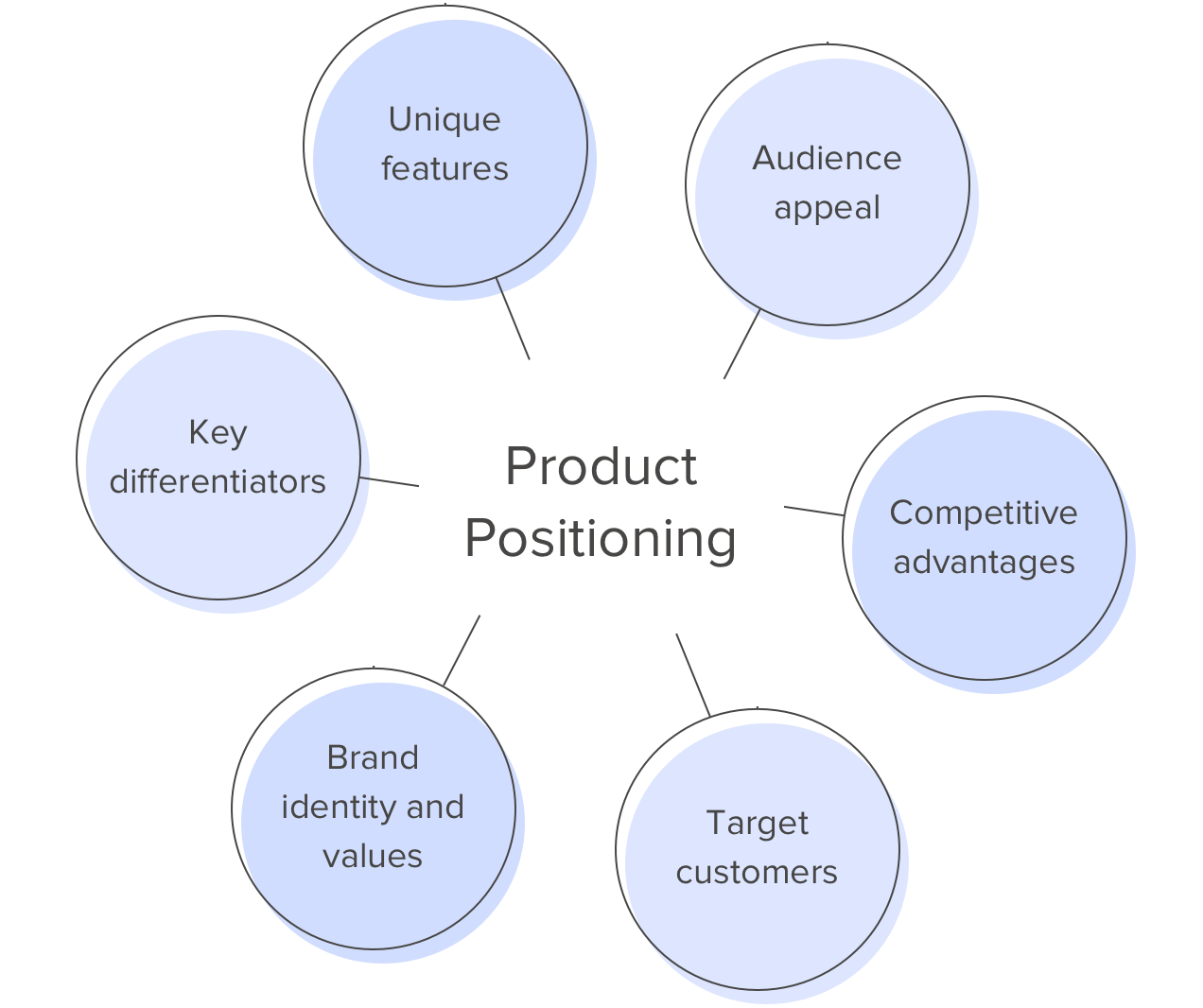
When positioning your product, you’ll want to consider the following factors:
Unique features
What makes your product unique? What are the most important features of this product, and what makes them original? How do you want these features to be seen by your audience – and how are they implemented in the product design?
Audience appeal
Who is your target audience? How can you market this product so that they see it as more attractive or “worth it”? What would they like to see from your product in the future?
Competitive advantages
Even if your market is relatively new, you’re likely going to face some competition. What are the key competitive advantages your product has and how can you market and promote them?
Category or industry
What is the market category for this product? How will people see it? Will consumers immediately understand how it fits in the marketplace? For many products, there are obvious answers to these questions. For others, your definition could dictate its ultimate fate.
Target customers
Who is your target customer? Who is going to be using this product and how are they going to see it? You’ll need to define the product features and utility differently if you’re targeting a fundamentally different audience.
For example, products marketed to teenage girls and those marketed to middle-aged men rarely highlight the same features and advantages. What are the core values, needs, and perceptions of your audience?
Pain points to be addressed
All high-quality products solve some sort of problem or address a major pain point. So what, exactly, does your product do? What pain points does your product address? This part of the equation can help you craft much more effective advertising – and make better pitches to your target audience.
Mission
What is your product mission statement? In other words, why does your product exist? What problem is it trying to solve? What are your objectives, and how are you going to serve your customers?
Vision
You’ll also need to think about your vision statement. What is your vision for the future? What are you aspiring to achieve? This is similar, yet distinct from your mission statement.
Brand identity and values
Your mission and vision are likely already part of your brand identity, but you’ll need to think about other variables as well. Does your product have a brand that’s distinct from your company’s brand? Either way, what is your brand personality like? What kind of colors, styles, and attitudes best represent your company and your product? How do you want to be perceived?
Key differentiators
Finally, what are your key differentiators? What makes your product appealing? What are the features of this product that set it apart from similar products on the market?
There may be a lot of factors to consider here, so think carefully about your audience and your competitive positioning. Are you less expensive? More robust? Do you offer better customer service? Are your brand and core values more subjectively appealing?
Why is product positioning important?
For starters, product positioning helps you define and better understand your target audience and their perceptions of your product. Having this understanding can lead to better messaging, a more effective marketing strategy and advertising campaign(s), and ultimately, more sales and revenue. It can also lead to higher customer satisfaction and customer retention, helping your business earn more revenue over time.
Product positioning is also important for the future of your product development. The strategic foundation of your product and the course of your product plan can always be tweaked and improved as you learn new information.
How can I position my product?
Now that I’ve covered what product positioning is and why it’s important, let’s look at how to carve out a unique position in the market.
Step 1. Rely on objective data
Many new entrepreneurs and inexperienced product developers rely on assumptions, instincts, or personal hypotheses to support their work. But it’s almost always better to rely on objective data whenever possible.
Thanks to modern measurement and analysis tools, it’s easier than ever to get this data. For example, you can use a Product/Market Fit (PMF) survey to learn more about your customers, your product, and your competitive environment. You can also use Net Promoter Score (NPS) tools to better understand customer loyalty – and your capacity to get referrals.
Focus groups are also a useful way to gather actionable data while tuning in to what’s on consumers’ minds.
Step 2. Determine your product’s positioning statement
A critical part of product positioning is crafting your positioning statement.
You may have heard this phrase before – a typical positioning statement goes something like this: “For [users] who have a [need], [our product/service] is a [solution] that solves it with [this benefit].”
Using the above statement format, you can easily identify who your ideal customers are, what types of needs they have, and how your product solves their problem using a specific benefit or feature(s).
Don’t let the simplicity of this statement fool you. Crafting an effective positioning statement is critical to understanding your customer and viewing your product from their perspective. Spend time thinking about and testing this statement to make sure it connects with your audience and truly resonates with potential customers.
Step 3. Test your hypothesis
Try to find evidence that supports (or rejects) your hypothesis.
Look for ways to test your idea or concept and pay attention to what the market is telling you. Primary market research is favorable, but you can also use secondary research such as reports published by industry experts, trade magazines, and academic journals. And, as you are validating your opinions, try to keep an open mind and always consider the counterargument whenever possible.
Step 4. Get feedback from multiple teams
Product positioning is cross-departmental. It’s relevant to departments like marketing, sales, product management, product development, and even customer service.
Accordingly, it’s a good idea to get feedback from multiple teams when figuring out what makes your product unique, the benefits of your product, how your customers see the world, what types of product positioning strategies work best, and whether or not your current strategy is actually working as intended.
When all of your teams can rally around a product mission, you can have confidence that your product strategy is aligned to support one overarching goal.
Step 5. Remain adaptable
Few businesses are able to nail product positioning from the outset. If you want a higher likelihood of long-term success, it’s important to remain adaptable.
That means gathering new information, challenging your previously held assumptions, experimenting with new tactics and approaches, tweaking your marketing plan, and even redefining your product, when necessary.
Examples of great product positioning
Let’s take a look at great product positioning in action. Here are some brands that get it right.
Allbirds
What sets this footwear and apparel brand apart? Two words: sustainability and accountability.
Allbirds is fighting the climate crisis by committing to be 100% carbon neutral – and inviting other businesses to follow suit.
TED
“Thank you for coming to my TED Talk.”
Many lengthy social media posts end with this phrase. And it’s a brilliant example of product positioning done right. Why? Because it demonstrates the ubiquity of the TED brand and its strategy to promote conversation and community knowledge sharing.
Apple
Apple dominates the tech market, offering products customers are fanatical about buying the minute they hit shelves. Having Apple’s latest and greatest phone – and accessories – has become a marker of status.
For Apple, it means they’re nailing product positioning focused on innovation, design, simplicity, and imagination – again and again.
Are you ready to get serious about your company’s product positioning? Do you wish you knew more about your product/market fit (PMF) and customer perceptions? Start gathering product and customer feedback with Delighted’s experience management software for free.
Justin Fowler is a Product Manager with over 5 years of experience and a Mentor at Product Gym. He transitioned into product management from a lengthy career in the insurance industry and now works with an AI-enabled voice analytics software company. Justin is living proof that you are not too old or out of touch to learn new tricks and practice another trade — if you are willing to put in the work.
First impressions are everything, especially when it comes to grabbing attention in your customers’ inbox.
To help your customers recognize that your email survey is coming from a trusted source – your brand – right off the bat, we’re excited to announce our new Sending domain feature.
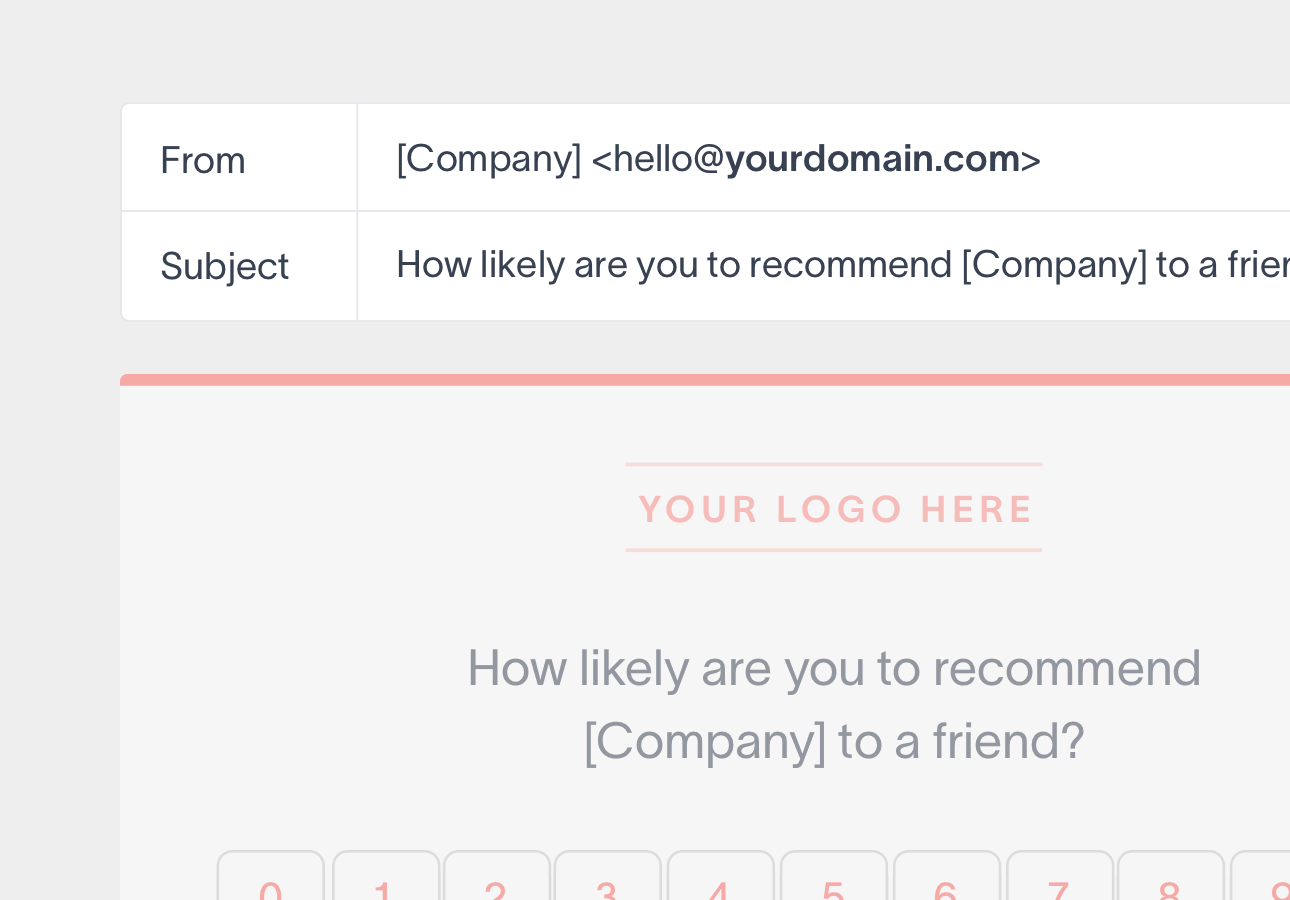
Now you can set a custom domain for your From email address, right in the Delighted platform.
In short, if the default state of your Delighted email survey is:
yourbrandname@delighted.com
You can now make it:
anythingyoulike@yourdomain.com
Why a custom email “from” address can boost response rates
Successfully getting feedback from your customers often depends on what type of relationship you have with those customers – the crux of the matter being that they have a relationship with you, not with Delighted.
Your customers will see your email surveys coming from a trusted, familiar name.
Since your customers know your brand, they’ll be more confident when opening the email survey and clicking to respond, which means more feedback for you.
While the default email surveys sent from the Delighted domain have high deliverability and follow the strictest sending policies, this one small change can make a difference in email open and response rates due to brand recognition.
Pro tip: It’s an email marketing best practice to specify a subdomain for your various email programs – usually the split occurs between transactional emails (think support or confirmation emails) and sales or marketing emails.
Our new Sending domain feature would also support specifying a subdomain specifically for your surveying program (e.g. feedback.yourdomain.com), to separate your survey program email reputation score from the ones that your other teams use.
This way, if the email sender score drops for one subdomain for whatever reason, it won’t affect the deliverability of emails from the others.
A completely secure, authenticated way to send emails from your own domain
To ensure Delighted has permission to use your domain when sending email surveys, we’ll provide you with a CNAME/TXT and DKIM record to enter into your DNS email management tool.
While domain verification is taking place, Delighted will continue sending email surveys using your old email “from” address, so that you still have an uninterrupted flow of feedback.
We’ll notify you within 72 hours if domain verification is complete. Then, all you’ll have to do is:
Activate the feature
Check that all the customization you’d like is in place, including your From name
Send yourself a test email – this isn’t strictly necessary, but highly recommended
And presto! You’ll be sending surveys from your own domain.
The customer experience (CX) space is relatively new – those courageous enough to take the reins of a young CX program at a growing company are often an army of one, with limited headcount and even fewer resources.
To add to these challenges, educational tools like handbooks, seminars, and models that explain how to grow a CX program, or assess your customer experience maturity, don’t really exist.
So where does the manager of a CX program start? Or, better yet, how does a CX leader keep a steady pulse on making sure their program is constantly maturing alongside their growing company?
How about with a framework – an approach to effectively mature and scale a program, while streamlining CX processes to support growth.
In this post, I’ll explain what customer experience maturity is, why a maturity model is an indispensable tool for CX leaders, and introduce the 5 pillars of our Delighted CX Maturity Assessment to help you assess and develop your program.
What is customer experience maturity?
Customer experience maturity is a tiered framework that evaluates the level at which the Voice of the Customer impacts key business decisions. The framework also helps you assess the depth and breadth of the processes in place to facilitate and evaluate that cross-functional impact.
After watching many of our customers grow their CX program on Delighted, we’ve found maturity can be simplified into 3 core tiers:
1. Getting started
An organization uses one metric to evaluate the customer experience, but findings don’t always make it to the rest of the company to act on.
2. Making progress
An organization begins to collect feedback at multiple touchpoints across departments and develops cross-functional objectives to improve CX.
3. Expanding and scaling
The entire company views experience management as a priority and engages the entire workforce in a workflow to make their customer experience a brand differentiator.
Before we dive into the 5 crucial pillars for CX leaders to know (no matter what tier your company is in), let’s take a look at your role and how you have a unique opportunity to take charge of evaluating and expanding your program with tools you can use today.
The role of the CX leader in maturing a customer experience program
As a CX leader, you are indispensable. You’re a cross-functional guru, bridging gaps between marketing, product, insights, and retention teams. You are the point person for the Voice of the Customer and a strategic resource for every other business unit, whether they know it or not.
When your marketing team has the budget for net new acquisition or retention campaigns, they lean on you to understand:
Which cohorts are happiest with our product/service offerings?
Who is most engaged and willing to promote the brand or purchase again?
When your product team is defining new features or optimizing existing ones, they may tap you to get clarity on:
What are customers saying about our existing products?
What features are being requested that we don’t currently offer?
When support managers are focused on cost reduction, promoting self-service, and creating delightful support interactions, they may ask you:
Who’s providing the highest level of service? Who’s falling below our support standard?
Which support channels are most efficient and which need extra attention?
As such, CX programs, the data that is collected, and the insights that are shared, can have a broad reach across the business. Likely, your goal isn’t to simply collect feedback to report out on a single metric (whether that’s Net Promoter Score (NPS) or Customer Satisfaction (CSAT)), but instead, magnifying the Voice of the Customer to strategically drive business growth and operations.
Why is a customer experience maturity model an indispensable tool for CX leaders?
Having said all of the above, many CX programs start out as the responsibility of just one department – marketing, product, or support.
Most likely, feedback isn’t being effectively actioned across the company. Stakeholders all believe it’s important to be customer-centric in principle, but they may not be able to effectively strategize around the Voice of the Customer.
A CX leader’s responsibility in maturing their customer experience program is to:
Align all of the aforementioned stakeholders on that customer-centric vision and empower department heads to make customer-first decisions
Build all the processes and pathways for the Voice of the Customer to drive business strategy
Institute a regular reporting cadence that monitors the impact of the program at large
This is a difficult, time-consuming process, but that is where a CX Maturity Model comes in to help break everything down into steps.
Additional benefits of using a CX maturity model
Your customer experience program should grow alongside your business. With routine evaluations through a model such as the Delighted CX Maturity Assessment, you will be able to:
Always understand the strengths and weaknesses of your current program
Develop plans to address those weaknesses
Track progress against your goals for CX improvement
Socialize the Voice of your Customer across the organization
Having widespread knowledge of where your CX program is and how you’d like it to grow can also help you avoid:
Siloing CX data and the insights your customers are surfacing
Over-indexing on superficial changes to your customer experience
Acting to improve a product/process because you think it’s what customers want
Evaluating customer experience maturity across the 5 pillars of a CX program
Here at Delighted, we’ve spent a few years auditing our customer’s CX programs and extracting the themes that we most commonly see among CX programs at various levels of maturity.
We’ve found that the most valuable and embedded programs are built around 5 simple pillars:
Strategy: A high level, company-wide roadmap for CX improvement
Surveying: Deploying feedback call-to-actions across customer lifecycle milestones
Actioning: Closing the loop on point-in-time feedback
Reporting: Aggregating feedback and surfacing customer insights
Sharing: Prescribing action, based on customer feedback, to other teams
I won’t delve into the details here, but these elements are interdependent – you won’t see a world-class CX program that excels in some pillars but not all.
Let’s take a look at a real-time example of how these pillars can move the needle on your CX strategy.
A real-time example of maturing with the 5 pillars
Here at Delighted, to no surprise, we take our own CX program very seriously.
The feedback we collect from our customers directly informs what we build and why we build it – a major part of the 5 pillar philosophy.
For example, the Delighted Customer Concierge team continually gathers NPS feedback and feature requests (Surveying) and builds reports on the feedback (Reporting) every month. We send these reports to our CEO (Sharing) and say, “Here is what our awesome customers are asking for, here is how we should prioritize it, and here is how it impacts the product” (Actioning and Strategy).
That is an example of a customer’s voice building a product roadmap – my team is simply here to organize and amplify.
The results of this process? We’ve added product features such as Additional Questions, Product/Market Fit (PMF) surveys, in-app reporting, and dozens of integrations to our platform based on verbatim feedback. We’ve also streamlined UX to double-down on self-serve functionality – which has the added benefit of reducing support volume.
Get the Delighted Customer Maturity Assessment today
Simply put, these 5 pillars have helped us navigate and mature our own CX program. And the impact carries through – our CX program exists not so that we can boast about an NPS score, but to give our customer’s voice a seat at the table.
Regardless of where your program stands today, start thinking about CX within the framework of these 5 pillars. To guide you in this endeavor, download the Delighted Customer Experience Maturity Assessment to:
Diagnose where your business is in its CX journey
Determine where you want to be, and
Plot out a path to grow your program in a scalable and valuable way.
Whether you’re just getting started with your CX program, making progress towards CX maturity, or expanding and scaling the program in stride with your business, this assessment provides prescriptive action just for you.
One of the most common questions we get from our customers is: What type of survey response rate can I expect?
When doing some research, you’ll see a wide range of numbers on what a “good” or “average” survey response rate is. These response rate benchmarks are usually qualified by a specific distribution channel or survey type:
33% as the average response rate for all survey channels, including in-person and digital (SurveyAnyplace, 2018)
Let’s dive in further to learn the definition, variations, and significance of survey response rates.
What is a survey response rate?
Survey response rate is the number of people who complete your survey compared to the total number of people who received your survey. Survey response rate is a percentage calculated by dividing the number of completed surveys by the total number of those surveyed (and multiplying it by 100).
For example, say you survey 1,000 people and 150 people respond – your survey response rate would be: 150/1000 = 0.15 x 100 = 15%.
What is a good survey response rate?
So, what is a good survey response rate? Factors that impact this include, how engaged your customers are with your brand, and whether you’re delivering surveys in a way that’s easy for them. Nevertheless, a good survey response rate ranges between 5% and 30%. An excellent response rate is 50% or higher.
Average survey response rates: Benchmarks from our 2021 data
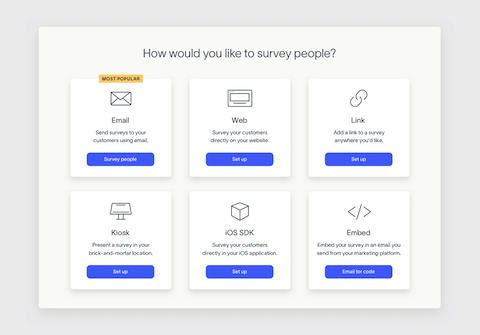
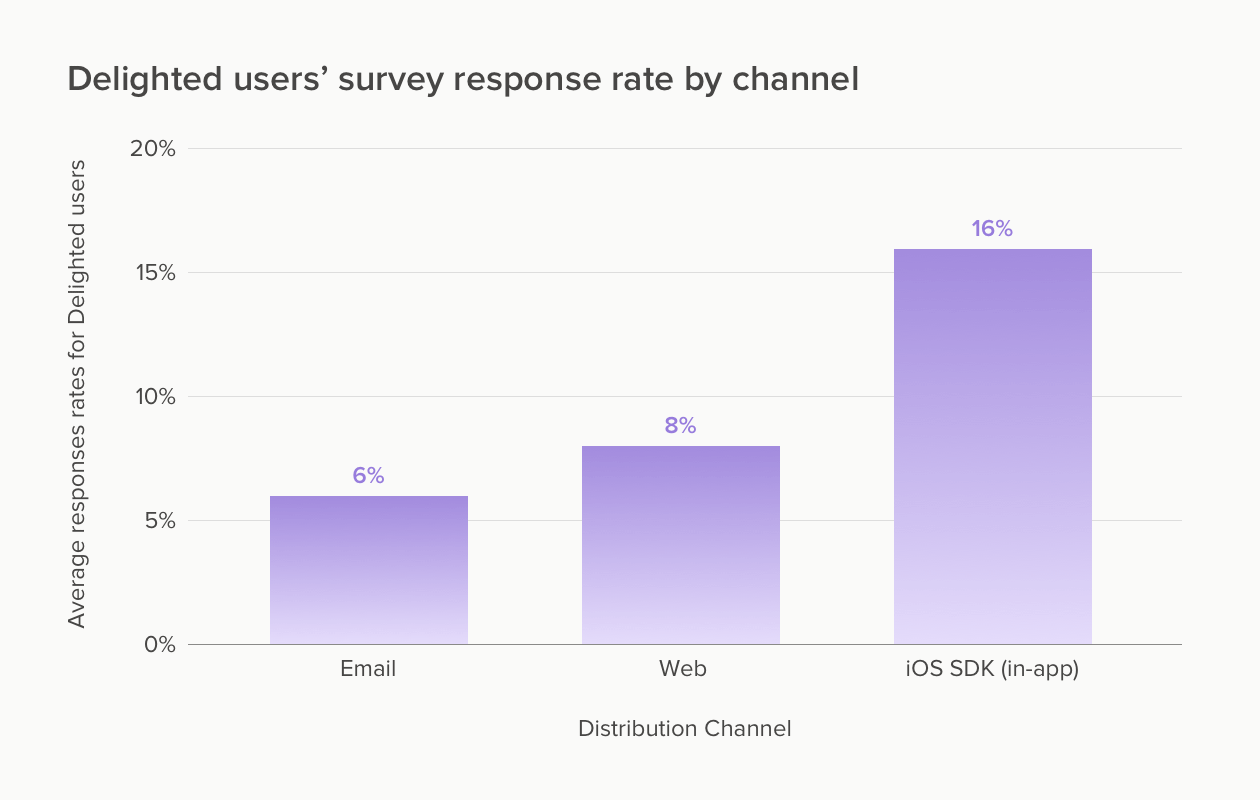
The average survey response rates ranged from 6 to 16% among Delighted users, varying by survey channel. iOS SDK surveys scored the highest response rates followed by website and email surveys.
6% for email surveys
8% for website surveys
16% for iOS SDK surveys
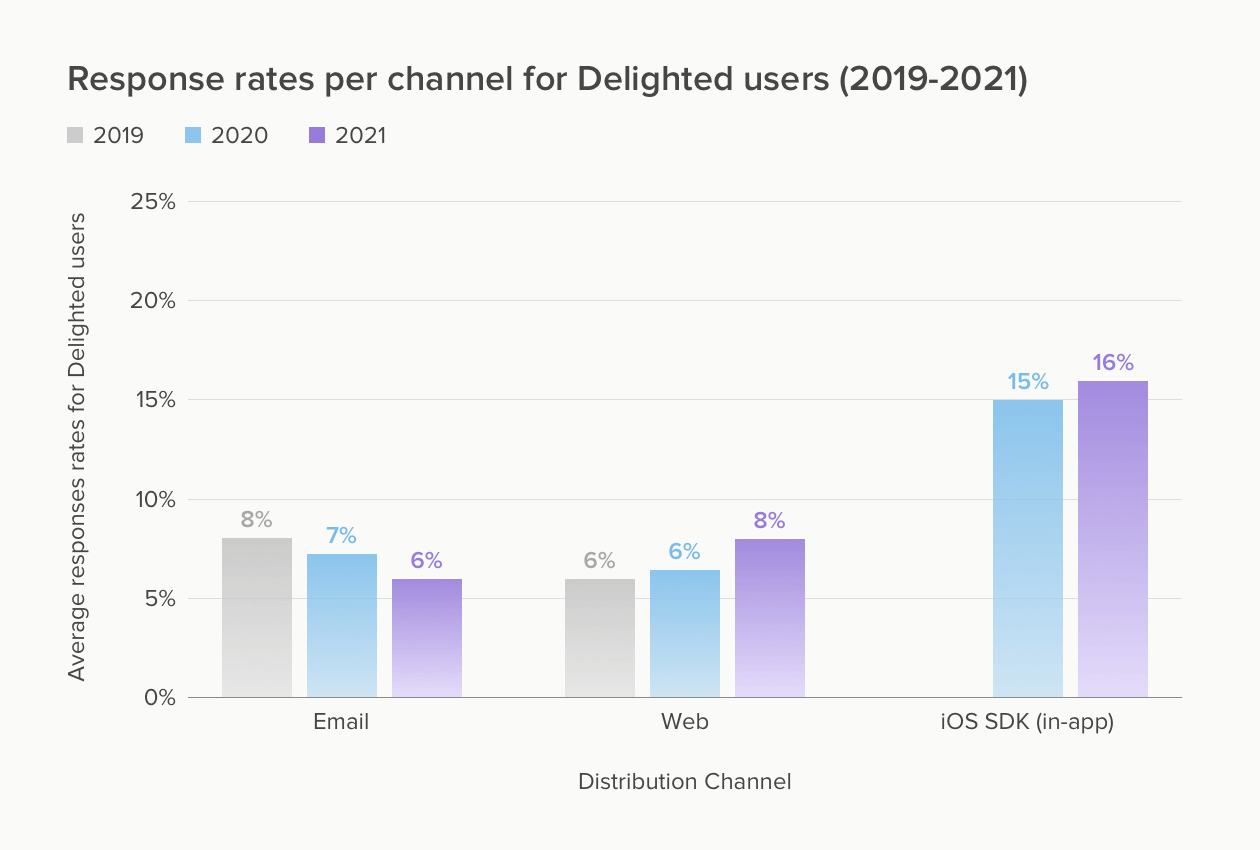
We were curious how the pandemic years may have affected survey response rates, and within each channel, the differences were pretty minimal. From what we’ve gathered, businesses that had to pause or slow down during the pandemic also limited the scope of their feedback programs. Customers who were receiving services still responded to feedback surveys at a similar rate.
Note: iOS SDK was introduced as a channel in 2020, which is why there is no iOS SDK data for 2019
What’s interesting to see is that there’s been a minor dip in response rates for email surveys over time, and a slight increase in response rates for surveys that are embedded into a user workflow – web and in-app.
Across the board, one of the lasting impacts of the pandemic has been an accelerated drive towards digital-first experiences. What the trend above suggests to us is that since more customers are in digital channels, embedding your survey into their user flow could be an effective way to get more feedback.
The takeaway: Response rates vary widely depending on the channel you’re using.
On the upper end, some of our customers have had response rates as high as 85% for email eNPS surveys and 33% for email NPS surveys.
Ido Breger, VP of Product for Cynet, recounts how switching from email surveys to web surveys dramatically increased the amount of feedback they received:
“Before we started using Delighted, we were sending email NPS surveys that just sat in our customers’ inboxes. Our response rates were so low that we couldn’t get an accurate NPS score with high probability.
We realized we needed to embed the survey into our customers’ normal workflow and make it very easy to give feedback.
With Delighted, a pop-up question appears on the website that our users can complete in a single click.
After maybe 10 days, we had six times the responses that we’d had within the last six months. It made a huge difference, and now NPS is something we actively participate in improving across the whole business.”
While it can be helpful to compare your survey response rate to an external benchmark, it’s even more important to set your own internal benchmarks by customer segment, survey type, and service tier. Try different channels and messaging to see what works best for you and your customers.
Why do survey response rates vary so much?
A wide variety of factors can impact how high your survey response rate will be, the most important being how engaged your audience is with your brand. Survey response rates can also vary by:
Industry: B2B vs B2C, with the likelihood of survey responses for B2B being higher than B2C
Your audience demographics: younger audiences may be more likely to respond than those over 65, especially if you’re using digital survey tools
Internal employee surveys vs external customer surveys, with response rates for employee surveys trending higher
The type of feedback you’re gathering: transactional surveys (CSAT or CES) tend to have higher response rates than relational NPS surveys – for example, our post-support CES survey response rate via an email signature link is 20%
Whether an incentive is offered to complete the survey
Timing can play a much larger role in your survey response rate than you might expect.
“Recency from an event, specifically for transactional NPS or event-based surveys, is a major driver of response rates.
For example, sending a post-support survey 24 hours after an interaction versus 7 days after an interaction is likely to produce better results, since customers know why you’re reaching out, and have top-of-mind feedback to share.”
– Sean Mancillas, Head of the Delighted Customer Concierge Team
To move the discussion away from the actual response rate number for a minute, let’s go bigger picture: what impact does your response rate have on your CX program?
Just how important is survey response rate?
The question of survey response rate is tied to statistical best practices for survey sample size – just how much feedback do you need to have an accurate understanding of your audience. The more pieces of feedback you have, the better, right?
Not quite. Just because you’re able to increase the number of people who respond to your survey, doesn’t mean the feedback you’re getting is more representative of the customers who matter most to you.
Here’s what research scientists in the space have to say:
“Concerns about response rates have solid theoretical grounding. You can’t make inferences about a larger group if people in the group won’t talk to you. Most of our statistics and margins of error assume having information from every member of a random sample.
But the reality for most research is that response rates are not high. And yet our findings are still accurate and there is evidence that sometimes lower rates give us more accurate findings. The reason? What matters is not how many people respond to a survey, but how representative they are of the groups to which they belong.”
“What counts most, of course, is high response rates from your core or target customers – those who are most profitable and whom you would most like to become promoters. Retail banks, for example, find it helpful to survey their customers by segment, so that the responses of their most profitable clients aren’t drowned out by those who are only marginally profitable.”
Though your business situation may vary, one concept holds true. Segmenting your customers and ensuring you’re hearing the voices that matter most is the key to success.
One of the easiest ways to do this is to connect your feedback tool to your CRM, so you can segment customers by service tier and gain a better understanding of how each of your customer cohorts feels about your business. You can also then confirm that you are hearing from the customers that drive your business forward.
None of the above discounts the importance of having a strong, consistent flow of customer feedback. If you’re getting little to no feedback, try taking these steps to strategically improve your survey response rates.
What role does response rate play when you’re thinking of how you’ll set up your CX program?
Many of our customers are setting up a customer experience program for the first time, with questions on how response rate factors into their program optimization.
Sean Mancillas, the Head of the Delighted Customer Concierge Team, shares his guidance:
“Our role is definitely to help ramp up the volume of feedback by strategizing around best practices and sampling, but also to manage and report on the feedback in a way that can tell an effective story. If you’re getting a 20-25% response rate, but it’s scattered across totally disjointed and unrelated subsets of customers, the feedback is going to be all over the place and will produce super confusing net results – potentially worse than just a lower response rate.
When we’re helping on response rates, we’re also working with you to scope your CX program a bit more thoughtfully to specific customer segments (e.g. folks that are more active, with a recent purchase, from X location) – which naturally leads to better engagement and a quality of feedback that can really drive effective reporting and a strong customer narrative.”
For more specifics on building your program with statistical significance in mind, check out our post on survey sample size or use our sample size calculator to find your ideal sample size.
How Delighted optimizes our own CX program for maximum feedback
We’ve done quite a bit of work on figuring out how best to reach our audience, and it has paid off. (Check out best practices to follow in this guide on increasing response rates.)
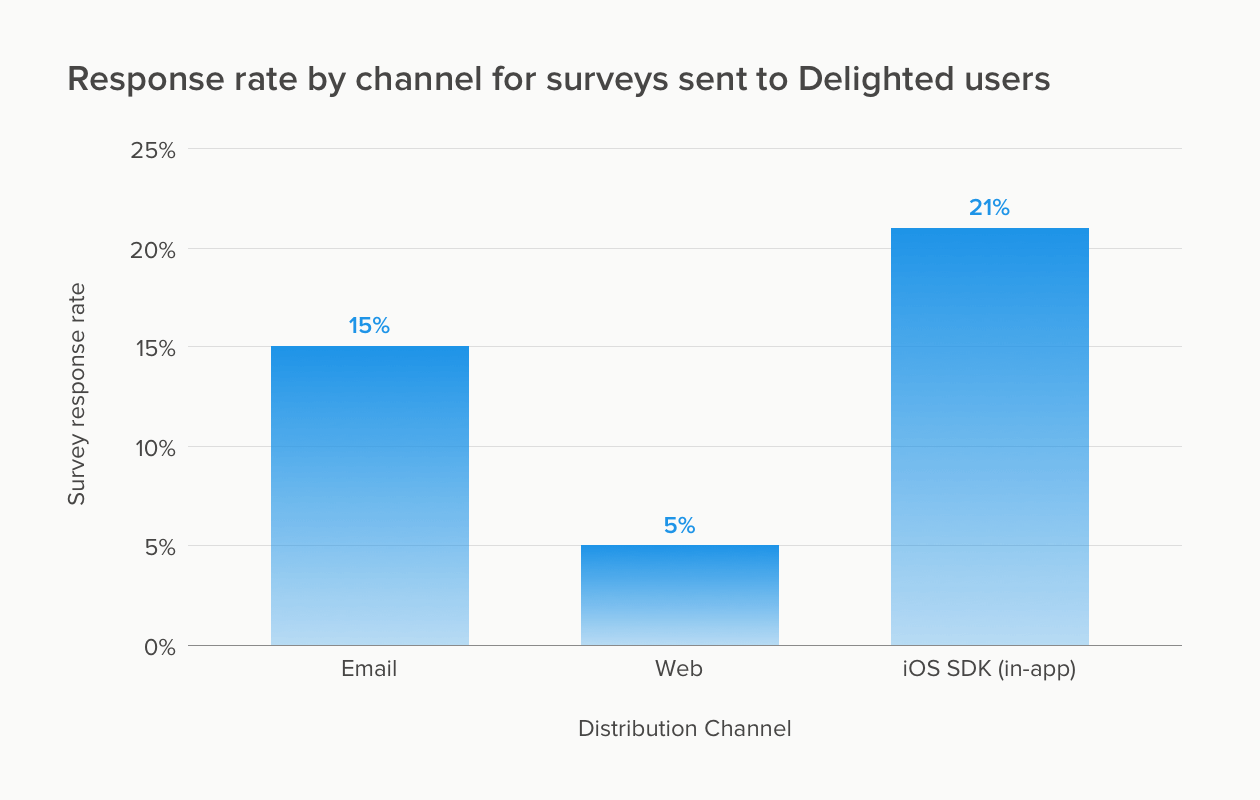
Here are the actual response rates we get when we send surveys out to our own customers to find out how much they like using Delighted.
You can see that we use multiple survey channels – email, web, and iOS SDK – to cast as wide a net as possible. The response rate varies substantially from 5% to 21% depending on the channel. Before we started using iOS SDK surveys, our internal response rate for email surveys was 21%, while for web surveys it was 10%.
Your response rates will fluctuate as you test the best distribution channel for your audience. Since we’re a B2B business with an app, it makes total sense that the iOS SDK channel would be a great way for us to gather NPS feedback.
At the same time, we still want to continue using email and web surveys to capture feedback from stakeholders who aren’t always logged into our platform.
If you’re itching to see how much customer feedback you can gather, try Delighted’s customer experience solution or customize one of our survey templates. Your surveys will be out to customers in minutes!
Does the future look bleak for brick and mortar stores?
2020 sure made it seem that way. The COVID-19 outbreak showed no mercy. Along with alarming health concerns worldwide, it had most retail businesses running for cover, with some of them having to bear the brunt of overnight closures.
For many others, their in-store footfall started to plummet and what followed was a desperate attempt to adapt and survive in the new normal. As the curtains came down on thousands of physical stores, customers took to the more convenient and safer alternative of shopping online.
We saw many brick-and-mortar stores pumping in resources to their existing ecommerce channels. Some of them even pivoted to go online for the very first time. It’s no wonder then that the online share of retail sales is expected to touch a record-breaking 21.8% by 2024, indicating a drastic shift in customer preferences courtesy of COVID-19.
But with global lockdowns in play, one of the things that ‘home-confined customers’ craved for is in-person (real-world) experiences. Going by recent survey which took place in the UK nine months into social distancing – one in four of UK adults were reportedly experiencing feelings of loneliness and were waiting to get back to their daily routines.
Today, with retail stores marching down the road to recovery, the pent-up demand for in-store experiences is making customers head back into the store – resulting in a 43.2% spike in the customer count across stores in the US. We’re slowly starting to see an uptick in restaurant reservations too – with reports by UK’s Office for National Statistics stating that there has been a 32% increase in seated diners compared to the same period in 2019.
The in-person shopping experience is making a comeback like never before
It’s safe to say that no business was immune to the ramifications and the digital acceleration brought on by the pandemic.
That said, people are now eager to get back to one of their favorite pastimes – in-store shopping.
With physical storefronts in the UK reopening, the BRC-KPMG Retail Sales Monitor reported that total retail sales were 17% higher in June 2021, on a like-for-like basis from June 2019.
Things are certainly starting to look up for physical store retailers. Nonetheless, there is also a need to reinvent the retail customer experience with a renewed focus on health and safety – which every in-person interaction demands today.
As the in-store customer experience is being redefined, it’s important to understand that there has been a massive disruption in the way we shop, especially for FMCG goods.
While the in-home consumption of perishables has been on the rise, another pandemic-infused trend is that customers are finding new stores to shop at. Globally, there was a considerable spike in customers shopping at stores that they have never shopped at before. The numbers climbed up from 39% in May 2020 to 45% in September 2020.
How can retailers offer an in-store experience that is welcoming and safe?
Retailers that are looking to weather the storm and increase walk-ins to their stores must realize the need to up their game and transform the in-store experience altogether. Retailers need to be quick to evaluate and reimagine their strategies to offer customers an inimitable shopping experience.
From implementing strict safety norms and social distancing programs to stock quarantining and hand sanitizing stations, retailers cannot afford to overlook fundamental COVID-19 preventive measures. It’s also imperative for retailers to tap into the omnichannel opportunity and give customers a perfect blend of offline and digital channels for their entire customer experience.
With a need to dial-up the digital presence, retailers are now taking the in-store experience online. Live streaming and virtual appointments are just some of the ways of reimagining in-person interactions for customers who may be hesitant to venture back into physical stores.
6 noteworthy examples of in-store customer experiences in a post-pandemic world
As the pandemic is rewriting the rules of retail, we’ve been treated to innovative in-store customer experiences that are fitting for a post-pandemic world.
Here’s a quick rundown of our top picks:
1. The rise and rise of BOPIS
The Buy Online, Pickup In-Store (BOPIS) trend has been quite a hit. In today’s fast-paced world, customers are looking at ways to leverage technology to expedite the shopping experience.
BOPIS offers just that – with the ‘click and collect’ option, customers can shop online and then head to the store to pick up their purchase. As per Insider Intelligence, in 2020, US shoppers spent a whopping $72.46 billion via ‘click and collect’.
In addition to ensuring that safety and security measures are in place, BOPIS also allows retailers to pace up and adapt to the customers’ busy lifestyles.
Lowe’s, the home improvement chain of retail stores, had introduced BOPIS back in 2019. Today, they are taking convenience to the next level by deploying pickup lockers at their stores in the US — removing the need for customers to wait in line or reach out to store associates for assistance. Customers are allowed to collect same-day orders by using a barcode that they receive via an automated email.
Lowe’s is enabling customers to get in and out of the store, faster than ever before thereby streamlining the in-store experience for a post-COVID world.
2. Say hello to built-in drive-thrus and digital menus
Eating out in a restaurant may not feel the same anymore. The restaurants had it tough with health and safety laws cracking down on them.
Fearing closure, many restaurants are pivoting to offer curbside pick-up and home delivery. Diners, on the other hand, are stepping in with disposable silverware, single-use or digital menus, and QR codes to enable no-touch ordering.
Among restaurants that have moved to the cash-free space is Chick-fil-A. With customers demanding hygienic, touch-free payment alternatives, the restaurant takes things up a notch by allowing customers to make in-app payments for their orders.
Another example from the restaurant space that’s worth a mention is Taco Bell’s revamped drive-thrus. Customers are increasingly shifting to ordering food online – and Taco Bell is meeting their demand with two newly designed drive-thru lanes. Customers who placed orders via their mobile app can now pick up their nachos and burritos a lot faster with a dedicated lane for picking up mobile orders. That’s not all, Taco Bell is also ramping up the customer experience with high-tech kitchens and pickup shelves for their curbside pickup.
3. Autonomous stores take over
With customers heading back to grocery stores to shop for their daily essentials, autonomous stores like the Amazon Go model are making a mark.
Amazon’s ‘cashier-free, just-walk-out’ experience where customers are not required to touch anything besides the items that they are purchasing – is starting to see many takers despite their slow roll-out.
Retailers today are looking to quickly adapt and implement autonomous store technologies in a bid to allow customers to skip checkout lines and give them the touch-free experience that they desire.
4. The power of virtual retailing
Retailers are leaving nothing to chance in their race to keep up with digital-savvy customers. Virtual retailing is helping them tap into new revenue streams and also attract health-conscious shoppers by meeting their safety demands.
From just a nice-to-have feature, the virtual shopping experience has gone mainstream.
Ralph Lauren joined forces with Snapchat to give a new meaning to virtual connections. Together they have created virtual versions of real-life Ralph Lauren outfits for Snapchat Avatars, called Bitmojis.
With these virtual connections, Ralph Lauren is pushing beyond physical restrictions to build immersive and personalized brand interactions with customers. Using Bitmojis, Ralph Lauren enables customers to virtually ‘try on’ the clothes and make the purchase within the app. Allowing shoppers to try on collections virtually, comes as a relief for many – especially with growing health concerns of visiting the store and waiting in lines to use the fitting room.
5. Grocery stores bank on new delivery mechanisms
With an increasing demand for perishables and convenience items, grocery stores are turning to the likes of food delivery companies like DoorDash.
DoorDash launched DashMart to help customers order household essentials and ready-made meals from the comfort of their homes – removing the need to make those quick trips to the store.
As more convenience stores take on the digital route, DoorDash offers customers a wide selection of daily essentials and even promises express delivery, faster than what their local grocery stores can offer.
6. Co-working brewery, anyone?
As breweries started losing out on sales, most of them had to close their doors for the last time. But not Optimism Brewing. They found a new way to attract customers by turning the brewery into a co-working space.
Customers seemed to love the idea of working from their favorite brewery. Optimism Brewing allows customers to even reserve a desk in their outdoor space, giving them the much-deserved break from the mundane work-from-home routine.
Gear up for an innovative in-store customer experience
The pandemic has forever changed customer behavior.
To keep customers coming back for more – brick-and-mortar store retailers will have to take on a more agile operating model, one that redefines the physical layout of the stores.
Retail spaces with built-in distancing and strategic product placements are essential to offer the grab-and-go shopping experience that today’s customers will enjoy.
About Ganesh Mukundan
Ganesh Mukundan is a content marketer at Hiver who loves everything customer experience and customer service. Ganesh is passionate about narrating delightful customer stories, researching CX trends, and diving into concepts such as VoC and Customer Journey Mapping. When he’s not working, Ganesh likes to rap, play football, and binge-watch Nordic TV shows.
You’ve likely heard the saying, “If you can’t measure it, you can’t improve it.” And while the saying may not be referring to the employee lifecycle, the sentiment certainly rings true within the workplace.
The employee lifecycle is the journey employees embark on when they first join your organization and lasts through to when they leave (and sometimes beyond that). While there are a myriad of experiences within the lifecycle, there are 7 major stages – and understanding the stages is key for experience improvement.
Here’s a closer look at what the employee lifecycle is, why designing an employee lifecycle is important, the 7 stages you should know about, and how to develop a strategy to improve your employee experience management.
What is the employee lifecycle?
The employee lifecycle model is used to identify the various stages an employee goes through during their engagement with your company. The 7 stages include attraction, recruitment, onboarding, development, retention, exit, and advocacy.
Collectively, the employee lifecycle is the sum of all the moments spent at your organization: from when an employee becomes aware of your company to when they move on to the next company (hopefully speaking kindly about their time working for you) and every moment in between.
By understanding the employee lifecycle, organizations – and HR teams and leaders, in particular – have an opportunity to measure and improve all those micro-experiences for their workforce.
Why is it important to design an employee lifecycle strategy?
When organizations design employee lifecycle strategies, they are able to understand the moments that matter most, how those moments impact the employee experience, and what to do to positively impact metrics like employee engagement, retention, and productivity.
By designing and implementing an employee lifecycle strategy at your organization, you can:
Uncover valuable insights to design and execute better experiences at each lifecycle stage, including formerly unseen experiences.
Find out which stages of the employee lifecycle work well and apply those insights at other stages to meet employees’ needs.
Fix bad experiences more effectively. Capturing feedback throughout the employee lifecycle helps reveal why you haven’t met employee expectations – and what you need to do to better support your staff.
Having a better understanding of the employee lifecycle can also improve how you hire employees, retain them, and even how those employees remain productive and add value to your organization.
What are the 7 stages of the employee lifecycle?
Whether a team member works at your organization for 10 weeks or 10 years, every person you hire goes through the employee lifecycle.
This journey can be segmented into the following 7 stages.
1. Brand attraction
If you’ve ever made a purchase and thought, “Wow, this product is great and so is this company. I want to work for them.” – then you’ve experienced brand attraction.
Organizations that build strong brands to attract customers can also translate that magnetism to attract new employees.
We consider employer brand attraction the first stage of the employee lifecycle and a stage to get right if you want to win the recruiting war for talent.
2. Recruitment
From job postings on social media platforms to the interview processes with your team members, this stage includes all the steps that lead to hiring a new employee and any aspect that impacts the candidate experience.
In this phase of the employee lifecycle, you should not only represent your employer brand as a great and fulfilling place to work (i.e., speaking to your company culture in the job description), but you might want to ask candidates about their experiences to know if finding and interacting with your company made for an easy recruitment process.
Some questions may include topics such as:
Length of their recruitment process
Communications with the recruiter and/or hiring manager
Satisfaction with the interviews themselves
3. Onboarding
In this stage, employees undergo training to learn your organization’s systems, tools, processes, expectations, and duties of their new role.
When a new employee engages with an efficient onboarding process, they can translate their initial enthusiasm for their new job into a commitment to achieving their goals and creating a meaningful connection to the organization.
4. Professional development
An ongoing stage in the employee lifecycle, professional development pertains to the activities organizations conduct to train and develop employees.
Employees develop at different rates, and as they do, they’ll discover new interests. Be sure to offer employees opportunities to continuously expand their skill sets.
This stage will also include milestones or annual events, such as role changes, promotions, employee performance evaluations, and career conversations.
5. Retention
At this stage, employees fully integrate into your organization. As such, organizations want employees to continue performing, developing, and contributing to the company’s success.
While there are many ways to boost employee retention and engagement, organizations should start by simply asking how employees feel about their work, what matters most to them, and taking action on that feedback.
6. Exit
Every employee will leave your company at some point – whether it’s their choice to retire, move to another employer, or make a life change. Finding out why employees leave is an opportunity to improve and develop the employee experience for current and future employees.
Our advice? Always conduct exit interviews with departing employees. Those who are leaving may be more candid and honest – revealing truths and insights you can take action on.
Near the end of the employee lifecycle, you also want to leave a lasting, positive impression on departing employees. Stage 7 reveals why creating an effective offboarding process is a critical step in employee lifecycle management.
7. Advocacy
From social media posts about your company to real-life conversations about your brand, employee advocacy is everything your employees do and say that represents what it is like to work for your company.
But what about former employees? Have you thought about what they’re saying after they leave your company?
Research shows that employees with positive exit experiences are nearly 3x more likely to recommend their former organization than unhappy or neutral ones.
Conversely, unhappy departing employees can damage your employer brand (hint: that’s what we talked about back at stage one), impact your ability to attract new hires, and damage your customer brand.
That why it’s critical to get the final stage of the employee lifecycle right.
How to develop an employee lifecycle strategy
Now that you understand what the employee lifecycle is, its importance to employee attraction and retention, plus the 7 stages at which you should gather feedback, it’s time to start creating your own employee lifecycle strategy.
Not sure where to start? We’ve provided three simple tips below.
1. Map your employee lifecycle
Start by fully mapping out the employee lifecycle at your organization, using the 7 stages as a framework. Then, consider variables like:
How does the average employee learn about your business and start working for you?
How do they grow and develop?
What’s their main reason for leaving?
2. Utilize surveys to capture employee feedback
Next, you’ll need objective analytics tools to help you capture variables related to sentiment throughout the employee lifecycle stages.
Detailed employee surveys at each stage of the employee lifecycle will give employees an opportunity to present you with honest feedback about your organization. For example, you can use an employee Net Promoter Score survey, or eNPS survey, to learn how likely an employee is to refer another employee to your organization.
Metrics from employee lifecycle surveys will allow you to pinpoint potential problems, identify strengths and weaknesses, and brainstorm possibilities to improve the employee experience in the future.
3. Prepare to grow your survey program
Delighted provides an ideal turnkey solution to launch an employee experience program and quickly gather actionable feedback.
Once your organization becomes accustomed to surveying, you can gradually expand your employee experience (EX) management program and mature into the Qualtrics Employee Experience suite of EX solutions – including 360 performance feedback and feedback for the most resource-intensive and impactful experiences, like hiring and onboarding.
Ready to get started? Jump into eNPS surveys here, or capture employee feedback across the employee lifecycle with Delighted’s HR survey templates.
Consumers experience your brand in many different ways. And with each new interaction, their perception of your brand can change, potentially leading to a new customer or a lost one.
The stakes are high. Bad experiences currently cost global businesses around $4.7 trillion in consumer spending annually, as customers stop spending money with brands that don’t give them the experience they’re looking for. With 9.5% of your bottom line at risk because of negative experiences, you can’t afford to let bad interactions slide.
So, how do you go about ensuring more positive customer experiences and fewer negative ones?
Customer Experience Management will help you to determine what customers are experiencing, what their expectations are of those experiences, and if your business is delivering on those expectations.
This guide will teach you how to understand and implement Customer Experience Management so you can launch your own customer experience program to connect with consumers effectively.
Customer experience (CX) is the overall perception of your brand in the eyes of your customer, based on the individual and accumulated interactions they have with and about your brand.
To be able to improve customer experiences, you need to be able to track, measure, and understand all the interactions your customers have with your business. That’s where Customer Experience Management comes in.
Customer Experience Management (CXM) enables you to make sense of not only what your customers want, but what actions you need to take to deliver experiences that meet or exceed customer expectations. A CXM strategy will take a brand from simply reacting to customer requests to anticipating and adapting to customer needs in advance with insights gathered directly from the customers themselves.
In other words, CXM focuses on learning how customer interactions can be improved and then taking action. It’s a system for continual improvement, carried out across your company.
Why is Customer Experience Management important?
Investing in Customer Experience Management can give your company insight into how customers experience your brand, what’s lacking, and how to do better.
The benefits include:
A customer-focused company culture with aligned mission and values
Better-informed product development and service provision based on real customer expectations, thoughts, actions, and behaviors
Lower churn rates and more opportunities to upsell current customers
Better reviews and testimonials due to continued, positive customer interactions
What are the challenges of Customer Experience Management?
Customer Experience Management is a vital but often complex process. The challenges that can arise during this procedure can be:
Keeping track of customer experiences, expectations, and sentiment
Getting customer opinions when they don’t proactively offer them
Releasing useful customer information from your company’s siloed departments
Creating useful insights instead of collating extensive data
Empowering your teams to take action
EffectiveCustomer Experience Management planning and execution can solve these challenges. That’s why we’ve provided step-by-step guidelines to help you get started with CXM strategy planning.
An actionable Customer Experience Management framework
The below framework offers a high-level Customer Experience Management strategy to help you launch a thriving CXM program.
Step 1: Improve organizational understanding of the customer experience
Aligning your organization around the customer and enabling employees with a clear strategy is critical to Customer Experience Management success.
Increasing awareness across your organization of how the company is performing with customers and what actions contribute to the current state of the customer experience is a good place to start.
Your company could already be tracking core operational metrics, but here are a few important ones to track and share:
Churn rate: the rate at which customers stop doing business with you
Retention rate: the percentage of customers that remain customers over a given time period
Customer Lifetime Value (CLV): the customer’s total revenue value over the lifecycle of your relationship with them
Monitoring your key operational metrics is one goal, but tracking operational metrics alone is not enough for Customer Experience Management. You’ll also need to take action — but more on that later.
Step 2: Map out your customer journey
Think of a customer journey map as a visual guide of the touchpoints to track, measure, analyze, and improve. Plotting the touchpoints people experience with your unique business before, during, and after purchase helps you to see where gaps lie and which interactions lead to success.
Remember – customer experience happens everywhere people see or engage with your brand, both online and offline. And, every touchpoint with your brand is a moment of judgment that can be mapped out and used for strategic CXM planning.
To get started, company leadership should work with each department (sales, support, marketing, product, etc.) to detail their respective touchpoints and produce your company’s unique customer journey map.
From there, aim to gain a baseline understanding of how each touchpoint is performing. This data can be found in tools you likely already use. Social media software, survey software, customer support software, CRM software, and product analytics platforms should all provide reporting on interactions and performance of their respective touchpoints.
It’s best to collate this data in a central experience platform to help your entire organization see how their work impacts the customer experience. Again — more on that later.
Step 3: Establish customer-centric values and processes
With an organizational understanding of Customer Experience Management initiatives and a centralized understanding of customer data, you’ll be able to encourage more customer-focused collaboration, as well as a sense of accountability.
Internal feedback (received verbally, in focus groups, or even through employee surveys) will start to surface from each department on how improvements can be made. You will learn the challenges each department faces, opportunities for improvement, and anecdotal experiences they have had with customers.
This new dialogue helps establish customer-centric values that the whole company can embrace. It will also help implement processes that boost internal collaboration to improve customer experiences together, as a team.
Step 4: Set goals for improvement
Performance transparency, clear values and processes, and improved internal collaboration make it much easier to set goals and stay accountable to them.
Company leadership should work with their teams to identify how they can best impact operational metrics, touchpoint performance, customer experiences, and customer service.
Then, set specific goals (or KPIs, key performance indicators) that they can work towards.
These goals are not just to track metrics – they’re to help you work towards the improvement of your internal processes and increase customer satisfaction long-term.
Measuring your customer experience with CX data
While operational metrics and touchpoint performance data provide a high-level understanding of the customer experience, they don’t provide much insight on customer sentiment or provide ideas for improvement. To get specific insight from your audience, you need to ask them directly through customer feedback.
Step 1: Obtain direct customer feedback and create profiles
The best way to learn why individual people do the things they do and gauge their sentiment along the way is to ask them strategic questions that align with your overarching goals.
This is where a Voice of the Customer (VoC) program comes in. This is a closed-loop process of collecting written or spoken feedback on customer experiences and expectations.
Customer Effort Score (CES) is a CX survey methodology for measuring how easy it is for a customer to complete a specific action with your business.
Thumbs is a two-option CX survey for straightforward Yes/No feedback.
5-star and Smileys are CX surveys designed for quick sentiment reading through visually intuitive rating scales.
After giving a rating answer, each CX survey above asks a follow-up question on why they gave the rating they did. This is where the written feedback comes from. You get back quantifiable data in the rating and qualitative data in the feedback that answers the elusive “Why?” question.
Here are some examples of how you can use these methodologies to understand customers better:
Want to learn why customer retention is down? Trigger a Net Promoter Score (NPS) survey to new users after they have used your product to get written feedback on why they would or wouldn’t recommend your product to others.
Want to learn how you could improve the conversion rate of purchases? Show a Customer Effort Score (CES) survey after checkout to learn how easy/hard it was to complete the purchase.
Want to learn how customers feel about their interactions with customer support? Email a Customer Satisfaction (CSAT) survey to customers that just completed a customer support interaction.
This data can help you to develop specific customer profiles (buyer personas) that will make personalization and specific audience targeting easier.
Step 2: Track customer experience scores
The rating answers from customer surveys aren’t just there to provide insight into how the individual survey taker thinks. These ratings are calculated into CX scores that give you a baseline understanding of how you currently stand with your customer base as a whole.
You can also dive deeper into specific touchpoints across the customer journey and use these metrics as benchmarks to gauge improvement over time.
Gathering CX intelligence to gain insights on customer experiences
Now that your teams are enabled with process, goals, useful operational data and purposeful CX data, it’s time to use this information to uncover actionable insights.
Step 1: Get the right customer experience management tool
First off, the ease and quality of your customer experience analysis really comes down to choosing the right customer experience management platform. Besides being able to create and deliver CX surveys, your Customer Experience Management solution should provide the following analysis capabilities:
Easy integration of customer data to add context to survey results and enable segmentation
A real-time feedback dashboard that can be organized with customer segmentation, tagging, sorting, and filtering
Automatic CX score calculation and reporting that makes it easy to see scores (and feedback) by customer segment and/or tag
Step 2: Analyze customer feedback and CX scores
Analyzing your customer feedback and scores can be undertaken as follows:
Read the survey feedback as it comes in – there may be obvious insights that you can act on quickly without further analysis.
Categorize your feedback – as you review, use filtering, tags, and imported customer data to add layers of segmentation to the feedback that will enable meaningful analysis.
Dive deeper by comparing the feedback and CX scores across your segments – this process is called cross-tab analysis, and your Customer Experience Management platform should have this capability built-in.
Even with more advanced feedback analysis, sometimes what might appear as a problem on the surface may just be a symptom of a larger issue. In these cases, a root cause analysis is required to uncover what the real problem is, why it happened, and what can be done to prevent it moving forward.
Taking CX action to improve customer experiences
With customer experience insights under your belt, you are now ready to take action to improve customer experiences, outcomes, and sentiment.
Step 1: Close the loop quickly and win over customers
When uncovering a critical issue through customer feedback, not only should your team aim to resolve the problem immediately, but also acknowledge the customers who provided you with this insight by closing the loop. This is when someone at your company reaches out to those that provided feedback to let them know that their voice was heard and that your team is working to resolve the issue.
Closing the loop is a proactive activity and something that should be done not only with those who rate an experience poorly or flag issues to your customer support team, but also with those whose sentiment towards your business is positive.
Having a customer service strategy in place can help with that. Established CX strategies can ensure your support team members are onboarded with the latest close-the-loop processes and know the tools and communication standards for acting on feedback responses quickly and effectively.
Step 2: Leverage insights and feedback to improve marketing results
Listening to your customers through customer experience surveying and follow-up engagement will not only uncover ways to improve experiences, but it will also uncover what people love about your business and opportunities to fuel growth.
More positive customer experiences will lead to more positive customer testimonials and reviews you can use to boost conversion rates on your website and drive more prospects from review sites. While not every happy customer will provide reviews or testimonials on their own, customer feedback-powered reputation marketing can help you be proactive in getting more customers to do so.
Step 3: Make informed decisions for organizational transformation
As you build out your Customer Experience Management (CXM) program, your organization will collect more and more definitive insights. You will uncover high-impact opportunities to increase customer satisfaction with their experiences and to grow your business. However, you may not be able to implement them right away.
If the same issues continue to arise, don’t just implement stop-gap fixes. Gather enough insight to make informed decisions on how to address customer concerns with new product developments or policy changes.
With your CX data and insights accessible across your organization, encourage everyone to share their ideas on how real, transformative improvements can be made.
How to get Customer Experience Management right
Customer Experience Management is a continuous and long-term business activity, but one worth investing in. With 84% of organizations that focus on improving CX reporting an increase in revenue, implementing a Customer Experience Management program offers a great return on investment.
However, there are a few key ways Customer Experience Management has to be done to see these stellar results. Here are our suggestions:
Implement your Customer Experience Strategy from the top down – without leadership buying in, your teams will likely still work in a siloed fashion
Try to bring all your data and analysis under one roof – using disparate programs can make it much harder to see key insights
Don’t just track, take action – it’s easy to monitor scores and call it a day, but the real ROI is in the organizational changes you make as a result of the insights you gather
Manage customer expectations – if you can’t provide the experience they want or have failed to in the past, show them you’re working on it
Understand that this might be a long-haul digital transformation, but one worth making
Launching your Customer Experience Management program
The Delighted Customer Experience Management platform is built for organizations ready to dive into CXM with ease and affordability. Everything detailed in this guide, from CX surveying to analysis and action, can be done with our experience management software – no technical expertise required.
This article was written by Project Manager and B2B Copywriter, Lee Li Fang.
No matter what industry a company is in, customer satisfaction is one of the most important measurements of success. The best way to ensure that your company is succeeding in this area is to collect and monitor customer opinions and sentiments.
Insights into customer satisfaction can help your brand develop better products, create breakthroughs in service delivery, attract ideal customers, and optimize business operations. It can also assist your company with developing and, most importantly, maintaining positive customer relationships.
In this article, we will discuss the most common measurements of customer satisfaction, how this data is collected, and why these metrics matter to the success of a company.
Online customer reviews
This one may seem obvious, but it’s one of the most important measurements of customer satisfaction. Common online review platforms – such as Yelp or Google – employ their own metrics for how your company meets customer expectations. Typically, these are rated as stars, with 5 stars being the best rating and 1 star being the worst.
Studies show that the majority of people read reviews before visiting a business, and among 18-34-year-olds, 91% of those surveyed trust reviews as much as personal recommendations. For this reason, encouraging your customers to leave reviews after they purchase your product or service is integral to attracting more customers.
In fact, some may say that no reviews is even worse than negative reviews. A company with no reviews seems new, inexperienced, and unattractive to the average customer. This is one of the reasons why influencer marketing has grown in popularity. When customers see that their favorite celebrity or online influencer endorsed a product, they are much more likely to try it out.
Negative reviews present opportunities as well. They can be used as a customer retention tactic and give your company insight into what areas can be improved. Ensuring that your company responds to negative reviews with an offer to make it right shows people how your company handles potential customer service issues. In fact, handling a negative review well can instill just as much confidence as a positive review.
Churn rate
Enhancing customer retention can be even more important than attracting new customers. In fact, acquiring a new customer can cost 5x more than retaining an existing customer. To calculate how well your company is at retaining existing customers, you can use a formula that will show you your company’s churn rate.
(Lost Customers ÷ Total Customers at Start of Chosen Time Period) x 100
For example, let’s say you want to measure your churn rate for the month. At the beginning of the month, you have a total of 100 customers. By the end of the month, you lost 15 customers. Your churn rate would be (15 / 100) x 100 = 15% churn.
Churn rate is critical because it can help companies understand why customers leave and even indicate times of the year when churn rate is highest. Marketers and sales teams can then make meaningful decisions regarding new promotions or develop customer activation strategies based on the insights. It can help you better nurture your existing customers and turn them into valuable brand promoters.
Churn rate can help your company understand the patterns that lay behind churn that they otherwise wouldn’t have known. For example, a company may have a high-rated product and stellar customer service, but perhaps they notice that their churn rate is highest around the same time customers pay their bill.
After some investigation, they discover that the issue isn’t the product or its pricing at all, but rather an invoicing system that is time-consuming and inconvenient. Choosing high-quality invoicing software that comes with crucial features like recurring payments for repeat customers can help mitigate a high churn rate during that time of the customer journey.
Customer Effort Score
These days, customers expect the buying process to be easier than ever before. Not only do they expect to be able to get all the information they need to make a quick purchase, they also want deliveries to come at lightning speeds and with overall little effort on their part. Without question, customers who describe a transaction as being cumbersome and time-consuming will be much less likely to buy again.
An easy way to measure and reduce customer effort is through determining your Customer Effort Score (CES), typically gathered through CES surveys.
Reducing customer effort is important for easing the online and in-person shopping experience, your self-serve support solutions, the return process, etc. CES surveys make it easy to capture sentiments at specific interactions with your brand so you know exactly where to take action and correct the customer experience.
Net Promoter Score
Just like customer reviews, word-of-mouth referrals are very important if you are looking to expand your customer base. The best way to get insight regarding how many of your customers are promoting your products or services is by calculating the Net Promoter Score (NPS), usually with a post-purchase survey. You can send a customer survey through multiple distribution channels and ask customers to rate how likely they are to recommend your company on a scale from 0 to 10.
Customers that respond with a 9-10 display a high level of customer loyalty and are likely to share your brand with their friends and family. Customers who are loyal to your brand represent a huge marketing opportunity because prospects are much more likely to buy from companies recommended to them by people in real life.
Customers who respond with a 7-8 are considered “passive,” as they don’t dislike your company, but they won’t necessarily try to convince people to buy from you either. Customers considered “detractors” are those that label companies with a 6 or lower.
To calculate your NPS score, take the percentage of your detractors (those who scored 6 and lower) and subtract them from the percentage of your promoters (those who scored a 9-10). Net Promoter Score can help you predict churn and learn more about customer loyalty throughout the customer journey.
Customer Satisfaction
Customer Satisfaction Score (CSAT) is a simple rubric that asks your customers to rate their satisfaction on a 3 or 5-point scale and the CSAT score ranges from 0-100. After sending out the CSAT survey question, you can calculate your CSAT score by dividing the number of satisfied customers (scores 4 or 5 on a 5-point scale) by the total number of responses, and multiply that number by 100. For example, if you have 100 customer responses and 90 of them indicate satisfaction, your CSAT score is 90%.
CSAT surveys are not only great tools for measuring general customer satisfaction but also for measuring satisfaction specifically with customer service team interactions. Continually improving your customer service strategy with real-time insights can build confidence not only with your customers but with your support team members as well.
Conclusion
Actively measuring customer satisfaction through a variety of metrics can help your company stay ahead of potential issues. It enables your business to consistently optimize its services and offers insight that can guide product development, employee training, and operational procedures. Staying attuned to customer feedback is the most important focus a company can have if they want to scale their customer bases and reach new heights.
About Lee Li Fang
Lee Li is a project manager and B2B copywriter with a decade of experience in the Chinese fintech startup space as a PM for TaoBao, MeitTuan, and DouYin (now TikTok).
Have you ever been asked a question you weren’t sure how to answer? Maybe the wording of the question was confusing and your inability to answer wasn’t because of your lack of understanding, but rather the murkiness of the question itself. Perhaps it was that, instead of one simple, straightforward request, you were asked a double-barreled question – a type of question that’s actually two questions in one.
Now, picture your employees or customers in that very situation when you survey them about their experience with your company.
You want your employees to be able to quickly and accurately give you feedback about, say, the recruitment process at your company, or for your customers to tell you what they think about your product or service.
Understanding double-barreled questions – and knowing how to avoid them in your employee and customer surveys – is a great place to start.
A double-barreled question, also known as a double-direct or compound question, is a question that asks about more than one topic but only allows for a single answer. Since double-barreled questions ask about two different issues in one question, it’s impossible to know which question the respondent’s answer applies to.
Double-barreled questions are easy to identify because they typically include words like “and” or “or” to connect the series of questions.
For example, consider the questions: “Are you hungry or thirsty?” and “Do you want coffee and breakfast?”. Both are double-barreled questions that ask your opinion about multiple things. They may require two or more answers to respond with how you really feel or what you really want.
What if you’re not hungry, but thirsty, and your response options are simply “yes” or “no” – how do you respond?
That conundrum is exactly what makes double-barreled questions confusing and difficult to answer.
When you ask your employees and customers how they feel or what they want, you want to be as specific as possible. By asking two questions in one, you make it difficult for your employees and customers to answer either one accurately or honestly.
As a rule of thumb, you always want to avoid double-barreled survey questions to receive clear, concise, and actionable feedback.
Examples of double-barreled questions
Feeling unclear about how to avoid double-barreled questions in your surveys? Not to worry.
Here are some examples of double-barreled questions in employee surveys and customer surveys, respectively.
Double-barreled employee survey questions
How would you rate your recent training and onboarding process?
Was the recruiter or hiring manager helpful throughout the recruitment process?
Would you recommend this company to your friend and how likely are you to do so?
Are you happy with your work environment or do you prefer working from home?
Does your technology make you feel productive and connected with your team?
Double-barreled customer survey questions
Was the product easy to find and did you buy it?
How likely are you to return to or recommend this store?
Did your recent purchase meet your needs and would you buy it again?
How satisfied were you with your recent in-store experience and purchase?
Was the website helpful and did the chatbot make it easy to get your questions answered?
As you can see, each double-barreled question example asked about two separate topics in the same question. Questions like this can influence responses, leading to inaccurate data or causing people to feel frustrated and not respond at all.
How to avoid writing double-barreled questions
Correcting surveys with double-barreled questions is simple. Let’s break down the three easiest ways to avoid double-barreled questions.
1. Split up your survey questions into separate questions
The most straightforward fix for a double-barreled question is to split it up. Doing this has two benefits: your employees and customers won’t get confused, and you can interpret the results more accurately.
Let’s look at one of the above examples: “Did your recent purchase meet your needs and would you buy it again?”
If a customer had answered “yes,” you wouldn’t necessarily know if they were saying “yes” about the recent purchase meeting their needs or if they would consider buying the item again.
And if they said “no,” it’s possible that the purchase met their needs, but they didn’t have a great buying experience so they wouldn’t buy the product again.
Either way, based on the survey results alone, you would have no way of knowing their true opinion – including what went right or wrong.
The split-out correction would be:
Question 1: Did your recent purchase meet your needs?
Question 2: How likely are you to purchase the product again?
2. Align the questions to your goals for accurate results
Another fix would be to ask more intentional questions that strictly align with your survey goals.
Take the work environment question, for example – Are you happy with your work environment or do you prefer working from home?
The question is a bit confusing. To help clarify the question, consider asking yourself if you’d like feedback on your employees’ overall hybrid working experience or the tools they need to succeed at home or in the office. And ultimately, which question is more in sync with the goal of the survey?
Aligning your questions to the ultimate survey goal is the best way to get actionable feedback to help you reach your objectives.
3. Proofread your questions before sending them
Lastly, don’t forget to proofread. Re-read your questions before submitting the survey to make sure your questions only ask about one topic each.
You could send a test survey to a colleague for another set of eyes on the questions. Ask them to gut-check that the survey is clear and stays true to your goals.
Other common survey question errors to avoid
In addition to double-barreled questions, survey creators should attempt to avoid all types of survey bias. Below are common questions to know and stay clear of when building your survey.
Leading questions
Leading questions sway respondents’ answers one way or another, as opposed to leaving room for objectivity. They typically contain biased language to encourage respondents to answer a certain way, but they can often be tricky to identify.
Here’s an example: How great is our hard-working customer support team? Here it is fixed: How would you describe your experience with the customer support team?
Whether intentional or unintentional, if your respondent is guided toward an answer, your survey data will likely contain unhelpful and untrue results.
Loaded/Assumptive questions
A loaded question contains an assumption about a respondent’s habits or perceptions. As a result, people inadvertently agree or disagree with an implicit statement when answering the question.
Here’s an example: How often do you exercise twice a day?
These types of questions are often context-based, so fixing these mistakes doesn’t always require tweaking the language you used. Instead, ensure that your previous survey question or existing customer information qualifies the potentially “loaded” question.
For example, ask if your audience exercises twice a day first, and then ask how often they exercise. If they don’t exercise twice a day, use conditional skip logic so that the customer doesn’t need to answer the irrelevant question.
Ambiguous questions
An ambiguous question asks about a topic too broad for respondents to provide a useful answer to. Because it isn’t specific enough to a particular topic, ambiguous questions are open to interpretation and responses to this type of question are often inaccurate.
Here’s an example: If our company offered a new product, would you be interested?
This question is nearly impossible to answer because you haven’t told your audience anything about the product besides that it’s new. Instead, be as specific as possible so you can collect data that’s both insightful and actionable.
Double-negative questions
A double negative question contains two negatives in the same sentence, and including them in your survey questions can confuse your respondents. Avoid double negatives in your survey questions by checking for proper grammar.
Identify double negatives by looking for the words “no” or “not” in your questions along with the following words:
Words with the prefix “un-”. A double negative question like this may sound like “Was the room not untidy?” Remove the double negatives to instead read: “Was the room tidy?”
Negative adverbs. A question with this type of double negative could sound like “Do you rarely not shop in-store?” Fix this instance of double negatives to instead read: “Do you shop in-store?” and “If so, how often?”
Exceptions. Words like “unless” or “except” paired with “no” or “not” can create double negatives like this statement: “Would you not purchase from us again except for a sale?” Tidy up this question to instead read: “Would you purchase from us again?” and “If so, do you prefer to buy items on sale?”
Keeping an eye out for the types of words outlined above can help fine-tune your survey data.
Avoiding double-barreled questions for accurate survey data
Double-barreled questions and other types of survey question errors are easy to avoid if you know what to look out for. By carefully examining and constructing your questions, your survey results will be more straightforward and actionable – a win for you and for those whose experiences you want to improve.
Ready to put your knowledge of how to avoid double-barreled questions to use? Start gathering feedback with Delighted’s free online survey maker.
This post is a contribution by Sruthi Srinivasan, from the Technology Partnership Marketing team at Freshworks.
When it comes to providing stellar customer service experiences, businesses are constantly on their toes to evolve alongside changing expectations and industry trends. There’s an inherent need to raise the bar and reimagine CX strategies in order to exceed expectations.
Unfortunately, there’s often a mismatch between what customers want and what businesses perceive that they want. Fortunately, there is a way to bridge that gap: real-time customer support feedback.
The value of customer feedback in the process of providing a great customer service experience cannot be stressed enough. In this post, we’ll dive into why customer listening matters and how you can start leveraging feedback to create the experience your customers expect.
The importance of customer listening
The world we live in today is fueled by change. And how we adapt to it and evolve, as individuals, businesses, and economies define how successful our strategies are. While interacting with brands, customers look forward to holistic experiences with expectations that go above and beyond transactional interactions.
Studies show that over 66% of customers expect companies to understand their needs and expectations. The top priorities include accelerated digital initiatives, consistent interactions, personalization at every touchpoint, and a great deal of empathy.
In order for an experience to be positive, customers need to feel heard, acknowledged, and answered. While the expectations are high, reality falls short with 53% of customers feeling that brands fail to meet their expectations.
What’s more, according to the peak-end rule created by psychologists Barbara Fredrickson and Daniel Kahneman, people judge an experience largely based on how they felt at two key moments: (1) the most intense point known as the peak, which could be either the best or worst, and (2) the ending.
For customer experiences, this “Peak-End Theory” is more applicable now than ever.
For brands, this means the last experience you provide to your customers takes precedence over all previous ones. And one bad experience can cause you to lose your customer’s trust and loyalty. This is particularly true for the experience economy in which we operate.
In fact, 86% of buyers are willing to pay more for a great customer experience, while 32% of customers would stop doing business with a brand they loved after one bad experience.
How customer support feedback bridges the experience gap
The experience gap exists across industries. But, if your business is able to reimagine your approach to solving your customers’ problems, you’ll be well-positioned to stand the test of time.
Businesses need to take a step back and ask themselves some critical questions.
Are the experiences you provide meeting customer expectations?
How well do you understand your customer needs and preferences?
How can you improve your product or service to solve your customers’ issues?
The key to answering these questions lies in understanding the voice of your customers by collecting feedback after every interaction and at every touchpoint in the support cycle. Use customer experience surveys to measure customer satisfaction, identify barriers, and deepen your understanding of your customer base.
Asking for feedback also shows customers that you are listening to them, which plays a huge role in building trust. A study by Microsoft shows that 77% of consumers view brands more favorably if they seek out and apply customer feedback.
By translating this feedback data into meaningful and actionable customer insights, you can improve your support strategy and work towards being more proactive.
How to evaluate the quality of your customer service experience
Customer feedback takes many forms and can be collected over various channels depending on the insights you want to gather.
For example, you can actively solicit feedback with in-app satisfaction Customer Satisfaction Score (CSAT) and Net Promoter Score (NPS) surveys, as well as request reviews on social media and review sites. On top of that, you can also perform sentiment analysis on support emails, calls, and community forum posts.
Find the right feedback tool for your business
The right feedback software will match the unique requirements of your business, facilitate easy analysis, and spur cross-functional collaboration to close the loop with the customer. The more automated the process can be, the better.
Omnichannel support desk tools such as Freshdesk help manage all support-related communications from multiple channels on a single platform. When integrated with Delighted’s experience management platform, you can automate feedback collection and follow-up for your support team.
The integration enables you to automatically trigger Delighted surveys after a ticket is marked closed or resolved and send customized follow-up messages to customers based on their feedback. Additionally, it can also be employed for quality assurance based on metrics like Customer Satisfaction Score (CSAT), Customer Effort Score (CES), and sales hand-off surveys.
6 effective ways to improve your customer service experience
While they say the devil is in the details, it is also in the data. It is vital for businesses to analyze the data gathered from feedback and turn it into actionable insights that help drive customer satisfaction and help desk efficiency. There are 6 tried and tested approaches that you can adopt to leverage customer feedback in your operations:
Be available across channels and devices
Employ intelligent ticket routing
Help customers help themselves
Measure, analyze, and improve support quality
Enable feedback to seamlessly flow across functions
Build a proactive support strategy
1. Be available across channels and devices
Looking at feedback data, you can see if more channels need to be integrated with your helpdesk software. For example, you might find your customers complaining that a chat option is not available. In the era of mobile, customers prefer quick and effortless support and it is vital that you are available for them across messaging apps and devices.
2. Employ intelligent ticket routing
Analyzing customer feedback gives you insight into whether knowledgeable help was given during a support interaction. This enables you to strengthen how tickets are assigned to agents. Additionally, you can employ skill-based routing, where knowledgeable agents handle tickets based on priority status and the nature of the query.
3. Help customers help themselves with a knowledge base
If the feedback data suggests customers are more inclined towards self-help, empower them with a self-service experience that includes an exhaustive knowledge base. Use advanced bots, a knowledge base with integrated forums, and a web widget to help your customers find answers faster. This also helps improve agent efficiency by letting them focus more on complex problems.
4. Measure, analyze, and improve support quality
There will also be situations where your feedback data shows that your customer did not have a good experience – maybe their query wasn’t resolved well or fast enough. Having the right real-time feedback metrics in place helps track both team and individual agent performance. This helps you understand who needs more coaching and guidance, as well as to modify your team’s Key Performance Indicators (KPIs) accordingly.
5. Enable feedback to seamlessly flow across functions
In instances where your customer shares feedback about your product/service or expresses interest in another product offering, it is essential to pull in the relevant team, be it product development or sales. Make sure you have a collaborative tool in place that enables you to share this feedback instantly with the various departments involved. To resolve the customer query quickly and efficiently, provide the teams working on the query with visibility into the ticket ensuring everyone stays in the loop.
6. Build a proactive support strategy
Customer feedback also gives you foresight into changing customer expectations or trends that are picking up. This provides businesses with the opportunity to be proactive and come up with innovations that can benefit the customer, rather than being reactive and finding solutions to problems.
Conclusion
At the end of the day, your customers want to know that you care about them and are willing to have meaningful conversations. There’s a whole world of technology, tools, and software that can aid you in providing them with a good experience. But to make it a great one, businesses need to go the extra mile and add a human touch. Make it more personalized. Nurture connections and build a community of loyal customers.
Leveraging customer feedback and the insights derived from it help delight your customers as well as continuously improve your products and processes. The outcome is bridging that gap between your customer’s expectation and experience, and finding the sweet spot of success. If you’re looking to learn more on how to elevate feedback as a crucial element of customer service, check out the Freshdesk and Delighted by Qualtrics integration.
About Sruthi Srinivasan
Sruthi Srinivasan is a content writer for the Technology Partnership Marketing team at Freshworks. With a diverse background and over 2 years of experience in social media marketing and advertising, she enjoys creating captivating content for various platforms. When not typing at lightning speed, you’ll find her behind a book with constant refills of coffee or baking treats to go along with it.
Gone are the days of mere customer transactions. Now, every interaction with a customer is a two-way conversation; one where customers expect to be asked for their opinions – and listened to – in order for you to keep their business.
Companies need to open up a dialogue to better understand their customers and that dialogue starts with asking for customer feedback. Customer feedback allows companies to collect the opinions of the people buying their products and services by asking pointed questions about their experiences.